Legal win for Australia’s nuclear veterans
 Radiation in court: landmark success for Australia’s nuclear veterans, Ecologist Chris Busby 24th June 2015
A legal judgment in Australia has fatally damaged the ‘official’ ICRP model of health damage by nuclear radiation, writes Chris Busby – reflecting the fact that cancer originates through the mutation of individual cells, not whole organs or organisms. The ruling is good news for Britain’s bomb test veterans whose day in court is coming up; and for all who suffer radiation induced cancers.
At the end of last month the Veterans Appeals Tribunal Decision on the CaseJean Mahoney vs. Australian Repatriation Commission was published.
The result was a win for the appellant, setting aside of the earlier Australian government decision not to grant a pension to the widow of a veteran who worked among the ruins of Hiroshima and later died from metastatic colon cancer.
I was the expert witness in this case and persuaded the Australian Tribunal (in an expert report and with oral cross examination by telephone, Brisbane to Riga) that the radiation risk model of the International Commission on Radiological Protection (ICRP) was not applicable to the kind of internal exposure to radioactive particles which her late husband, George Mahoney will have received. Continue reading
Depleted uranium becomes more radioactive with time – a nuclear waste problem

 Federal regulators hear Utah testimony on depleted uranium By Amy Joi O’Donoghue, Deseret News, June 25 2015 “…………The NRC is proposing to adopt a rule that for the first time specifically addresses the disposal of the material, which is a waste stream generated from the enrichment process of uranium in the nuclear fuel cycle.
Depleted uranium poses unique disposal challenges because it does not hit its peak radioactivity until 2.1 million years, and actually grows more radioactive over time. In its disposal stage, however, depleted uranium contains radioactivity that falls under the lowest level classified by the federal government — that of class A — and is legally within limits on what can be buried in Utah at EnergySolutions’ Clive facility. Continue reading
Rio Tinto fears that the uranium market will not pick up
 Rio warns on uranium
Rio Tinto fears the uranium market will not pick up in the near term, as it defended walking away from the Ranger mine… (subscribers only)
http://www.theaustralian.com.au/business/mining-energy/viability-key-to-rio-tintos-decision-to-walk-away-from-ranger-mine/story-e6frg9df-1227416141283
Bill Gates promotes nuclear power, rejects push for renewable energy
Gates: Renewable energy can’t do the job. Gov should switch green subsidies into R&D, The Register , 26 Jun 2015 , Lewis Page
‘Only way to a positive scenario is innovation’ ……….In Bill Gates’ view, the answer is for governments to divert the massive sums of money which are currently funnelled to renewables owners to R&D instead. This would offer a chance of developing low-carbon technologies which actually can keep the lights on in the real world……
Pope Francis rejects nuclear power
 Pope Francis Calls Nuclear Power Plants a Modern-Day Tower of Babel, Helen Caldicott MD by Ricky Onsman on June 26, 2015
In an audience with Japanese Bishops, Pope Francis had criticized nuclear power by comparing it with the Tower of Babel, as reported by Takeo Okada, the Archbishop of Tokyo. When human beings attempted to reach heaven they triggered their own destruction. “Human beings should not break the natural laws set by God,” the Pope said. (Mainichi Shinbun March 22, 2015; Asahi Shinbun March 25, 2015)
This is probably the first clear-cut criticism of the “civil use” of nuclear power issued by the Vatican. The Pope expressed his conviction during an ad limina meeting with the Japanese bishops on March 20. “The destruction of nature is a result from human beings claiming domination (over the earth).” With these statements the Pope referred to the TEPCO-nuclear disaster in Fukushima in March 2011. Soon after the terrible disaster, the Japanese Catholic Bishops’ Conference had publicly demanded from the government the immediate shutdown of all nuclear power plants. Continue reading
Melbourne city’s hub stops as protestors rally against closure of remote Aboriginal communities
Rally against closure of Aboriginal communities disrupts inner city, The Age 27 June 15 Tom Cowie and Timna Jacks“………..More than 1000 protesters blocked the busy intersection at Flinders Street and Swanston Street, after earlier stopping on Swan Street bridge. The protest created difficult traffic conditions in the inner city…….
“When you haven’t got a homeland or place to go, you lose your identity,and personality and you become sick. Where are these communities going to go?”…….http://www.theage.com.au/victoria/rally-against-closure-of-aboriginal-communities-disrupts-inner-city-20150626-ghyoke.html
Rallies across Australia protesting shutdowns of remote Aboriginal communities
Protestors stage more rallies over plans to close remote Aboriginal communities, Guardian, Melissa Davey, 26 June 15 Organisers protesting the WA government’s plans to close Aboriginal communities are retaliating by shutting down major cities For the fifth time since the Western Australian premier, Colin Barnett, announced that many of the state’s 274 remote Aboriginal communities would be closed, protesters shut down major cities during peak hour on Friday.
Barnett has not provided details about how many or which communities will be affected, saying only there would be “significantly fewer” at the end of the reform process.
In protest, activist group Warriors of the Aboriginal Resistance has held frequent rallies around the country, with the last round of protests held on 1 May in more than 90 locations……..
Protest organisers did not return requests from Guardian Australia for comment, but in a statement on their Facebook page said the intention was to bring cities to a standstill.
“As we prepare to shut down the CBD, we watch as state and federal governments prepare to shut down Aboriginal communities in clear defiance of well expressed will of the people,” the statement said.
“It is routine in the Australian colonial state for the government to degrade, discriminate against and disrespect Aboriginal people in an ongoing campaign of genocide designed to slowly destroy us.
“We have a right to stay on our homelands, we have a right to practise our culture and we have a responsibility to stand up for our brothers and sisters impacted [on] by racist policies.”
A small protest also took place in Darwin, with more planned for that city over the weekend. http://www.theguardian.com/australia-news/2015/jun/26/protestors-stage-more-rallies-over-plans-to-close-remote-aboriginal-communities
Germany closes Grafenrheinfeld nuclear reactor, leads the way with renewable energy
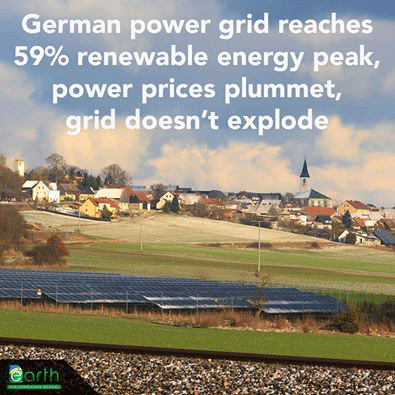 Germany’s Energy Revolution goes from strength to strength as the Grafenrheinfeld nuclear reactor closes http://www.greenpeace.org/international/en/news/Blogs/nuclear-reaction/grafenrheinfeld-nuclear-reactor-closure/blog/53355/
One less nuclear reactor threat to the people of Europe with the early closure of the Grafenrheinfeld nuclear reactor. Germany’s 33 year-old Grafenrheinfeld nuclear reactor will be shut down permanently on June 27th as the country’s phase out of nuclear power continues. It’s the first reactor to close since Germany passed its Atomic Energy Act in July 2011 which requires the closure of all commercial nuclear reactors by the end of 2022.
The reactor is being shutdown seven months early as the disastrous economics of nuclear power and Germany’s drive for clean and sustainable energy have made it impossible for its owner E.ON to operate the reactor and make a profit.
E.ON and other large nuclear utilities only have themselves to blame. They failed to anticipate the growth of renewable energy and so they failed to invest in it. At the same time, electricity prices have fallen making their nuclear power plants even less profitable.
That said, even E.ON is waking up to the new energy future of Germany. “The transformation of Europe’s energy system continues to offer us attractive growth opportunities in renewables and distributed energy,” said the company in a report from March this year.
But what are the implications of the closure of Grafenrheinfeld? Won’t it leave an energy gap?
In short: no. Continue reading
World is watching Australia’s pathetic performance on Climate Change
 Paris 2015: Australia in the climate change spotlight, SMH, June 26, 2015 Tom Arup and Adam Morton
Back home, the Abbott government was furiously arguing that there was nothing unusual about this – that the probe was a standard part of the laborious theatre of international climate negotiations.
“I think he’s right. We got some 36 questions on notice, so there is substantial interest in Australia’s climate change policies,” Peter Woolcott, Australia’s environment ambassador, later told the meeting.
“Particularly since the change of government, and the change in our approach to the Direct Action scheme to address climate change challenges in Australia.”
While some in Australia make the case that the country is largely irrelevant as a tiny contributor to global emissions – about 1 per cent of the total – the meeting in Bonn, Germany earlier this month suggested the international community thinks otherwise.
To many observers it was clear that other countries are closely watching Australia’s climate change debate as work continues on a global treaty due to be signed in Paris late this year. Continue reading
Life in the shadow of Australia’s windfarm ‘hell’
“Any ill health effects?” he asked, cracking open a second can of bitter before answering his own question. “Yes, it gives me more money so I can buy more beer.”
 Minimal sound and almost no fury: life in the shadow of Australia’s windfarm ‘hell’, Guardian 27 June 15 As the political cacophony about ‘noisy, visually awful’ wind turbines reaches fever pitch, Calla Wahlquist visits the farmers who host one of the southern hemisphere’s largest windfarms and finds them stubbornly unperturbed “………..On Monday night the Davies family opened their home to Guardian Australia to spend the night next to a windfarm. Bernice was right; you couldn’t hear the turbines inside the house.
But as any proponent of “wind turbine syndrome” will tell you, it’s infrasound – low-frequency sound beyond human hearing – that allegedly causes problems.
However, despite comments from the prime minister, Tony Abbott, that windfarms are noisy, “visually awful” and have a “potential health impact”, and from shock jock Alan Jones that living next to them was “hell”, the Davies family don’t have any complaints.
Their only gripe is that cuts to the renewable energy target mean the second stage of the development has been shelved, and they’re unlikely to get the final four turbines they had been promised……… Continue reading
As the world moves to renewable energy, Tony Abbott has tried to wreck development in Australia
 Abbott lets Australia slip behind as renewable energy advances, Canberra Times June 20, 2015 Allen Hicks
While the vocal attack on wind farms and the renewable energy target generally were rounded on as being out of touch, few people seem to realise exactly how dangerous that thinking is, not only for the environment, but for our nation’s future economic prosperity.
Far from being at the crossroads on renewable energy, most of the world has moved on, embracing a range of technologies that provide sustainable, renewable, affordable power.
Wind power, which Abbott decried as awful and noisy, is not only a mature and proven technology, it is a major growth sector, with global installed capacity leaping 44 per cent in 2014 alone…….. Continue reading
Aboriginal People Need A Treaty First- Forget constitutional recognition

A fair go cannot be achieved without a Treaty.
A Treaty would be the basis upon which the sovereign Indigenous people of Australia and the Government could negotiate the terms of rights to land, minerals and resources and the self-governing of communities. It would be a binding agreement that would have sanctions that would deter breaches of the terms of the treaty.
Forget constitutional recognition. It’s not the best option. Let’s do Treaty and let’s do it  right. http://misseaglesnetwork.blogspot.com.au/2015/06/forget-constitutional-recognition-its.html Let’s out Australia’s racist past, its attempts at ethnic cleansing, its whitewashing of who did what. The post below comes from Yinarr Yarning: Life, Love, Laughing, Politics and People – the blog of Natalie Cromb. It is re-posted here with Natalie’s kind permission.
Constitutional Recognition? Treaty First!
Between the Recognise campaign and Noel Pearson’s latest support for a conservative campaign for Declaration of Recognition, one thing is certain, constitutional recognition is on the agenda. Despite noted Indigenous support, these campaigns are looked upon with suspicion mainly because of the fact that the question remains over whether it would affect the sovereignty of Indigenous people, especially with respect to land rights.
In order to effect the changes suggested by the constitutional recognition campaigns, we would need to have a referendum. This would not be our first referendum. Continue reading
Debunking the myths on the cost of wind energy
How much does wind energy cost? Debunking the myths, The Conversation, Dylan McConnell, June 23, 2015 Are renewables pushing up the cost of electricity? That’s the claim made by Alan Moran in an opinion piece for the Australian Financial Review this week.
Moran, executive director of Regulation Economics and a former director at the Institute of Public Affairs, argues that increasing investment in renewables and particularly wind energy will cost consumers billions of dollars. The high operating costs and requirements for backup when the wind isn’t blowing are the problem, he argues.
But the evidence actually suggests the opposite: wind energy is already competitive with fossil fuels, will reduce electricity prices for consumers, and will play a large role in reducing Australia’s greenhouse gas emissions.
So, let’s go through Moran’s claims one by one…………https://theconversation.com/how-much-does-wind-energy-cost-debunking-the-myths-43710
Big economic benefits to regional communities, from new wind and solar farms
 Regional areas to reap economic benefits of new wind and solar farms after new RET passes Federal Parliament ABC Rural By Catherine McAloon 26 June 15 Up to 50 new wind and solar farms are expected to be built in regional Australia, after a bill on a new Renewable Energy Target passed Federal Parliament this week.
An international consortium has announced plans to build a $450 million wind farm near Ararat, in western Victoria, and the Clean Energy Council expects it will be the first of many new projects.
“The Ararat wind farm really represents the first green shoots for an industry that’s been doing in extremely tough for the last 18 months,” the council’s Mark Bretherton said.
“We’re very confident that, with the bipartisan support that’s been restored to the Renewable Energy Target, we’ll see a lot more activity in this sector over the next few years.”
Mr Bretherton said between 30 to 50 major wind and solar projects, worth an estimated $10 billion, were expected to be built over the next five years, with most of those in rural areas.
“Most of the opportunity that we are going to see over the next five years will probably be in the wind and solar farm sector, so what that means is basically where there is the strongest wind and an opportunity to connect to the grid you’ll see wind farms, where there is the best sun, you’ll probably see some solar farms, particularly where there is enough land to build those kind of projects.” He predicted regional areas would see the greatest economic benefits of new renewable energy projects.
“That’s really good news, particularly for people who live in those areas. What it means is extra income being paid to farmers, direct jobs and it means money being paid for community projects as well.
“But apart from local jobs, it also means money is being spent at local restaurants, corner stores, equipment suppliers, motels, pie-sellers and much, much more.”………………http://www.abc.net.au/news/2015-06-26/regional-australia-to-benefit-from-new-renewable-energy-projects/6575566
General Electric prepared to spend $billions on renewable energy in Australia
GE ready to spend billions on renewable energy THE AUSTRALIAN, Damon Kitney, 26 June 15
The local chief executive of global conglomerate GE says its head office has given the green light for the company to pursue potentially billions of dollars of new investments in renewable energy in Australia after bankrolling the nation’s third-biggest wind farm in southwest Victoria.
GE, in partnership with local firms Renewable Energy Systems and Downer, has secured a major contract for the supply of 75 wind turbines to the 240MW Ararat Wind Farm, a $450 million project financed by shareholders RES, GE, Switzerland-based investment manager Partners Group and Canadian pension group OPTrust.
The project was secured by the passage through parliament on Tuesday of a new renewable energy target of 33,000 gigawatt hours of electricity from large-scale renewable energy projects by 2020.
“We are putting $125m of equity into the deal and we would not have done that without the policy certainty we now have,” said Geoff Culbert, president and CEO, GE Australia, New Zealand and PNG.
He said GE wanted to be involved in projects that produced as much of the 33,000 gigawatt hours as possible, noting they would be worth “billions” of dollars.
“We see GE playing an active role in that build-out. We are very heavily focused on trying to build a pipeline of wind deals in Australia and that is recognised right back to head office,” he said.
“We have a pipeline of deals that we have been looking at but we haven’t been able to progress. Now we have certainty we have a pipeline we are going to aggressively pursue. Australia is a really attractive place to invest for GE and we have the support from headquarters to invest more here.”
Two years ago, GE was part of a consortium that received a contract to supply wind turbines for the 55MW Mumbida wind farm in Western Australia, the first use of GE wind turbines in Australia. But political uncertainty about the RET target put further investment by the group under a cloud.
OPTrust managing director Stan Kolenc said the breaking of the political deadlock over the renewable energy target this week would open the floodgates to international investors in the Australian renewables industry………
Mr Culbert declined to comment on Mr Abbott’s views, instead noting that he was optimistic about the future. There are now more than 60 wind projects across the nation.
“There is trillions of dollars sitting on the sidelines globally looking for a place to invest. When you create a market with policy certainty, you unlock that investment,” Mr Culbert said.
The Ararat project is also being supported by a power purchase agreement with the ACT government which guarantees the purchase of about 40 per cent of the energy produced at the site http://www.theaustralian.com.au/business/ge-ready-to-spend-billions-on-renewable-energy/story-e6frg8zx-1227415347623
1 This month
7 April – WEBINAR – Australia and the Doomsday Clock – Preventing nuclear war through NoFirstUse and other policies
Online | Tuesday April 7, 4:00-5:30pm, Australian Eastern Time / 8:00-9:30am Central Europe Time
– Access the registration link
15 April – Zoom –Nuclear Power is Not the Solution
Apr 15, 2026 01:00 AM in Canberra, Melbourne, Sydney

Join the International Physicians for the Prevention of Nuclear War (IPPNW) on Tuesday, April 14th for a timely webinar exploring the risks associated with nuclear power and challenging the myth that it offers a simple, safe, carbon-free solution to the climate crisis

21 April Webinar: No Nuclear Weapons in Australia
Start: 2026-04-21 18:00:00 UTC Canberra, Melbourne, Sydney (GMT+10:00)
End: 2026-04-21 19:30:00 UTC Canberra, Melbourne, Sydney (GMT+10:00)
Event Type: Virtual
A virtual link will be communicated before the event.
Host Contact Info: australia@icanw.org

of the week – Australians for War Powers Reform (AWPR)
To see nuclear-related stories in greater depth and intensity
 Antinuclear