Fukushima’s birds greatly affected by radiation
Mousseau said the reason comes down to the long-term impact of the radiation. “It takes multiple generations for the effects of mutations to be expressed in natural populations,” he said
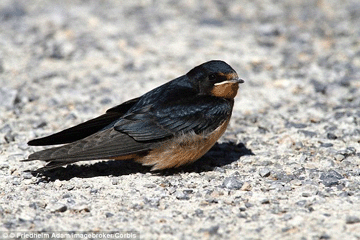 Near site of Fukushima disaster, birds still in peril, By MICHAEL CASEY CBS NEWS April 16, 2015, Four years after the Fukushima disaster, birds are becoming a rarity around the damaged nuclear site.
A study in the Journal of Ornithology found that half the populations of 57 bird species had suffered declines. Studying birds over three years at 400 sites, University of South Carolina biologist Tim Mousseau and his colleagues found that the numbers continue to decline over time – even as the radiation threat drops.
“There are dramatic reductions in the number of birds that should be there based on the overall patterns,” Mousseau told CBS News. “In terms of barn swallows in Fukushima, there had been hundreds if not thousands in many of these towns where we were working. Now we are seeing a few dozen of them left. It’s just an enormous decline.”
In addition to barn swallows, the great reed warbler, Japanese bush warbler and the meadow bunting have been the hardest hit………
Mousseau also has been among researchers leading a project that compares the environmental impact of Fukushima to that of Chernobyl, the scene in 1986 of the worst accident at a nuclear plant. As the director of the Chernobyl + Fukushima Research Initiative, he looked at the impact of birds in both places.
In a second paper in the Journal of Ornithology this month, Mousseau and his longtime collaborator Anders Moller of the French National Centre for Scientific Research found that migratory birds appear to fare worse around Chernobyl than year-round residents. The opposite is true in Fukushima…….
Around Fukushima, Mousseau predicts the worst may not be over.
“The relationship between radiation and numbers started off negative the first summer, but the strength of the relationship has actually increased each year,” Mousseau says. “So now we see this really striking drop-off in numbers of birds as well as numbers of species of birds. So both the biodiversity and the abundance are showing dramatic impacts in these areas with higher radiation levels, even as the levels are declining.”
Mousseau said the reason comes down to the long-term impact of the radiation.
“It takes multiple generations for the effects of mutations to be expressed in natural populations,” he said, referring to effects such as shorter life spans and reduced fertility. “At some point, there will be a balance of the negative effects of mutations and immigration of fresh, new birds. We just don’t know enough to say when a balance will be reached.” http://www.cbsnews.com/news/fukushima-disaster-taking-a-toll-on-birds/
No comments yet.
1 This month
7 April – WEBINAR – Australia and the Doomsday Clock – Preventing nuclear war through NoFirstUse and other policies
Online | Tuesday April 7, 4:00-5:30pm, Australian Eastern Time / 8:00-9:30am Central Europe Time
– Access the registration link
15 April – Zoom –Nuclear Power is Not the Solution
Apr 15, 2026 01:00 AM in Canberra, Melbourne, Sydney

Join the International Physicians for the Prevention of Nuclear War (IPPNW) on Tuesday, April 14th for a timely webinar exploring the risks associated with nuclear power and challenging the myth that it offers a simple, safe, carbon-free solution to the climate crisis

21 April Webinar: No Nuclear Weapons in Australia
Start: 2026-04-21 18:00:00 UTC Canberra, Melbourne, Sydney (GMT+10:00)
End: 2026-04-21 19:30:00 UTC Canberra, Melbourne, Sydney (GMT+10:00)
Event Type: Virtual
A virtual link will be communicated before the event.
Host Contact Info: australia@icanw.org

of the week – Australians for War Powers Reform (AWPR)
To see nuclear-related stories in greater depth and intensity
 Antinuclear
Leave a comment