#NuclearCommissionSAust needs to learn about the DisEconomics of Small Modular Reactors (SMRs)
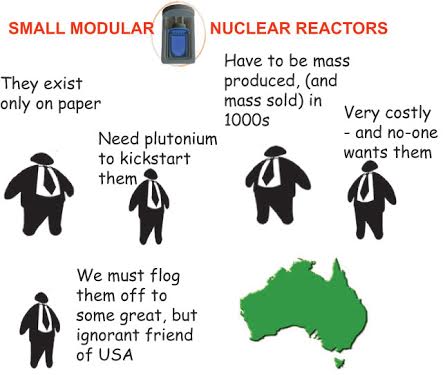 Conclusion: There are no benefits to the smaller, modular nuclear power plants that some nuclear power proponents advocate.
No Benefits From Smaller Modular Nuclear Plants Sowells Law Blog, July 2015 There is a contingent of nuclear power proponents that insists that costs per kW can be reduced by building smaller plants, more of them, and building them in controlled factory conditions. But, are those assertions true?
The short answer is, No. Supposedly, the benefits are shorter construction times, less inflation, less interest on loans, all of which lead to lower costs. But, loss of economy of scale overwhelms such benefits. Consider 1200 MWe vs 600, 400, 300, and note that Dept of Energy defines Small Modular Reactors as 300 MW or less. Each of the smaller size plants must be delivered much more quickly to achieve any savings in materials inflation and interest on construction loans. A shorter construction period very likely cannot be done due to fabrication and delivery of large items: the reactor, steam generators, turbines, and pumps. …….
we can compute the number of years that the modular plant must require for construction, at inflation of 5 percent per year. Calculations show that approximately 5.5 years at 5 percent per year yields the desired result. To save any on the final costs, then, the modular plants must be built in less than 5.5 years. Stated another way, savings are realized only if the plant can be brought online in 3 or 4 years from notice to proceed.
The question is, then, can it be done? Once again, the nuclear industry is scrambling, trying to find a way to justify itself. Small, modern design, modular-constructed nuclear power plants have never been built in the US, indeed, they are not even approved by the NRC. The first projects would suffer all the problems of first-of-a-kind projects, and likely have no cost reductions at all.
The same analysis can be performed for smaller plants, such as 300 MW, where four plants would be required to produce 1200 MW of power, and 200 MW, where six plants would be required. The results are as follows. The 300 MW plants must be constructed in 4 years to have zero savings, with any savings produced only if construction time is 2 or 3 years. The 200 MW plants must be constructed in 2.1 years to have zero savings over the cathedral design. It seems highly unlikely that small, modular plants can be built on such short timescales.
The analysis is dependent on the inflation or escalation rate for equipment, labor, and services over the life of the project. If the inflation rate is higher, as many forecasters predict must be the case, then the situation is worse. The amount of time required to build the plant and yield a cost savings will be less and less as the inflation rate increases.
Conclusion
There are no benefits to the smaller, modular nuclear power plants that some nuclear power proponents advocate. The loss of economy of scale requires much shorter construction times for any savings to be had. http://sowellslawblog.blogspot.com.au/2014/04/the-truth-about-nuclear-power-part-eight.html
No comments yet.
1 This month
7 April – WEBINAR – Australia and the Doomsday Clock – Preventing nuclear war through NoFirstUse and other policies
Online | Tuesday April 7, 4:00-5:30pm, Australian Eastern Time / 8:00-9:30am Central Europe Time
– Access the registration link
15 April – Zoom –Nuclear Power is Not the Solution
Apr 15, 2026 01:00 AM in Canberra, Melbourne, Sydney

Join the International Physicians for the Prevention of Nuclear War (IPPNW) on Tuesday, April 14th for a timely webinar exploring the risks associated with nuclear power and challenging the myth that it offers a simple, safe, carbon-free solution to the climate crisis

21 April Webinar: No Nuclear Weapons in Australia
Start: 2026-04-21 18:00:00 UTC Canberra, Melbourne, Sydney (GMT+10:00)
End: 2026-04-21 19:30:00 UTC Canberra, Melbourne, Sydney (GMT+10:00)
Event Type: Virtual
A virtual link will be communicated before the event.
Host Contact Info: australia@icanw.org

of the week – Australians for War Powers Reform (AWPR)
To see nuclear-related stories in greater depth and intensity
 Antinuclear
Leave a comment