We need to change the Native Title Act and get Real Land Rights for Aboriginal poeple
“we have no rights to say no to mining under native title.”
The court has never once found in favour of holders of native title.
the constitution is not silent. It is actively discriminatory, explicitly enabling authorities to enact race-specific laws. This must end.
Native title yes, but still no land rights, The Age July 8, 2015 Elizabeth Farrelly Sydney Morning Herald columnist, author, architecture critic and essayist
Sacred land must not be dug up and our constitution and laws should assure that. So it’s NAIDOC Week. “We all stand on sacred ground,” protests the starry-eyed tagline. “Learn, respect, celebrate.”
Going by the flood of earnest Indigenous heritage displays, trucked-in smoking ceremonies and family-friendly clips of smiling Koori kids you’d think we meant it. Eighty-five per cent of us, apparently, support removing anti-Aboriginal racism from the constitution. God knows it’s little enough, late enough – but is it also hypocritical?
The most memorable part of that June 22 Q&A program wasn’t Zaky Mallah. It was the nine-minute segment on native title and mining rights. Yet the Mallah story was beaten up nationwide like a thousand-egg free-range souffle, while the land-rights conversation once again sank without trace. Continue reading
#NuclearCommissionSAust – Even Kevin Scarce has big doubts about thorium reactors
 Kevin Scarce sometimes scarce on nuclear reality, Online opinion, Noel Wauchope, 7 July 15 On June 29 Kevin Scarce, chief of South Australia’s Nuclear Royal Commission, was interviewed by Ian Henschke on ABC Radio 891 Adelaide. Scarce had just returned from a Royal Commission whirlwind tour of Taiwan, Japan, Europe and the UK. The interview can be heard here.
I was pretty amazed, not only at the speed at which the Commission examined the nuclear industry, at so many places, from 26 May 12 June 2015, and at the complicated facilities that they examined, but also at how much information was left out of Scarce’s report, and at the apparent inadequacy of their grasp of current developments in the nuclear industry.
First and most obvious were two questions, both which Kevin Scarce had emphasised at his pre-tour community forums in South Australia. Scarce had stressed that the Commission would be consulting people on both sides of the nuclear debate – those for the nuclear industry, and those against it. In the whole interview, in all the places and organisations that Scarce described – not one word about meeting anyone remotely anti-nuclear.
Secondly, at the pre-tour meetings, Scarce had repeatedly said that the Commission would be studying renewable energy as well as nuclear. In his talk with Ian Henschke, it was clear that the Commission had not visited any renewable energy organisations or facilities. Indeed, when the interviewer brought up the subject of renewable energy, Scarce glossed over it very quickly – pointing out that Germany was “a way away’ from their renewables goal, and saying “We are certainly looking at renewables”.
Their first visit was to Taiwan, as Scarce said “to talk to the Taiwanese about their spent reactor fuel and about how they were going to manage it.” Well, it’s not surprising that Scarce did not go on to explain how the Taiwanese are going to manage their spent nuclear fuel, because the Taiwanese themselves do not know what to do with it. They are probablyretiring one reactor early, due to its accumulating wastes, and are also trying to work out a plan to export their nuclear wastes, but facing opposition in their legislature to this plan.
Then on to Japan…….
Reporting on France, Scarce was fairly reticent, considering that they spent so much time talking to AREVA, the State owned nuclear company. But that’s understandable. The South Australian Nuclear Royal Commission arrived at AREVA on 4th June. On 3rd June, the French government announced the break-up of AREVA, due to its disastrous financial record, to prevent it from bankruptcy……..
Questioned about new Generation IV nuclear reactors, Scarce emphasised their safety features, and, to be fair to him, he did point out the “enormous uncertainty” about when they would be commercially available – “not much before 2040″. He was asked about thorium reactors, and again, admitted to not knowing much about them, and that “2040 might be optimistic for thorium reactors“. Scarce said that with these reactors, thorium, not uranium, is the source of power. That’s not actually correct, as uranium 233 is the power source in thorium reactors. They need plutonium or enriched uranium to trigger the transformation of the inert thorium, to the fissile uranium.
To give credit to Kevin Scarce, he did mention the fact that this process is not so clean, meaning that plutonium or enriched uranium are a radioactive problem issue. He said “so some of your benefit in terms of a clean fuel source isn’t there”. Also, to be fair to Kevin Scarce, he did point out that thorium reactors have been tried in the past, in America, and closed down, and that he was doubtful about their future.
Henschke asked Scarce if he saw “state of the art” nuclear reactors. Yes, the Commission had been to both Olkiluoto and to Flamanville in France, and had seen the pressurised water reactors – the very ones that are now described as afinancial and safety fiasco. No wonder that Scarce did not elaborate on these visits……. http://www.onlineopinion.com.au/view.asp?article=17489

No safe level of ionising radiation
 Why There Is No Safe Level of Man Made Radiation, Radiation Prevention, [Good diagrams, photos and video] People on the west coast of North America inhaled an average of 5 hot particles every day during the month of April 2011 alone. Arnie Gundersen, Fairewinds, 8 July 15
Nuclear Myths Abound
Many public figures like to equate environmental effects of the Nuclear Industry to things such as bananas, X-rays, and even taking a flight to Mexico. Below we will do our best to explain to you, exactly why they are so very, very wrong.
This article is an excerpt of a larger feature coming out in May, and specifically focuses on man made radiation. It isn’t meant to minimise the health affects of natural forms of radiation, as there is no safe dose of radiation.
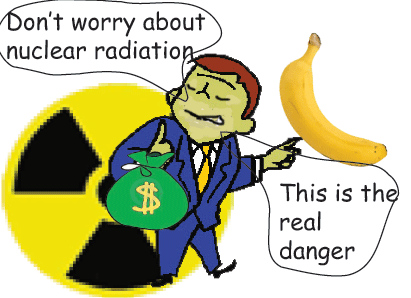 Let’s Talk Bananas
There exists in the world, naturally occurring forms of radiation. There are many of them, they come in many different shapes and forms. We have adapted to some of them, others, not so much.
Bananas contain a radioactive isotope called Potassium40 (k40). This isotope is also naturally found in milk, soil, and countless other things. Even oranges, as noted here.
If you have one gram of potassium from a banana, only 0.0117% of that potassium is considered radioactive.
Now to put things in perspective, if you have one gram of cesium (which mimics potassium in our bodies) 100% of that gram is radioactive.
And that’s not all.
I’m sure everyone has heard the term “half life” by now. Without getting too geeky on the subject, I will try to explain exactly what that means below………… http://radiationprevention.com/safe-level-manmade-radiation/#ixzz3fR1xuR8z
107 nations pledge to stigmatise, prohibit and eliminate nuclear weapons
 Looking back on the nuclear non-proliferation treaty (NPT) review conference, May 2015
ICAN Campaign Update, June 2015: 107 nations pledge to stigmatise, prohibit and eliminate nuclear weapons
By the end of the month-long Non-Proliferation Treaty (NPT) review conference in New York, 107 governments had endorsed an Austrian-sponsored pledge “to fill the legal gap for the prohibition and elimination of nuclear weapons”. Although this high-level conference, which concluded on 22 May, could not adopt a consensus outcome document, the preferred course of action for the majority of nations was clear: it is time to begin negotiations on a new treaty to prohibit nuclear weapons outright and establish a framework for their elimination. …
https://gallery.mailchimp.com/a6e5567f81275b06aabcfd87e/files/June2015Update_ICAN.pdf
Nuclear disarmament? Forget it.
- More than 100 countries snubbed by nuclear powers
- UK defence budget – nuclear v conventional
The latest nuclear non-proliferation treaty (NPT) review conference did not make waves. There was hardly a word in the mainstream media.
Perhaps it was not surprising. What is there newsworthy in hundreds of diplomats and scores of NGOs over a period of four weeks calling for nuclear disarmament, in effect praising motherhood and apple pie?
Yet the UN-sponsored conference in New York did not end in bland consensus. Far from it. It ended in disarray and angry exchanges. http://www.theguardian.com/news/defence-and-security-blog/2015/jun/02/nuclear-disarmament-forget-it
Akwa Ibom State Leaders Caucus rejects nuclear power project in Nigeria
 Nigeria: Caucus Rejects Siting of Nuclear Plant in Akwa Ibom All Africa, By Idongesit Ashameri, 7 July 15 Uyo — The Akwa Ibom State Leaders Caucus has rejected plans by the Nigerian Atomic Energy Commission (NAEC) to site a Nuclear Power plant in Itu local Government Area of the state. The group attributed their rejection of the Nuclear Power plant to disastrous consequences that failure of nuclear plants had brought in other parts of the world.
The leaders’ caucus questioned why Nigeria, which they said had a perennial incompetence in matters of safety and security, could venture into such a risky project, while countries with known competences, like Germany, Italy, USA, Russia and Japan are shutting down such plants.
USA Catholics and Green Muslims push for renewable energy jobs

 From Pope Francis to Green Muslims, faith groups steadfast in push for clean energy, Midwest Energy News, BY Kari Lydersen, 9 July 15 Rev. Booker Steven Vance took to the pulpit in historic Old St. Patrick’s Church in downtown Chicago on June 22 to praise Pope Francis’ ground-breaking encyclicalon climate change and sustainability.
Vance attached a very concrete and local element to the Pope’s sweeping call to action. He and other religious and environmental leaders hosting a press conference declared that passing a proposed Clean Jobs bill in the Illinois legislature is one way the Pope’s call to action should be answered.
“The encyclical provides an opportunity for a game-changer, bringing this conversation to a whole new level,” said Vance. “I’m talking about the bill downstate in Springfield that deals with clean air, clean energy and clean jobs. The pope is absolutely correct, we are responsible and the onus falls on us.”
That same evening 90 miles north in Milwaukee, the Islamic Environmental Group of Wisconsin, also known as the Wisconsin Green Muslims, gathered to break the Ramadan fast together while also talking about a spiritual obligation to care for the earth, in part by reducing carbon emissions and embracing a more sustainable lifestyle…………
The Clean Jobs bill would create about 32,000 jobs in Illinois, according to proponents, by increasing the state’s commitment to renewable energy and energy efficiency. A study by the Union of Concerned Scientists found it would spur $23 billion in clean energy investment and lower consumer bills by a total of $12 billion over 15 years.
The bill has widespread support — including from interfaith groups and religious leaders — but it also faces competing bills backed by powerful energy interests and a state budget crisis that is consuming the legislature’s attention.
Meanwhile the Wisconsin Green Muslims also are up against powerful forces in trying to promote clean energy……….http://midwestenergynews.com/2015/07/09/from-pope-francis-to-green-muslims-faith-groups-steadfast-in-push-for-clean-energy/
1 This month
7 April – WEBINAR – Australia and the Doomsday Clock – Preventing nuclear war through NoFirstUse and other policies
Online | Tuesday April 7, 4:00-5:30pm, Australian Eastern Time / 8:00-9:30am Central Europe Time
– Access the registration link
15 April – Zoom –Nuclear Power is Not the Solution
Apr 15, 2026 01:00 AM in Canberra, Melbourne, Sydney

Join the International Physicians for the Prevention of Nuclear War (IPPNW) on Tuesday, April 14th for a timely webinar exploring the risks associated with nuclear power and challenging the myth that it offers a simple, safe, carbon-free solution to the climate crisis

21 April Webinar: No Nuclear Weapons in Australia
Start: 2026-04-21 18:00:00 UTC Canberra, Melbourne, Sydney (GMT+10:00)
End: 2026-04-21 19:30:00 UTC Canberra, Melbourne, Sydney (GMT+10:00)
Event Type: Virtual
A virtual link will be communicated before the event.
Host Contact Info: australia@icanw.org

of the week – Australians for War Powers Reform (AWPR)
To see nuclear-related stories in greater depth and intensity
 Antinuclear