Submission Points to Issues Paper 4 – Nuclear Royal Commission
Submissions Issues Paper 4 (Storage and Disposal of Waste) are due by 24 July, 2015
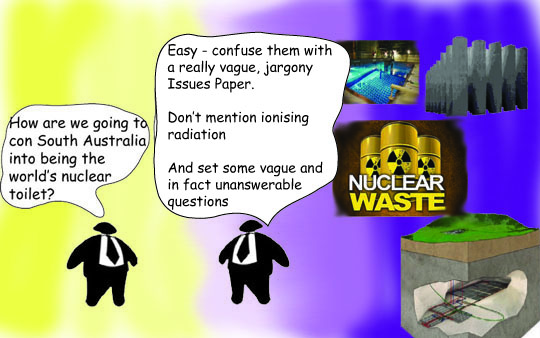
4.1 Are the physical conditions in South Australia, including its geology, suitable for the establishment and operation of facilities to store or dispose of intermediate or high level waste either temporarily or permanently?
Earthquake hazard: For either temporary or permanent storage of radioactive wastes, South Australia poses great risks. While the whole State has a small earthquake hazard zone, there are large sections which have an increased earthquake hazard. Particularly in the South of the State (1)
Risk to precious artesian water. While the South of the State has earthquake risks, almost the entire of the rest of the State covers the Great Artesian Basin. (2)
Effectively, this means there is almost no part of South Australia that could safely store radioactive trash for decades, let alone for thousands of years.
- 3 What would the (overseas) holders of radioactive wastes be willing to pay for disposal and storage of radioactive wastes in South Australia?
This question really has no answer. At present every country with nuclear facilities is struggling with the unanswered question of what do do with their radioactive trash. Even Finland, which has built a 500 metre deep burial place, will not have enough space for their accumulating radioactive trash. So far, there is no room for Fennovoima’s waste in the Onkalo repository in Olkiluoto. (3)
At this stage there are no proposals for exporting nuclear waste. Royal Commissioner Kevin Scarce, in his recent report on the Commission’s overseas visit, said “We haven’t done the financial study”. When anyone does do the financial study, they will need to factor in the financial costs of insurance, of security for hundreds, thousands, of years, as well as of environmental degradation.
Another factor would be the comparison of the commercial value of renewable energy not pursued, tourist and agricultural opportunities lost as government money went into fostering nuclear schemes rather than South Australia’s more positive activities.
4.4 What sorts of mechanisms would need to be established to fund the costs associated with the future storage or disposal of either Australian or international nuclear or radioactive wastes?
A mechanism has been put forward by Oscar Archer. (4) In Archer’s words “it goes like this. Australia establishes the world’s first multinational repository for used fuel – what’s often called nuclear waste” he wants the funding to be provided by “our international partners”, on condition that “This is established on the ironclad commitment [my emphasis] to develop a fleet of integral fast reactors to demonstrate the recycling of the used nuclear fuel” This would be a highly unsatisfactory arrangement. As the nuclear industry now struggles to fund these as yet not developed Generation IV reactors – South Australia would find itself locked in – in a sort of blackmail position, to buying a technology that very likely has no future.
4.5 What are the specific models and case studies that demonstrate the best practice for the establishment, operation and regulation of facilities for the storage or disposal of nuclear or radioactive waste?
The massively expensive 500 metre deep bunker being developed in Finland is so far the only facility that has appears to have relative safety, but that can accomodate only some of Finland’s radioactive trash . Meanwhile in USA, the Waste Isolation Pilot Plant has been as disaster. (5)
4.6 What are the security implications created by the storage or disposal of intermediate or high level waste at a purpose-built facility?
In the short term (i.e a period of decades) the above ground concrete containers are vulnerable to terrorist attack. In the long term , i.e. thousands of years, deep waste reposiitories run risk of climate and seismic events, as well as possible terrorism. They need to to be guarded virtually forever, or else, as they are forgotten, pose risks to future generations.
4.9 Bearing in mind the measures that would need to be taken in design and siting, what environmental risks would the establishment of such facilities present?
Climate change continues to increase risks of extreme weather events, and it is possible that seismic activity, already a risk, would increase.
4.10 What are the risks associated with transportation of nuclear or radioactive wastes for storage or disposal in South Australia?
Extreme weather, transport accidents that would spread ionising radiation , terrorist attack.
4.12 Would the establishment and operation of such facilities give rise to impacts on other sectors of the economy?
In the past, countries like France accepted the risks of nuclear power, and their other industries thrived. Now, even in France, there is concern about polluting industries. For some time after the Chernobyl nuclear catastrophe, the French wine industry was severely depressed., because the wine growing regions were squarely in the path of the ionising radiation fallout. (6) There is concern in Washington State about the impact of Hanford nuclear waste facility on the wine industry. (7)
(1) https://www.sa.gov.au/__data/assets/pdf_file/0005/17168/Earthquake_hazard_zones_SA.pdf
(2) http://www.environment.gov.au/water/environment/great-artesian-basin
(3) http://yle.fi/uutiset/battle_for_nuclear_waste_disposal_site/5097360
(4) http://www.abc.net.au/radio/programitem/pgJrGaLDL7.
(5) 1 6 June 2014, ‘Fire and leaks at the world’s only deep geological waste repository’, Nuclear Monitor #787,www.wiseinternational.org/node/4245 222 27 Nov 2014, ‘New Mexico nuclear waste accident a ‘horrific comedy of errors’ that exposes deeper problems’, The Ecologist,
(6) http://wineeconomist.com/2008/01/26/the-science-of-unintended-consequences/
(7) http://www.thedailybeast.com/articles/2015/03/28/hanford-nuclear-site-could-be-threatening-washington-state-s-best-vineyards.html
radophilia = the irrational love of radioactive poisons that harm children.
 Brett Stokes, 10 July 15 Kevin Scarce is challenged over the “fuel cycle” deceptive language and Scarce responds with a straight face, academy award stuff – I could not help coughing, something caught in my throat.
Scarce was challenged by an audience member at Flinders Uni in May 2015, regarding the diagram showing reprocessing as though that part of “the nuclear fuel cycle” was fully happening
Scarce’s response was a bold denial of the obvious, saying “we’re not trying to make it sound better than it is. We’re not trying to gild the lily” at 1:15:40 to 1:15:46 in https://www.youtube.com/watch?v=R2rexEyELig&feature=youtu.be
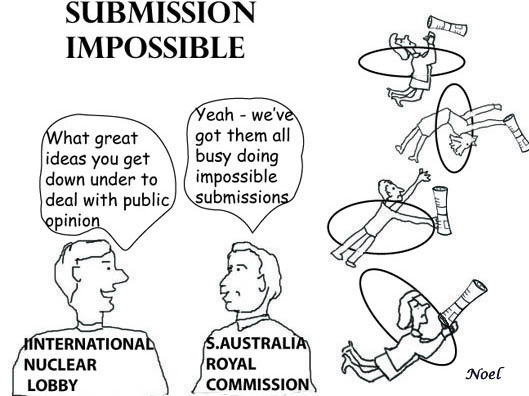
South Australia’s Just About Impossible Submission Process For Nuclear Royal Commission
 Submission Impossible: SA Royal Commission into nuclear fuel cycle, Independent Australia, 10 July 2015, The SA Royal Commission into the nuclear fuel cycle is calling for submissions but the mechanics involved have made it Submission Impossible, writes Noel Wauchope.
THE SOUTH AUSTRALIAN Labor government has ordered a Royal Commission, to inquire into the Nuclear Fuel Cycle: ‘Investigating opportunities and risks for South Australia’. This fast moving Royal Commission will receive submissions on this topic
All sounds good, doesn’t it? And who is supposed to send these submissions in? Well, any person or organisation in South Australia. As the Royal Commission (RC) has received little or no publicity outside South Australia, then it is likely that submissions will not be appreciated nor forthcoming from the other States.
However, the RC has invited nuclear technology companies from overseas, to put in submissions.
The RC has published four Issues Papers, with points for discussion. I could digress here, into the wording of these points, which are very much geared to receive input from nuclear companies. But my interest here is not so much in the content of submissions, but rather in the mechanics of actually writing, and sending in a submission. Submissions are due by 24 the July (for two Issues Paper topics) and by 3rd August (for the other two)
This is what is required:
- First, go to the RC’s website, Click on ISSUES PAPERS, and read the papers for each Issue………
Well, I’m thinking that the mechanics of this exercise pretty well trumps the content.
Imagine the scene … scenario 1:
You’re an executive of the French nuclear company AREVA, or of the Canadian nuclear company,SNC-Lavalin. (AREVA is in desperate financial straits and SNC-Lavalin in strife for corrupt practices). See report in the Financial Times 4 June 2015 ‘AREVA loses its reactor heart to EDF under French state plan’. Both companies are absolutely dependent on selling their nuclear technology overseas.
You have access to highly paid top lawyers, nuclear lobbyists and strategists, and access to top electronic equipment and computer skills. Indeed, this sort of thing is their job, and the company is well pleased to give them time to do this submission very thoroughly.
Submissions from a nuclear company do not need to be published. The Royal Commission deems that they can be kept private.
Imagine the scene … scenario 2:
You’re an ordinary citizen of South Australia, perhaps living in a rural area. Do you have access to the Internet, for a start? Well, you could make the effort, using a town library’s facilities. Then there’s the printing off of the ISSUES PAPERS, with those required question points. Then there’s the typing and printing of your Submission …. the JP …. the scanning … the PDF …. and so on. Your Submission will be published on the Internet, with your name.
What if you’re an Aboriginal, and your command of English is not great? No problem. The RC will send an officer to guide you. Mmmm … is there a problem in this?
I haven’t even touched on the content. I wonder … do I really need to?
Most of the questions appear to me to be squarely aimed at the nuclear companies…….. Some people have criticised the plentiful graphs and diagrams in the Issues Papers as sometimes inappropriate. I don’t know. It hardly matters. Many ordinary people, who are worried about the prospect of the entire nuclear fuel chain being established in South Australia will be sufficiently intimidated by the whole process anyway — never mind the graphs, or even the written content.
Perhaps that was the Royal Commission’s intention? https://independentaustralia.net/environment/environment-display/submission-impossible-sa-royal-commission-into-nuclear-fuel-cycle,7917
Australian uranium miners’ toxic track record in Africa
[Paladin’s] Langer Heinrich Uranium mine[Namibia] …
Craton Mining and Exploration [copper] is a subsidiary of Australian-based International Base Metals…..
Rio Tinto owns Rössing Uranium Mine…
[Australian] Deep Yellow Limited (DYL) the Aussinanis uranium project.
Aussies in toxic trail By Shinovene Immanuel, Ndanki Kahiurika 10 July 15 http://www.namibian.com.na/indexx.php?id=28936&page_type=story_detail&category_id=1#sthash.TJSxEgQV.P3bN2nwk.uxfs&st_refDomain=blogs.icerocket.com&st_refQuery=/search?tab=buzz&fr=h&q=uranium+Australia NAMIBIA, a mining frontier for decades, continues to struggle with mining companies which subject workers to dangerous working conditions.
That mining in Africa provokes controversy, even violence, is not new. Chinese companies receive regular criticism. Canada, too, has been forced to confront allegations of violence and even slavery linked to its mining companies.
The ICIJ investigation looked at Australia’s increasing role in exploring and developing mining projects on the African continent because it has been less examined.
TROUBLING
What ICIJ uncovered and pieced together suggests a troubling track record on the part of Australian companies in the rush for Africa’s minerals, including practices that would be impermissible, even unthinkable, in Australia and other parts of the developed world. Continue reading
World’s poorest country, Malawi, ripped off by Paladin in tax avoidance?
 Australian miner accused of dodging tax in world’s poorest country, The Age, July 11, 2015 –Heath Aston Political reporter
Tax avoidance tactics of multinational companies have angered Australians, but an Australian mining firm used such methods in Malawi. Tax avoidance tactics of multinational companies have angered the public and placed pressure on the Abbott government to prevent profits being exported offshore.
But an Australian uranium miner is defending the use of identical methods to reduce its tax bill in the world’s poorest country, Malawi.
Between 2009 and 2014, Paladin Energy moved $US183 million out of Malawi to a holding company in the Netherlands and then on to Australia.
A 15-page report by London-based ActionAid has found the Dutch transfers and a special royalties deal – in which Malawi’s mining minister agreed to drop the initial tax rate applied to the uranium mine from 5 per cent to 1.5 per cent – have cost the Malawi public $US43 million.
In Africa’s poorest nation, where per capita GDP is just $US226 a year and life expectancy 55, that money could provide the equivalent of 39,000 new teachers or 17,000 nurses, according to the aid group……..
Paladin’s tax-free transfers to the Netherlands were a combination of management fees and interest payments on loans initiated in Australia. The company loaded its African subsidiary up with huge debts, leaving the Kayelekera uranium mine in northern Malawi with an 80:20 debt to equity ratio – a financing structure known as “thin capitalisation”.
The Dutch structure allowed Paladin to avoid paying a 15 per cent withholding tax to the Malawi government due to a tax treaty between Malawi and the Netherlands which expired in 2014, saving the company $US7.3 million. Paladin closed the mine in February 2014, citing a “sustained low uranium price”.
ActionAid has accused the company of “treaty shopping” and shortchanging the Malawi people. The country’s nursing ranks have the equivalent of four nurses to every 100 in Australia, despite 10 per cent of Malawi’s population being infected with HIV/AIDS……..http://www.theage.com.au/federal-politics/political-news/australian-miner-accused-of-dodging-tax-in-worlds-poorest-country-20150710-gi6uzv.html
As workers’ exposure to low level radiation increases, risk of dying from leukemia increases
As cumulative dose of radiation exposure increased, so did the risk of dying from certain kinds of leukemia, the researchers found.
In the new study, the researchers calculate that for each gray (1,000 mGy) of total radiation exposure, a worker’s risk of leukemia rose three-fold.
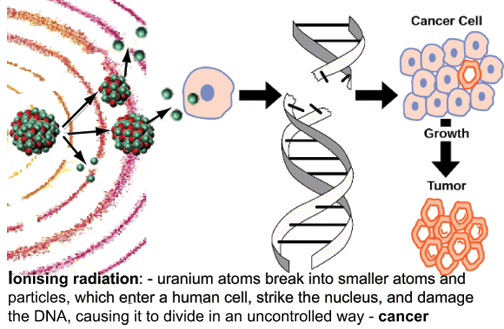
Long-Term Low-Dose Radiation Exposure May Increase Leukemia Risk, Scientific American, Leukemia was already known to be caused by exposure to high doses of radiation, like that released by the atomic bombs dropped on Japan in 1945 By Kathryn Doyle July 10, 2015 (Reuters Health) – In a long-term study of more than 300,000 workers in France, the U.S. and the U.K., those with many years of exposure to low doses of radiation had an increased risk of dying from leukemia.
Medical workers and even patients are also exposed to much more radiation than was common decades ago, the study authors point out, but it’s unclear what amount of low-level exposure raises cancer risk, they say.
“A lot of epidemiological or radiobiological studies have brought evidence that exposure to ionizing radiation can cause cancer and leukemia,” said lead author Dr. Klervi Leraud of the Radiobiology and Epidemiology Department at Fontenay-aux-Roses in Cedex, France.
Workers exposed to ionizing radiation who are later diagnosed with leukemia can already ask for financial compensation in the U.S., the U.K. or France, Leraud told Reuters Health by email.
Leukemia is known to be caused by exposure to high doses of radiation, like that released by the atomic bombs dropped on Japan in 1945. In the years following those bombings, leukemia cases increased among the survivors, the authors note in The Lancet Haematology, online June 21. But such high doses are rare today.
For the new study, researchers considered 308,297 nuclear energy workers whose radiation exposures were monitored. All had worked for at least a year for the French Atomic Energy Commission or similar employers or for the Departments of Energy and Defense in the U.S., or were members of the National Registry for Radiation Workers in the U.K.
The workers were followed for an average of 27 years, with data on exposure and health status through the early- to mid-2000s, depending on their country. Researchers looked for deaths from leukemia or lymphoma. Continue reading
Switzerland’s program – away from nuclear power, on to renewables and energy efficiency
 Switzerland’s transition away from nuclear power, Science Daily, July 7, 2015 Source: SAGE Publications
- Summary:
- Switzerland has a long history of trying to be as self-sufficient and energy independent as possible. Although its energy supply system has served it well in the past, the country is now looking to turn away from its reliance on nuclear power and seeks to compensate for the energy lost from hydropower as a result of climate change……
In the latest issue of theBulletin of the Atomic Scientists, published by SAGE, Dominic Notter of Empa discusses how the country aims to address this transition, finding a new supply mix that combines energy conservation, greater efficiencies, alternative energy sources, the “smart grid,” and the introduction of new technologies, so that Switzerland can secure its energy independence for the future……..
 “The goal is to gradually phase out of nuclear power and into renewables by 2034, and to be largely independent of fossil fuels. Reaching it is based upon the idea of combining highly efficient energy production processes with substantial reductions in energy consumption.”
Notter concludes: “Over the next four decades Switzerland faces a restructuring of its entire energy supply system. The new supply mix will be free from nuclear power, rather low in carbon intensity, and resting upon much higher efficiencies based on the newest and the most energy- efficient technologies- along with the developments of smart grids, decentralized power suppliers, hydropower, wind power, photovoltaics, biomass, wood, and the rigorous use of burning waste to generate energy whenever materials cannot be recycled […] A single “magic bullet” suitable for every purpose is not available. Switzerland most likely has to find its own energy supply mix, with the biggest sustainability potential.” Story Source:
The above post is reprinted from materials provided by SAGE Publications. http://www.sciencedaily.com/releases/2015/07/150707102025.htm
Litigation in Malawi against Australian uranium miner Paladin
“There is a very strong perception that when Australian mining companies come here they take every advantage of regulatory and compliance monitoring weaknesses, and of the huge disparity in power between themselves and affected communities, and aim to get away with things they wouldn’t even think of trying in Australia,”
Australian miners linked to hundreds of deaths, injuries in Africa, SMH, July 11, 2015 -Will Fitzgibbon Australian mining companies are linked to hundreds of deaths and injuries in Africa, which can go unreported at home. Some of the Australian Securities Exchange-listed companies include state governments as shareholders. One company recorded 38 worker deaths over an eleven-year period.
 In Malawi, litigation continues against Paladin Africa Limited, a subsidiary of Perth-based Paladin Energy, and its subcontractor after an explosion disfigured one worker with such heat that his skin shattered when touched by rescuers. Two others died in the same incident.
Other allegations include employees in South Africa hacking a woman with a machete and Malian police killing two protesters after a mine worker reportedly asked authorities to dislodge a barricade on the road to the mine.
An investigation by the International Consortium of Investigative Journalists, in collaboration with 13 African reporters, uncovered locally-filed lawsuits, violent protests and community petitions criticising some Australian companies. Continue reading
Victoria’s new wind farms going ahead
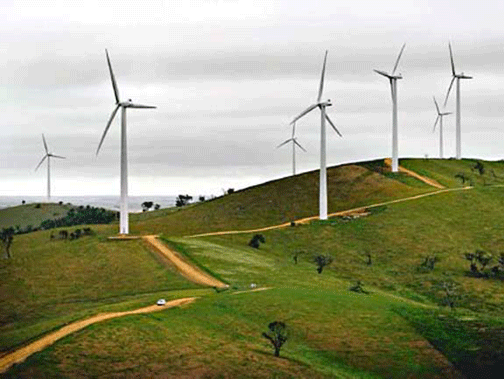 New wind farms for Victoria by Mark Eggleton, AFR, Jul 8 2015 This content is produced by The Australian Financial Review in commercial partnership with GE With the first new wind farm development beginning construction in Victoria since the election of the Coalition government recently, Australia could be on the brink of a new burst of activity in the renewable energy sector.
It follows the recent announcement of the $450 million Ararat project to build Australia’s third-largest wind farm in south-western Victoria with financing provided by developer Renewable Energy Systems (RES), turbine-maker General Electric and two other backers.
Yet while the new facility at Coonooer Bridge owes nothing to the recent agreement on the renewable energy target, the Ararat announcement came within days of the RET deal being passed in Parliament. Both projects come at a time when Australian business is starting to feel mildly confident about Australia’s energy future with the RET deal delivering much-needed certainty to the sector. Moreover, both wind developments play to the country’s natural resource strengths.
WIND SPEEDS
GE’s sales and finance managing director for Australia and New Zealand, Jason Willoughby, says Australia is blessed with great renewable energy resources – both from a wind perspective and from a solar perspective.
“I speak to colleagues in the US and in Europe and we compare what the wind speeds in Australia are, and they’re amazed that they’re so good and well located to where the load is.”
Importantly for Australia, Willoughby said the renewable energy target will unlock upwards of $10 billion of investment. http://www.afr.com/news/special-reports/australia-energy-future/new-wind-farms-for-victoria-20150708-gi6ulf
Runit Island in the Pacific Ocean and its radioactive tomb
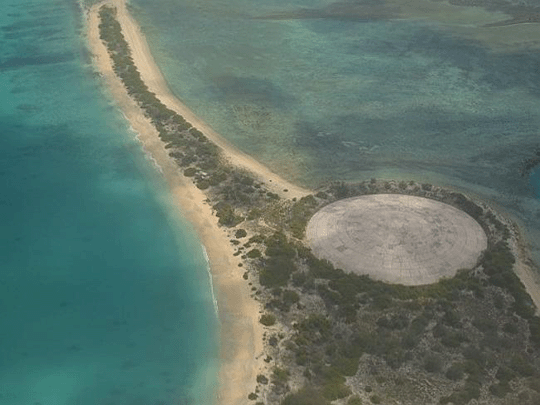
Deadly dome of gorgeous Pacific island leaking radioactive waste news.com.au , JULY 07, 2015 A PICTURESQUE coral atoll that lies northeast of Australia in the Pacific Ocean harbours a deadly secret.
A giant, concrete dome filled with radioactive waste looms above Runit Island, and it’s leaking. Locals call it “The Tomb”.
Runit (or Cactus) dome was used for Cold War nuclear testing by the US government for 10 years from 1948. There were 42 tests in total on Enewetak Atoll, including 22 explosions on platforms, barges and underwater in the space of just three months in 1958, just before a moratorium on atomic testing.
In the late 1970s, an estimated 73,000 cubic metres of contaminated topsoil was deposited in the Cactus nuclear test crater beneath the dome, according to a report commissioned by the US government.
It was only supposed to be a temporary measure — but the dome remains.
Scientists now fear that a major storm, typhoon or other natural disaster coulddamage the 46cm-thick concrete dome, releasing nuclear waste into the sea, The Guardian reports.
The US Department of Energy insists cracks in the dome are merely cosmetic, a result of drying and shrinking of the half-submerged dome, but there are plans for repairs. The 2013 report states that this is to satisfy local concerns, but adds that rainwater could infiltrate through the cracks, possibly affecting groundwater flow and “radionuclide migration into the marine environment”.
Inhabitants of Runit were resettled on nearby Enewetak Island in 1980. Even in the early days, concerns were raised over human exposure to radiation through locally grown food, with resettlers resorting to cans of spam, Columbia University’s Michael Gerrard wrote last year in The New York Times.
Runit remains uninhabited, home only to abandoned bunkers and cables, but locals still visit to fish and salvage scrap metal. It sounds dangerous, but impoverished Marshall Islanders say they have no choice.
And just because Runit is remote, doesn’t mean other countries are totally immune from its influence. A report published in the Environmental Science and Technology journal last year traced plutonium found in Guangdong province in the South China Sea back to the Marshall Islands…….. Continue reading
With climate change, heat waves, wildfires – Canada’s uranium shipments are suspended
Climate change is bringing heatwaves, which bring wildfires, which bring added dangers to all phases of the nuclear fuel chain
 Cameco, Areva suspend uranium shipments due to Saskatchewan fires http://globalnews.ca/news/2102099/cameco-and-areva-suspend-uranium-shipments-due-to-saskatchewan-fires/ By Staff The Canadian Press CALGARY – Cameco Corp. and Areva Resources Canada have stopped shipping uranium from their northern Saskatchewan operations after wildfires made highway transportation unsafe. Cameco spokesman Gord Struthers says the company suspended shipments from the mines in the region about a week ago.
Areva spokeswoman Veronique Larlham says that company did the same a few days ago.
READ MORE: Increased wildfire behaviour expected in Saskatchewan due to weather
But both say their overall uranium deliveries are continuing normally because they have large inventories.
The operations affected are Cameco’s Rabbit Lake mine, McArthur River mine and Key Lake mill, the Cameco-Areva jointly-owned Cigar Lake mine, and Areva’s McClean Lake mill.
North Queensland’s Collinsville solar energy project going ahead
 Collinsville solar power plant to go ahead thanks to Renewable Energy Target decision says Ratch http://www.abc.net.au/news/2015-07-06/collinsville-solar-power-plant-a-goer/6597400 By Jonathan Hair
The company behind a proposed solar power project in north Queensland says it hopes to start construction next year. Ratch Australia is planning to build a $100 million solar plant in Collinsville. It will create up to 80 jobs in the construction phase and two to three once operational.
Ratch general manager of business management, Anil Nangia, said the recent Federal Government deadlock on the Renewable Energy Target put the project on hold. However, he said the recent agreement on a new target meant the project would go ahead.
“The other good thing about renewable energy is it produces jobs and investment in regional Australia,” he said.”The key aspect of this resolution is it was bipartisan support, with no additional reviews until 2020. “We believe there’s real certainty in this target and it will stay in place and we think it will be there for the long run, if not increased.”
He said it was disheartening when politicians expressed a lack of faith in renewables. It’s terrible when they talk like that, renewables are the way of the future,” he said. “They basically are going to produce the low cost power in the long-term and they produce power with no emissions, no side effects, it’s really sad when they talk … down the potential of renewable energy in Australia.”
GDF SUEZ Australian Energy, coal mine owner, investing big into solar energy
“Solar is becoming totally competitive,” “Solar is an energy of the future. It is the energy with the biggest potential for development. It’s no longer a subsidized niche.”
the shift by Engie from centralised fossil fuel and nuclear capacity to one based around decentralised renewable energy generation is typical of the transformation going on around the world – with Europe’s E.ON, RWE and Vattenfall, and in the US, with generators such as NRG, and network operators in California, New York and elsewhere.
 Hazelwood owner makes big push into solar energy, REneweconomy, By Giles Parkinson on 10 July 2015 The owner of the Hazelwood coal-fired power station, the dirtiest generator in Australia, has announced a major push into renewable energy, snapping up the international solar farm developer SolaireDirect for about $A300 million.
GDF Suez, now known as Engie under a massive re-branding campaign that signals its shift from fossil 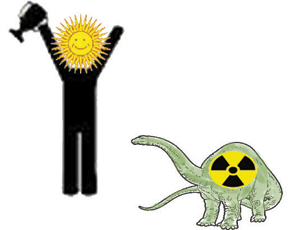 fuels and nuclear to renewable energy, will become the largest solar and wind developer in France after the purchase.
But its big focus is on the international scene. Gerard Mestrallet, the CEO of Engie, one of the biggest operators of nuclear plants in Europe, says new solar now beats new nuclear on price, with new solar parks costing between $US60 and $US90/MWh. Continue reading
True scale of global warning hidden in the heating oceans
Have the oceans been HIDING the true scale of global warming? http://sidharamp.blogspot.com.au/ Nasa warns heat hasn’t disappeared, it’s just been buried in the sea
- Scientists looked at a layer of the oceans between 300 and 1,000ft
- They found it has been accumulating more heat than first thought
- Study looked at direct ocean temperature data for more accurate results
- Previous attempts to explain the temperature trends have relied heavily on climate model results which are less able to deal with short-term data

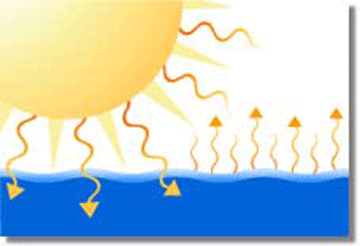
HOW OCEANS CAN BURY HEAT
Radio shock jock Alan Jones caught out in climate falsehood
Alan Jones gets slapped down for climate lies MYRIAM ROBIN | JUL 10, 2015 The Daily Mail got its maths wrong in a climate story, and even The Australian admitted it. But undeterred, Alan Jones repeated the falsehood after the Oz apologised. The fallout from an erroneous Daily Mail story that mucked up its maths on global warming continues, with shock jock Alan Jones the latest to be slapped down by the appropriate watchdog for relying on the dodgy figures.
On September 16, 2013, The Australian published a story based on reporting in the British tabloid, which claimed a leaked… [subscription only] http://www.crikey.com.au/2015/07/10/alan-jones-gets-slapped-down-for-climate-lies/
1 This month
To see nuclear-related stories in greater depth and intensity
– go to https://nuclearinformation.wordpress.com/


 Antinuclear