Runit Island in the Pacific Ocean and its radioactive tomb
Deadly dome of gorgeous Pacific island leaking radioactive waste news.com.au , JULY 07, 2015 A PICTURESQUE coral atoll that lies northeast of Australia in the Pacific Ocean harbours a deadly secret.
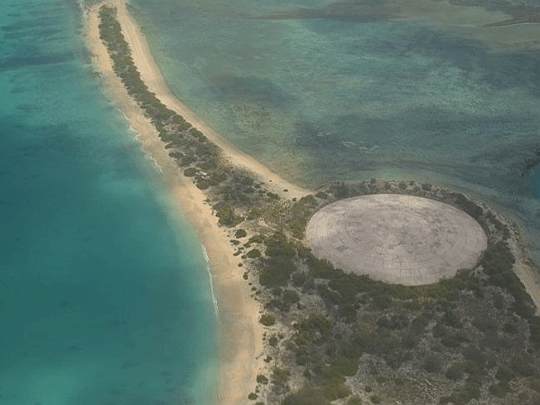
A giant, concrete dome filled with radioactive waste looms above Runit Island, and it’s leaking. Locals call it “The Tomb”.
Runit (or Cactus) dome was used for Cold War nuclear testing by the US government for 10 years from 1948. There were 42 tests in total on Enewetak Atoll, including 22 explosions on platforms, barges and underwater in the space of just three months in 1958, just before a moratorium on atomic testing.
In the late 1970s, an estimated 73,000 cubic metres of contaminated topsoil was deposited in the Cactus nuclear test crater beneath the dome, according to a report commissioned by the US government.
It was only supposed to be a temporary measure — but the dome remains.
Scientists now fear that a major storm, typhoon or other natural disaster coulddamage the 46cm-thick concrete dome, releasing nuclear waste into the sea, The Guardian reports.
The US Department of Energy insists cracks in the dome are merely cosmetic, a result of drying and shrinking of the half-submerged dome, but there are plans for repairs. The 2013 report states that this is to satisfy local concerns, but adds that rainwater could infiltrate through the cracks, possibly affecting groundwater flow and “radionuclide migration into the marine environment”.
Inhabitants of Runit were resettled on nearby Enewetak Island in 1980. Even in the early days, concerns were raised over human exposure to radiation through locally grown food, with resettlers resorting to cans of spam, Columbia University’s Michael Gerrard wrote last year in The New York Times.
Runit remains uninhabited, home only to abandoned bunkers and cables, but locals still visit to fish and salvage scrap metal. It sounds dangerous, but impoverished Marshall Islanders say they have no choice.
And just because Runit is remote, doesn’t mean other countries are totally immune from its influence. A report published in the Environmental Science and Technology journal last year traced plutonium found in Guangdong province in the South China Sea back to the Marshall Islands……..
An association of governments in French Polynesia is preparing to ask France for nearly a billion US dollars in compensation for damage caused by nuclear weapons tests around Mururoa Atoll, The Independent reported last year.
Other atolls in the Marshall Islands, Micronesia, have shared this dubious honour. The very first US hydrogen bomb test vaporised the islet of Elugelab in 1952. Then Bikini Atoll became the site of the country’s most powerful hydrogen bomb detonation, codename Bravo, set off on its reef in 1954.
A fireball shot into the air at 480km/h, taking millions of tons of sand, coral and marine life with it. Locals were moved to Kili, a small island with few resources, where they faced starvation. Many returned to Bikini Island, despite the contamination of its water wells, breadfruit and coconut crabs, which were found to be too radioactive for human consumption. Many now rely on US rice and canned goods to survive.
The nuclear crisis continues out in the Pacific. But it’s far enough away for everyone to forget about it.
- Runit is not the only Pacific island dealing with a nuclear legacy. “Poor islands have to deal with the mess left by large governments,” Professor Gupta said.http://www.news.com.au/technology/environment/deadly-dome-of-gorgeous-pacific-island-leaking-radioactive-waste/story-fnjwvztl-1227431164987
1 Comment »
Leave a comment
1 This month
15 April – Zoom –Nuclear Power is Not the Solution
Apr 15, 2026 01:00 AM in Canberra, Melbourne, Sydney

Join the International Physicians for the Prevention of Nuclear War (IPPNW) on Tuesday, April 14th for a timely webinar exploring the risks associated with nuclear power and challenging the myth that it offers a simple, safe, carbon-free solution to the climate crisis

of the week – Australians for War Powers Reform (AWPR)
To see nuclear-related stories in greater depth and intensity
 Antinuclear
One would think, given the obvious failure of nuclear (weapons and so-called, “peaceful nukes”), the cartel would have been shut down years ago. Instead, this little island has been problematic, and radioactive, for all of my (nearly) 57 years.
I do think it’s the perfect spot to retire the cartel members, though. I mean, if nuclear is so safe and all, why not just pile them all onto a boat and shipwreck them in this remote part of the Pacific?
*BTW; I would bet it’s been leaking for all of these years and could have a lot to do with the mass death(s) in the Pacific, along with Fukushima (and filthy chemicals, including strontium from frac-ing!)
LikeLike