Australia at historic turning point in global switch to renewable energy
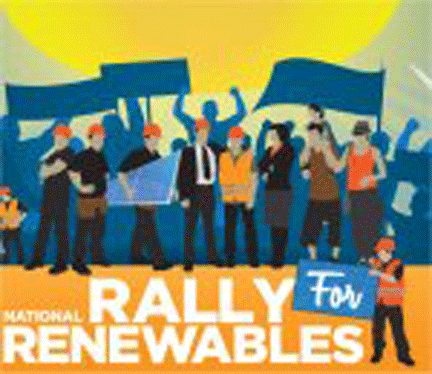
Dramatic changes in energy systems are evident in many other countries too, and they are affecting technological possibilities and relative prices everywhere.
Australia, with its world-class renewable resources, is among the best-placed countries to capitalise.
It is now beyond reasonable doubt that a more decentralised, renewables-based system will provide much cheaper power over the medium and long term, especially with ongoing innovation, and with the increasing uptake of smart electricity grid infrastructure and energy storage technologies, the costs of which are also falling rapidly.
Australia needs to accept the move to clean energy, Brisbane Times, July 24, 2015 James Rydge and Fergus Green
China is also transforming its energy system. The government has imposed restrictions on coal use in key economic regions and is supporting a rapid shift to cleaner energy sources. In 2014, $US83 billion was invested in renewable energy generation capacity (excluding hydroelectricity) in China – about a third of the global total. This shift is motivated partly by acute public concern about air pollution, which kills more than a million Chinese people every year and burdens tens of millions more with ill health and toxic living conditions.
The remarkable outcome is that in 2014 China’s coal use fell (after growing at more than 8 per cent a year between 2000 and 2013), and has fallen even more strongly in the first six months of 2015. Coal imports fell by about 38 per cent year-on-year in the first half of 2015.
This is China’s “new normal”. China’s next five-year plan, scheduled to start in 2016, will accelerate these economic shifts: China’s central bank estimates the country will spend at least $US320 billion in each of the next five years to meet the new plan’s targets for cleaning up China’s environment and expanding non-fossil-fuel energy.
The result of all this for Australia? Constantly rising Chinese demand for our resources has become a thing of the past, just as mining companies have invested heavily in expanding Australia’s supply. And demand for low-carbon, energy-efficient, and environmentally friendly goods and services will grow, just as Australia’s current government is systematically dismantling the policies and institutions designed to foster Australian growth industries in these areas.
Dramatic changes in energy systems are evident in many other countries too, and they are affecting technological possibilities and relative prices everywhere. ………
Australia, with its world-class renewable resources, is among the best-placed countries to capitalise. Wind energy is competitive with new-build coal and gas. And the cost of solar photovoltaic modules has fallen 80 per cent over the past decade – a key reason, no doubt, why one in six Australian households now uses them to generate their own electricity (up from one in 100 households in 2009), and why Australians overwhelmingly support efforts to expand renewables.
It is now beyond reasonable doubt that a more decentralised, renewables-based system will provide much cheaper power over the medium and long term, especially with ongoing innovation, and with the increasing uptake of smart electricity grid infrastructure and energy storage technologies, the costs of which are also falling rapidly. Energy planning, operation, and pricing arrangements designed to optimise such a system will make energy prices in the new system even more competitive compared with the alternative of propping up our creaking, centralised, fossil fuel-based system. Further improvements in energy efficiency – eminently possible with the right policies – will bring the cost of energy services down further still and can offset any short-term electricity price increases…………
What we now need is a government with the vision, strategy, and policy agenda to transition Australia to a zero carbon energy system, and in so doing underwrite our prosperity for the 21st century.
Dr James Rydge is lead economist for the New Climate Economy, a project of the Global Commission on the Economy and Climate.
Fergus Green is a policy analyst and research adviser to Professor Nicholas Stern at the Grantham Research Institute on Climate Change and the Environment at the London School of Economics. http://www.brisbanetimes.com.au/comment/australia-needs-to-accept-the-move-to-clean-energy-20150723-giipe2.html#ixzz3gqdWrBkZ
No comments yet.
1 This month
7 April – WEBINAR – Australia and the Doomsday Clock – Preventing nuclear war through NoFirstUse and other policies
Online | Tuesday April 7, 4:00-5:30pm, Australian Eastern Time / 8:00-9:30am Central Europe Time
– Access the registration link
15 April – Zoom –Nuclear Power is Not the Solution
Apr 15, 2026 01:00 AM in Canberra, Melbourne, Sydney

Join the International Physicians for the Prevention of Nuclear War (IPPNW) on Tuesday, April 14th for a timely webinar exploring the risks associated with nuclear power and challenging the myth that it offers a simple, safe, carbon-free solution to the climate crisis

21 April Webinar: No Nuclear Weapons in Australia
Start: 2026-04-21 18:00:00 UTC Canberra, Melbourne, Sydney (GMT+10:00)
End: 2026-04-21 19:30:00 UTC Canberra, Melbourne, Sydney (GMT+10:00)
Event Type: Virtual
A virtual link will be communicated before the event.
Host Contact Info: australia@icanw.org

of the week – Australians for War Powers Reform (AWPR)
To see nuclear-related stories in greater depth and intensity
 Antinuclear
Leave a comment