Nuclear facilities in South Australia would be at grave danger from bushfires
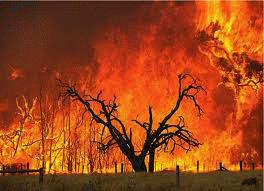 Dangers of Bushfires-Wildfires & Nuclear Business miningawareness, 3 August 15 “………
According to the South Australia Country Fire Service, nearly 1/2 of people living in bushfire prone areas don’t understand the threat. This is apparently true of those proposing adding nuclear
 anything in Australia.
circumstances.
The South Australia Country Fire Service has 13,500 volunteers, of which 1,000 are cadets ages 11 to 16 years of age. The South Australia Metropolitan Fire Service (SAMFS) has 1,000 firefighters. Bushfire season in Australia appears to be somewhat like US tornado season on steroids. It is serious business. Australia even gets fire induced tornados!
Reflecting the seriousness of the matter, South Australia’s Country Fire Service has an amazing web site, with so much information that it is difficult to choose from. But, even a small amount of time spent, on this most interesting of all web sites, drives home the seriousness of Australian Bushfires and Firestorms. Other parts of the world increasingly afflicted by wildfires can learn much from the SA Country Fire Service (CFS) web site.
Since the different parts of the nuclear fuel chain fall under the category of “businesses and organisations” we invite you to take a look at a couple of pages from the 48 page informational book: “Bushfire Safety and Survival for Businesses and Organisations.” What if this “business” were a nuclear power station, for instance?……..
“What to expect in the event of a Bushfire?” (from p. 24 of “Bushfire Safety and Survival for Businesses and Organisations” http://www.cfs.sa.gov.au/public/download.jsp?id=30936
1) Loss of Power: Nuclear Power Stations require power from the grid or backup power for cooling of the reactor and spent fuel pool. Without cooling water, a nuclear meltdown, which could be a major nuclear disaster, will occur in a very short time-frame. Nuclear reactors can not be totally shut down. Backup generators can be clogged with smoke. Fire sucks up oxygen needed to operate the diesel generators. It also sucks up oxygen needed by workers to breathe. Loss of power and smoke can both lead to loss of functional electronics-instrumentation.
2) Loss of Reticulated (Piped) water: Water is required for the cooling of the reactor and spent fuel and for fire-fighting.
3) Loss of Communications: Cannot call for help or backup; Cannot communicate the extent of the problem, etc.
4) Smoke, Darkness, etc: Smoke can clog the generators and air filters; can make it impossible for workers to breathe and do the necessary work to prevent a nuclear reactor meltdown, as can darkness.
5) No available firetrucks; no backup; difficulty or impossibility of any backup workers accessing the site.
6) No warning: Even if there were warning, it would be insufficient, and generators for pumps and cooling water would still be required; electronics would still be impacted………..
2015 Sampson Flat Bushfires
“The 2015 Sampson Flat bushfires were a series of bushfires in Australia in the state of South Australia, that primarily effected the Adelaide region, predominantly the Adelaide Hills and the outer Adelaide metropolitan area. The fires began on 2 January 2015 during a day of extreme heat and lasted until 9 January 2015.[6][7]
The fires began in the outer northern area of the city, in the suburb of Sampson Flat. It later travelled southeast towards the Kersbrook township and across the Mount Lofty Ranges toward the Adelaide Hills….Over 700 South Australian Country Fire Service volunteers were involved in fighting the fire, supplemented by teams from the New South Wales Rural Fire Service and Victorian Country Fire Authority.[20] A record number of 31 aircraft were available to assist in fighting the fire.[21]”https://en.wikipedia.org/wiki/2015_Sampson_Flat_bushfires
Black Sunday 1955
“Around 1,000 Emergency Fire Service volunteers from 60 brigades were tasked to the fires, but were overwhelmed. At 10am, the EFS head office requested urgent public assistance. Around 2,500 citizens volunteered.”
https://en.wikipedia.org/wiki/Black_Sunday_(1955)
Ash Wednesday Bushfires of 1983
“The Ash Wednesday bushfires, known in South Australia as Ash Wednesday II,[3] were a series of bushfires that occurred in south-eastern Australia on 16 February 1983, which was Ash Wednesday in the Christian calendar. Within twelve hours, more than 180 fires fanned by winds of up to 110 km/h (68 mph) caused widespread destruction across the states of Victoria and South Australia.[4] Years of severe drought and extreme weather combined to create one of Australia’s worst fire days in a century.[5] The fires became the deadliest bushfire in Australian history, until the Black Saturday bushfires in 2009.
In Victoria, 47 people died, while in South Australia there were 28 deaths. This included 14 CFA and 3 CFS volunteer fire-fighters who died across both states that day………….. https://wordpress.com/read/post/feed/4410547/768879957
No comments yet.
1 This month

of the week – Australians for War Powers Reform (AWPR)
To see nuclear-related stories in greater depth and intensity
 Antinuclear
Leave a comment