Decline of uranium mining in Australia
PHASING OUT NUCLEAR POWER, Taipei Times, By Ho Yi / Staff reporter, 30 July 15 “…….In Australia, uranium mining companies have suffered a major setback as global uranium prices have dropped 70 percent since the Fukushima meltdown, prompting Japan, one of the biggest importers of Australia’s uranium, to switch off its nuclear reactors.
Atkinson says that all the big companies that have thrived in the nuclear industry in Australia since the 1950s are going broke as they wait for Japan to restart their reactors.
Meanwhile, mining giants are leading the push to build new nuclear power plants in countries like India and Indonesia.
But Atkinson says the future looks bright. He says there is a strong sense that Australia’s four uranium mines will shut down over the next decade as renewable energy becomes cheaper than nuclear power.
And nuclear waste? Atkinson says that nuclear waste in Australia should be stored closest to where the greatest number of people use electrical power — Sydney — and where “people who know how dangerous it is can do the best they can to look after it.”
“This out of sight, out of mind philosophy is not the best way to deal with a substance so dangerous… [Nuclear waste] is never going to be in the middle of nowhere. We need to realize that there is no such thing as nowhere. There is always someone living somewhere,” he says…….. http://www.taipeitimes.com/News/feat/archives/2015/07/30/2003624204/2
Poverty and discrimination – the fate of Japan’s hibakusha
The A-bombs fell / Specter of radiation lingers on , Japan News, , August 04, 2015, August 04, 2015 The Yomiuri ShimbunThis is the second installment in a series. “……….When hibakusha (atomic bomb survivors) need treatment due to malignant tumors, leukemia, cardiac infarcts and other ailments, they may be officially recognized as having radiation sickness. This entitles them to a special monthly medical allowance of about ¥140,000, which is provided by the government apart from medical costs.
However, there are certain requirements for receiving the allowance, such as how far they were from Ground Zero when they were exposed. There were a total of 183,519 holders of special hibakusha health-care certificates for the bombings in Hiroshima and Nagasaki as of the end of March, but only 4.8 percent of them, or 8,749, were recognized as having radiation sickness……….. Continue reading
Wind inquiry: Australia’s pro-nuclear Senate trio downgrades nation’s peak medical research body
The Committee also cast doubt on the reliability of National Health and Medical Research Council investigations of the issue, after the nation’s peak research body reported a lack of evidence to support claims of the harmful effects of wind turbines.
It proposed the IESC take the lead on conducting research on the issue, dismissing the NHMRC’s efforts in the area as “manifestly inadequate”.
But in a dissenting report, Labor Senator Anne Urquhart shredded the credibility of Sarah Laurie, who the majority senators relied heavily upon for evidence of the adverse health effects of wind farms, as an authority on the issue.
 Senators want federal health body sidelined on wind turbine investigations, REneweconomy, By Adrian Rollins on 4 August 2015 Australian Medicine The Federal Government has been urged to sideline the nation’s peak medical research body and set up a stand-alone scientific committee to investigate the health effects of wind farm noise.
The Senate Select Committee on Wind Turbines, chaired by Democratic Labor Party Senator John Madigan, has recommended the establishment of an Independent Expert Scientific Committee (IESC) on Industrial Sound to research the health effects of wind turbines “and any other industrial projects which emit sound and vibration energy” and develop a national noise standard for wind farms.
The IESC, which along with a National Wind Farm Ombudsman, would be paid for through a levy on wind farm operators, would provide advice to State governments on the health effects of any proposed or existing wind farm, and the Senate committee called for states that did not accept expert advice or adopt the national noise standard to be overruled by the Commonwealth.
The recommendations are in keeping with Government hostility to the wind power industry. Continue reading
Obama’s Clean Power Plan seen as a Winner for New Nuclear Power
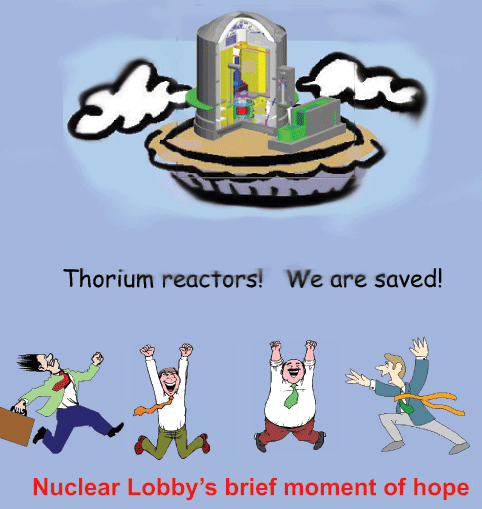 New Nuclear Power Seen as Winner in Obama’s Clean Power Plan, Bloomberg by Jonathan CrawfordMark Chediak, 4 Aug 15 The Obama administration gave the struggling U.S. nuclear industry a glimmer of hope this week by allowing new reactors to count more toward meeting federal emissions limits.
States can take more credit for carbon-free electricity to be generated by nuclear power plants under construction as they work to comply with emission-reduction targets set in the U.S. Environmental Protection Agency’s Clean Power Plan released Monday. Cuts from existing reactors won’t count, casting the fate of units at risk of premature retirement in doubt………
“We tend to view new rules as potentially the first bit of good news for the struggling nuclear industry,” Julien Dumoulin-Smith, an analyst for UBS, wrote on Monday in a research note…….
Existing Reactors
The Nuclear Energy Institute, a Washington-based trade group, said it was “pleased” that the EPA recognized that nuclear plants under construction “should count toward compliance when they are operating.” Continue reading
Global climate change – there’s nowhere to run to
 Is Anywhere on Earth Safe From Climate Change?,
  The Atlantic ADRIENNE LAFRANCE AUG 3, 2015 Relocating to a landlocked city isn’t enough Put simply: Climate change poses the threat of global catastrophe. The planet isn’t just getting hotter, it’s destabilizing. Entire ecosystems are at risk. The future of humanity is at stake.
Scientists warn that extreme weather will get worse and huge swaths of coastal cities will be submerged by ever-more-acidic oceans. All of which raises a question: If climate change continues at this pace, is anywhere going to be safe?
“Switzerland would be a good guess,” said James Hansen, the director of climate science at Columbia University’s Earth Institute. Hansen’s latest climate study warns that climate change is actually happening faster than computer models previously predicted. He and more than a dozen co-authors found that sea levels could rise at least 10 feet in the next 50 years. Slate points out that although the study isn’t yet peer-reviewed, Hansen is “known for being alarmist and also right.”…..
Staying away from scorching heat, hurricanes, floods, and wildfire will be difficult in a country that feels dramatically different in coming decades. “The best place really is Alaska,” said Camilo Mora, a geologist at the University of Hawaii, in an interview with The New York Times last year………http://www.theatlantic.com/technology/archive/2015/08/is-anywhere-on-earth-safe-from-climate-change/400304/
Batteries about to change everything – off-grid or on grid electricity
With the world’s highest uptake of residential solar per capita, Australian demand for batteries that allow households to better match up the power generated from their rooftop panels with when they want to use it is primed to take off……..
Morgan Stanley estimates that 2.4 million east coast homes will have batteries installed within the next few years.
Instead of having to draw on peak-tariff electricity from the grid in the evenings, a household can then use stored energy, saving money and helping prevent the grid from overloading. Batteries also provide back-up power for computers, lighting and life-support systems that have to stay on during power cuts.
How battery-powered homes are unplugging Australia, SMH, August 1, 2015 Angela Macdonald-Smith Energy Reporter “……….While the much-hyped Powerwall home battery system from Californian electric car pioneer Tesla Motors won’t be available locally until 2016, lithium-ion batteries have been on offer to Australian homes and businesses for the last year or so.
High-tech, adaptable and controllable and typically the size of a small fridge, these systems have left clumsy and ugly lead acid batteries far behind.
Less than a week after the soft launch of the sleek Powerwall and larger Powerpack batteries in late April, Tesla was said to have sold out until mid-2016 after about $US800 million of orders for some 55,000 Powerwalls and 25,000 commercial units.
In Australia, the 1.4 million homes with rooftop solar panels are the battleground for battery providers and retailers.
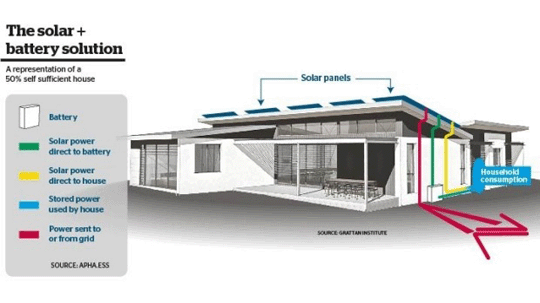
Others, like Whiltsher, are starting from scratch, having batteries and rooftop solar fitted at the same time. Even for homes without solar PV panels, batteries could make economic sense down the track, many say. Continue reading
Senate wind farm inquiry report designed to kill the industry
“You didn’t need a crystal ball to know the inquiry was going to demonise clean and safe wind energy,” said Leigh Ewbank, Friends of the Earth’s renewable energy spokesperson.
“Stacked with senators opposed to wind farms and selective leaks to the press show that the inquiry was a political exercise, not a impartial review.”
 Senate wind report slammed as ‘reckless’, ‘biased’ attack on renewables http://reneweconomy.com.au/2015/senate-wind-report-slammed-as-reckless-biased-attack-on-renewables-14968 By Sophie Vorrath on 4 August 2015 After an impromptu and questionably legal airing last week, the final report of the Senate inquiry into wind farms was tabled in Parliament on Monday, with a lengthy list of recommendations that the clean energy industry says would result in the death of the wind farm sector in Australia.
The recommendations, some already adopted by the Abbott government – include the creation of an independent scientific committee on wind farm noise, national standards on the level of sound allowed to be emitted by wind farms, ongoing investigation into the health effects of “infrasound,” and new limits and restrictions to wind projects’ access to renewable energy certificates (RECs). Continue reading
Energy storage revolutionising electricity – especially in off-grid solar
The next biggest potential market in Australia for energy storage – as a value proposition – would be the off-grid market, the report finds.
“Off-grid electricity is Australia’s most expensive electricity due to the underlying high gas and diesel prices in remote areas,” it notes.
“As such, the business case for renewables as a means to offset fuel use is strong. Similarly, in order to enable higher penetrations of renewables, energy storage can be utilised to manage the intermittent nature of wind or solar generation.”
Energy storage ‘megashift’ ahead, battery costs set to fall 60% by 2020, REneweconomy By Sophie Vorrath on 3 August 2015 [excellent graphs and tables] The key role energy storage will play in the electricity grids of the future – and the vital importance of investing in and testing the various emerging battery storage technologies – has been highlighted in a major report published by the Australian Renewable Energy Agency on Monday, which predicts a 40-60 per cent price plunge for certain battery technologies by 2020. Continue reading
Australian anti nuclear activist Marcus Atkinson at Taipei’s No Nukes Film Festival
ALLYING WITH ABORIGINALS
With a long nuclear-free history, Western Australia has a strong foundation for an anti-nuclear movement. Atkinson says Aboriginal people have formed a close and still growing alliance with environmental groups, politicians and union organizations since the 1990s because they have learned to “listen to each other.”
For example, the Walkatjurra Walkabout is an annual month-long trek through the Wangkatja country and is joined by local Aborigine villagers and people from around Australia as a way to celebrate the strength of an Aboriginal community that has fought to stop uranium mining for over 40 years.
Under the cloud of nuclear power, Taipei Times, By Ho Yi / Staff reporter, 30 July 15 Anti-nuclear activists from Japan, Taiwan and Australia gathered at the No Nukes Film Festival in Taipei last week to discuss uranium mining, nuclear waste and ‘radioactive racism’ What do Taiwan, Japan, Australia and France have in common? They are part of the global nuclear industry chain that starts with mining companies like Canada’s Cameco and Areva from France that extract uranium ore to build and fuel nuclear power plants.
Throughout the chain, there is another thing that happens over and over: the nuclear industry stores its waste at facilities located in poor and Aboriginal communities because of their remote locations. These communities also offer the least resistance against corporations and governments.
“We have an expression in Australia called ‘radioactive racism,’ meaning all of the radioactivity, nuclear tests, uranium mining and nuclear waste are always targeted at Aboriginal communities,” says Marcus Atkinson, an organizer with the Anti-Nuclear Alliance of Western Australia.
The anti-nuclear activist was in Taipei last week to attend the No Nukes Film Festival (核電影), a free biennial event organized by Green Citizens’ Action Alliance (綠色公民行動聯盟), an NGO and anti-nuclear advocacy group. The festival and film screenings ends Sunday. Continue reading
Largest coal mining union backs Labor’s Renewable Energy Target
Why has Australia’s largest coal mining union backed Labor’s Renewable Energy Target? Australian Broadcasting Corporation, ABC TV 7.30 Report Broadcast: 28/07/2015 Reporter: Matt Peacock
Australian’s largest coal mining and energy union was the surprise backer of Labor’s 50 per cent Renewable Energy Target at the party’s national conference, so what moved them to support it when Prime Minister Tony Abbott claims there will be a massive cost for consumers?
Transcript Continue reading
1 This month

of the week – Australians for War Powers Reform (AWPR)
To see nuclear-related stories in greater depth and intensity
 Antinuclear