Australian anti nuclear activist Marcus Atkinson at Taipei’s No Nukes Film Festival
ALLYING WITH ABORIGINALS
With a long nuclear-free history, Western Australia has a strong foundation for an anti-nuclear movement. Atkinson says Aboriginal people have formed a close and still growing alliance with environmental groups, politicians and union organizations since the 1990s because they have learned to “listen to each other.”
For example, the Walkatjurra Walkabout is an annual month-long trek through the Wangkatja country and is joined by local Aborigine villagers and people from around Australia as a way to celebrate the strength of an Aboriginal community that has fought to stop uranium mining for over 40 years.
Under the cloud of nuclear power, Taipei Times, By Ho Yi / Staff reporter, 30 July 15 Anti-nuclear activists from Japan, Taiwan and Australia gathered at the No Nukes Film Festival in Taipei last week to discuss uranium mining, nuclear waste and ‘radioactive racism’ What do Taiwan, Japan, Australia and France have in common? They are part of the global nuclear industry chain that starts with mining companies like Canada’s Cameco and Areva from France that extract uranium ore to build and fuel nuclear power plants.
Throughout the chain, there is another thing that happens over and over: the nuclear industry stores its waste at facilities located in poor and Aboriginal communities because of their remote locations. These communities also offer the least resistance against corporations and governments.
“We have an expression in Australia called ‘radioactive racism,’ meaning all of the radioactivity, nuclear tests, uranium mining and nuclear waste are always targeted at Aboriginal communities,” says Marcus Atkinson, an organizer with the Anti-Nuclear Alliance of Western Australia.
The anti-nuclear activist was in Taipei last week to attend the No Nukes Film Festival (核電影), a free biennial event organized by Green Citizens’ Action Alliance (綠色公民行動聯盟), an NGO and anti-nuclear advocacy group. The festival and film screenings ends Sunday.
For the past 20 years, Atkinson has worked as anti-uranium mining activist in Australia, which has nearly 40 percent of the uranium reserves on earth, making it the world’s third largest supplier.
REACHING OUT
Now in its second edition, the film festival examines different aspects of the global nuclear industry with a focus on issues that are rarely discussed in Taiwan such as uranium mining and environmental justice.
“I used to think of nuclear issues within a national framework,” says Chen Shi-ting (陳詩婷), the action alliance’s executive secretary. “But the nuclear industry is actually the source of oppression to people throughout the globe.”
“Through the film festival, we can … reach out to the general public who either don’t care about the nuclear issue or find it hard to digest,” she adds.
THE SYSTEM OF SACRIFICE
Among the lineup of 13 documentaries, Paiwan filmmaker Sasuyu Ubalat’s Get Out (原來我們不核) examines the Paiwan village of Nantian (南田) in Taitung County. The villagers are deeply divided over the future of their small community, which was chosen by Taiwan Power Co (Taipower) as a candidate for a permanent nuclear waste storage facility…….
Funahashi says the nuclear industry thrives on “a system of sacrifice” in which poor communities like Futaba sacrifice their histories, cultures and futures so that people in the cities can have enough electricity.
“The nuclear power plant robs small towns and villages of selfhood. It brings jobs and money, and locals become dependent on and addicted to it, fearing that if the plant is closed down, their livelihood will disappear… How to enable villages to survive without nuclear power plants is an important question we need to address,” Funahashi says.
“Ultimately, nuclear power is an ethical issue, not an economic one… What right do we have to impose something we don’t want onto others, our future generations and the environment?” he asks.
ALLYING WITH ABORIGINALS
With a long nuclear-free history, Western Australia has a strong foundation for an anti-nuclear movement. Atkinson says Aboriginal people have formed a close and still growing alliance with environmental groups, politicians and union organizations since the 1990s because they have learned to “listen to each other.”
For example, the Walkatjurra Walkabout is an annual month-long trek through the Wangkatja country and is joined by local Aborigine villagers and people from around Australia as a way to celebrate the strength of an Aboriginal community that has fought to stop uranium mining for over 40 years.
Atkinson says that when it first started in 2011, the event was limited to protesting uranium mining. But as community elders and villagers began to contribute, the walk has become about supporting Aboriginal sovereignty and advocating human rights, while facilitating a deeper understanding and reconnection to the land and traditional culture.
“The experience has been more empowering for us in a lot of ways. I think the work with the Aboriginal communities has really opened my eye to the bigger picture,” Atkinson says.
No comments yet.
1 This month
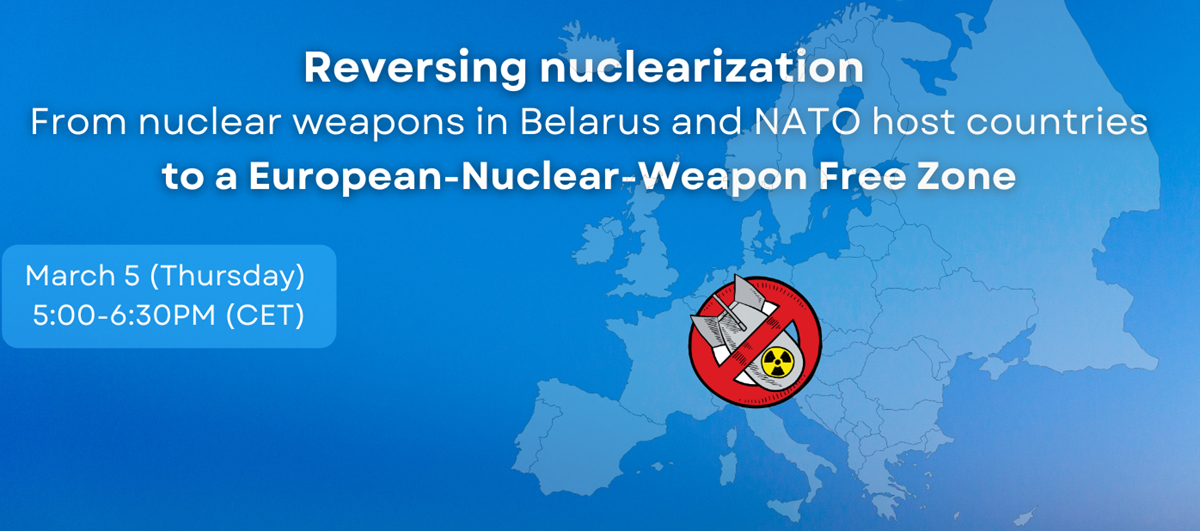
6 March -Online – Reversing nuclearization:
From nuclear weapons in Belarus and NATO host countries to a European-Nuclear-Weapon Free Zone
Mar 6, 2026 03:00 AM in Canberra, Melbourne, Sydney

of the week – Australians for War Powers Reform (AWPR)
To see nuclear-related stories in greater depth and intensity
 Antinuclear
Leave a comment