Batteries about to change everything – off-grid or on grid electricity
With the world’s highest uptake of residential solar per capita, Australian demand for batteries that allow households to better match up the power generated from their rooftop panels with when they want to use it is primed to take off……..
Morgan Stanley estimates that 2.4 million east coast homes will have batteries installed within the next few years.
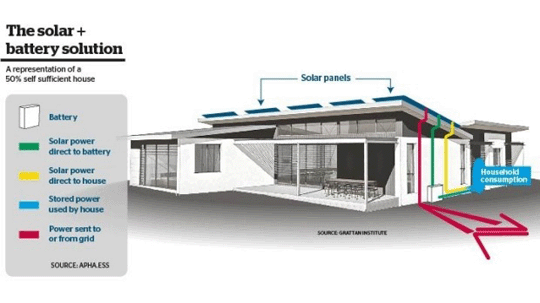
Instead of having to draw on peak-tariff electricity from the grid in the evenings, a household can then use stored energy, saving money and helping prevent the grid from overloading. Batteries also provide back-up power for computers, lighting and life-support systems that have to stay on during power cuts.
How battery-powered homes are unplugging Australia, SMH, August 1, 2015 Angela Macdonald-Smith Energy Reporter “……….While the much-hyped Powerwall home battery system from Californian electric car pioneer Tesla Motors won’t be available locally until 2016, lithium-ion batteries have been on offer to Australian homes and businesses for the last year or so.
High-tech, adaptable and controllable and typically the size of a small fridge, these systems have left clumsy and ugly lead acid batteries far behind.
Less than a week after the soft launch of the sleek Powerwall and larger Powerpack batteries in late April, Tesla was said to have sold out until mid-2016 after about $US800 million of orders for some 55,000 Powerwalls and 25,000 commercial units.
In Australia, the 1.4 million homes with rooftop solar panels are the battleground for battery providers and retailers.
Others, like Whiltsher, are starting from scratch, having batteries and rooftop solar fitted at the same time. Even for homes without solar PV panels, batteries could make economic sense down the track, many say.
Certainly that’s what experts predict. The International Renewable Energy Agency predicts the global market for battery storage will grow from $US220 million ($302 million) in 2014 to $US18 billion by 2023.
Ivor Frischknecht, chief executive of Australian Renewable Energy Agency, calls it an “energy revolution”.
“If batteries are cheap enough this value proposition will ensure that most homes have solar and storage within a few years,” he says.
With the world’s highest uptake of residential solar per capita, Australian demand for batteries that allow households to better match up the power generated from their rooftop panels with when they want to use it is primed to take off……..
Morgan Stanley estimates that 2.4 million east coast homes will have batteries installed within the next few years. That has real implications for retailers such as AGL Energy and Origin Energy.
Those retailers are in turn making sure they are in on the action. AGL has started offering suitcase-sized batteries with a 6 kilowatt-hour lithium-ion system, storing enough to power a home for a few hours.
Origin is set to introduce its battery offer within weeks, while Snowy Hydro’s Red Energy retail business is trialling a Panasonic battery……..
Supply is coming
Lithium-ion batteries from maker such as China’s Tianjin Lishen are already available in Australia, while consumer electronics giant LG Chem is also targeting Australia, as are California’s Enphase Energy and the Warren Buffett-backed BYD, also based in China.
Luring them here is the popularity of rooftop solar, which has created a huge market for storage systems that can soak up the excess power generated by solar PV panels during the day, which otherwise has to be fed back into the grid at little financial gain to homeowners.
Instead of having to draw on peak-tariff electricity from the grid in the evenings, a household can then use stored energy, saving money and helping prevent the grid from overloading. Batteries also provide back-up power for computers, lighting and life-support systems that have to stay on during power cuts.
Households could in theory even move into energy trading, based on power from their battery storage system……………………. http://www.smh.com.au/business/energy/how-batterypowered-homes-are-unplugging-australia-20150731-giogk2.html#ixzz3hskRSvFT
No comments yet.
1 This month

6 March -Online – Reversing nuclearization:
From nuclear weapons in Belarus and NATO host countries to a European-Nuclear-Weapon Free Zone
Mar 6, 2026 03:00 AM in Canberra, Melbourne, Sydney

of the week – Australians for War Powers Reform (AWPR)
To see nuclear-related stories in greater depth and intensity
 Antinuclear
Leave a comment