United Nations Secretary-General Ban Ki-moon calls for legally binding Nuclear Test Ban
 UN urges all States to sign, ratify Nuclear Test Ban as ‘critical step on road to nuclear-free world’ http://www.un.org/apps/news/story.asp?NewsID=51744#.VeDS4SWqpHw 28 August 2015 – For the fifth International Day against Nuclear Tests, United NationsSecretary-General Ban Ki-moon has welcomed voluntary moratoria on testing imposed by nuclear-armed states but stressed that these cannot substitute for a legally-binding treaty.
“The Comprehensive Nuclear-Test-Ban Treaty (CTBT) is essential for the elimination of nuclear weapons,” Mr. Ban said in a message. “It is a legally-binding, verifiable means by which to constrain the quantitative and qualitative development of nuclear weapons.”
The UN General Assembly declared 29 August the International Day against Nuclear Testsin December 2009, adopting a unanimous resolution that calls for increasing awareness and education “about the effects of nuclear weapon test explosions or any other nuclear explosions and the need for their cessation as one of the means of achieving the goal of a nuclear-weapon-free world.” 2010 marked the inaugural commemoration of the International Day against Nuclear Tests.
Reminding the world that this year marks the 70th anniversary of the dawn of the nuclear age, the UN chief said 70 years ago in 1945, “the Trinity Test unleashed the power of more than 20,000 tons of TNT and precipitated over 2,000 additional nuclear tests.”
“Pristine environments and populated communities in Central Asia, North Africa, North America and the South Pacific were hit,” he said. “Many have never recovered from the resulting environmental, health and economic damage. Poisoned groundwater, cancer, leukaemia, radioactive fallout – these are among the poisonous legacies of nuclear testing.”
“The best way to honour the victims of past tests is to prevent any in the future,” he said, noting that two decades after the CTBT was negotiated, “the time has long past for its entry-into-force.” “I welcome the voluntary moratoria on testing imposed by nuclear-armed States,” Mr. Ban said “At the same time, I stress that these cannot substitute for a legally-binding Treaty.”
“On this International Day, I repeat my longstanding call on all remaining States to sign and ratify the Treaty – especially the eight necessary for its entry-into-force – as a critical step on the road to a nuclear-weapon-free world,” he said.
The General Assembly resolution that established the world day was initiated by Kazakhstan, together with a large number of sponsors and cosponsors with a view to commemorate the closure of the Semipalatinsk Nuclear Test site on 29 August 1991.
In his remarks, Assembly President Sam Kutesa said the recently held 2015 Review Conference of the Treaty on the Non-Proliferation of Nuclear Weapons (NPT) had highlighted the stark reality of the increasing divisions between the States parties over the future of nuclear disarmament.
“It is now time to bridge the gap and work with more resolute political will to ensure that the NPT continues to remain the cornerstone of global security,” he declared.
Mr. Kutesa applauded the efforts of the Government of Kazakhstan, not only for initiating the International Day, but also for its continuing leadership in efforts to end nuclear weapons testing and to promote a world free of nuclear weapons.
He also commend the recent announcement of the Joint Comprehensive Plan of Action (JCPOA) on Iran’s nuclear programme, reached in Vienna between the international negotiators and Iran as an important step forward on this critical issue.
“I hope this agreement will benefit the non-proliferation regime and will lead to greater mutual understanding and cooperation on the many serious security challenges in the Middle East and beyond,” he said.
He also announced that on 10 September, he plans to convene an informal meeting of the General Assembly to mark the International Day under the overall theme ‘Towards Zero: Resolving the Contradictions.’
No place for nuclear power in Australia – economist warns
 Nuclear power is an expensive, inferior resource that has no place in Australia’s future energy mix, a US economist has warned.http://www.theaustralian.com.au/national-affairs/state-politics/nuclear-power-a-costly-relic-us-economist-warns-commission/story-e6frgczx-1227500265740?sv=f70611a9445ad64e9d33b11dcffd7050 27 Aug 15
Vermont Law School senior fellow for economic analysis Mark Cooper has called on South Australia’s Nuclear Fuel Cycle Royal Commission to reject nuclear power on the grounds that natural gas-fired generation is more cost-competitive.
The former Fulbright fellow’s submission to the royal commission argues that the rapid development of renewable energy technology renders nuclear power a 20th-century “relic” that will be outdated before a reactor can be built in Australia.
“Nuclear power is an inferior resource that has no place in a least-cost portfolio to meet the need for electricity in a low-carbon environment,” he says. “Before a new nuclear reactor could be brought online, efficiency, renewables, other distributed resources and the deployment of the physical and institutional infrastructure to build an intelligent electricity system should well be on their way towards creating a new 21st-century system.”
Nuclear reactors can take up to 15 years to build before becoming operational. Dr Cooper said the huge capital investment required over a long period of time to build a nuclear power plant meant investors would be exposed to “significant risk”.
Royal commissioner Kevin Scarce has acknowledged the rapid development of renewable energy technology could quickly change the goalposts for assessing the economic viability of nuclear energy. Because of this, “heavy assumptions” were being built into the royal commission’s report to government, he said.
French ACT co-operation on renewable energy for Canberra and South Australia
French diplomacy delivers renewable energy to Canberra and $250m to South Australia, ABC, SA Country Hour By James Jooste, 26 Aug 15 A joint venture between French company Neoen and the Australian Capital Territory Government will inject $250 million into the South Australian economy and deliver clean energy to the capital. Continue reading
Dr Ian Fairlie on Radiation Hormesis
US Nuclear Regulatory Commission (NRC): Consultation. Dr Ian Fairlie Consultant on Radioactivity in the Environment LONDON United Kingdom www.ianfairlie.org “………..Comments on Hormesis It is true that some cell and animal experiments indicate that if small amounts of radiation were administered before later larger amounts, the damage done is less than if no previous small amount were given. (The word “tickle” is used in radiobiology lingo to denote such small amounts.)
On the other hand, other cell and animal studies using different doses, durations and endpoints fail to show this effect, and there is no human evidence, ie from epidemiology. But it is true that some evidence from chemistry indicates the same effect, and there is some theoretical support for an adaptive effect in animals and plants.
Hormesis advocates typically argue that although radiation attacks DNA and causes mutations, DNA repair mechanisms quickly correct these. These mechanisms are certainly numerous and busy – it is estimated over 15,000 repairs per hour are carried out in each cell – but from the sheer number of repairs, many misrepairs occur and it is the misrepairs that cause the damage.
But even if the existence of hormesis were accepted, the question remains – what relevance would it have for radiation protection? The answer- as stated repeatedly in official reports by UNSCEAR and BEIR etc – is zero.

For example, do we give “tickle” doses to people about to undergo radiation therapy, or to nuclear workers? Of course, we don’t. And what about background radiation? All of us receive small “tickle” doses of radiation – about 3 mSv per year of which about 1 mSv is from external gamma radiation.
Do these somehow protect us from subsequent radiation? How would we notice? And if it did, so what? That is, what relevance would it have for radiation protection, eg setting radiation standards? The answer is again ….none.
Indeed, as we show below, increasing evidence exists that even background radiation itself is harmful. ……. http://www.ianfairlie.org/wp-content/uploads/2015/08/US-NRC-Consultation-4-1.pdf (NRC): Consultationhttps://www.federalregister.gov/articles/2015/06/23/2015-15441/linear-no-threshold-model-andstandards-for-protection-against-radiation
GE/Hitachi, Westinghouse/Toshiba and Areva/Mitsubishi all desperate to sell nuclear technology overseas
 Hitachi has made no secret of its motive for trying to export reactor technology saying it needed a fresh outlet for reactors after Tokyo shut down Japan’s nuclear plants
failure to agree a final deal between EDF Energy and the Government on Hinkley “threatens not only the first new nuclear power station for a generation, but potentially all those that will come in its wake,”
ABWRs – one of the least reliable reactors in the world nuClear news No.77, September 2015
Introduction – Anglesey: a victim of Abenomics? Exporting nuclear technology is a key element of Japanese Prime Minister Shinzo Abe’s economic strategy – “Abenomics”. Nuclear exports are seen as a way to rev up Japan’s long struggling economy, and tackle the persistent trade deficit made worse by the
need to import energy – especially Liquid Natural Gas – to replace reactors shutdown after Fukushima.
 Japan’s top three nuclear engineering companies — Hitachi, Mitsubishi Heavy Industries and Toshiba — which had a combined profit in their energy and infrastructure businesses of about 242 billion yen ($3.14 billion) in the fiscal year 2010/11, were keener than ever to look overseas for business after Fukushima put the domestic nuclear industry on hold. Continue reading
New app ‘Welcome to Country’ teaches about Australian Aboriginal culture
‘Welcome to Country’ app teaches users about Aboriginal culture in Australia, Telegraph, 26 Aug 15 New app delivers a “Welcome to Country” video introduction when users cross a tribal boundary A new app that delivers a “Welcome to Country” video introduction when users cross a tribal boundary in Australia has been launched.
In the short videos a traditional owner (or elder) welcomes the user to their country and gives an overview of basic cultural protocols specific to the tribal area.
The app was created by Aboriginal company Weerianna Street Media with the intent of educating people on the Traditional Owners’ culture and heritage protocols right across the Australia. It uses GPS data from the device to work where the users are in relation to the country they are entering……….The first version of the Welcome to Country app contains more than 30 tribes and language groups, of over 500 groups, across Indigenous Australia……..http://www.telegraph.co.uk/news/worldnews/australiaandthepacific/australia/11824895/Welcome-to-Country-app-teaches-users-about-Aboriginal-culture-in-Australia.html
A hydrologist warns about uranium mining and groundwater dangers to Grand Canyon
Claims that uranium mining near the Grand Canyon is safe don’t hold water, Guardian, David Kreamer, 25 Aug 15 Science shows we can’t assume that uranium deposits, when disturbed by mining, can’t leak into groundwater. We should be wary of claims to the contrary It only takes a few Grand Canyon hikes to realize the importance of its springs and other water sources. When refilling a water bottle in the cool depths below multi-colored rock walls, listening to a summer frog symphony at sunset or maybe snapping an icicle from a weeping ledge in winter, it’s clear that the living desert depends on its pockets of water.
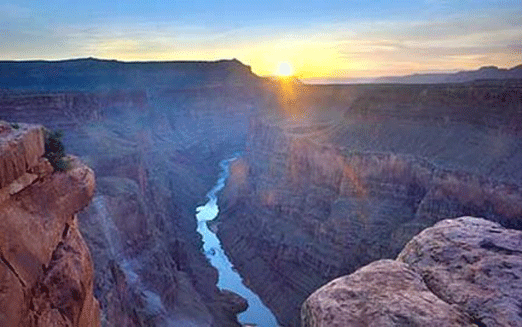
That’s why, as a hydrologist and longtime Grand Canyon hiker, boatman and scientist, I am profoundly concerned about continued uranium mining in or near it. It has great potential to irreparably harm Grand Canyon springs and the plants and animals that depend on them.
I am concerned because industry and agency officials are relying on a justification that isn’t supported by past investigations, research or data to promote uranium mining in the Grand Canyon region. Specifically, they claim that mining will have minimal impact on springs, people and ecosystems there.
Instead, the science shows that it is unreasonable to assume that uranium deposits, when disturbed by mining, can’t leak into groundwater. The deposits in the Grand Canyon are typically found in geologic features known as breccia pipes, formed millennia ago when caves in the main groundwater system collapsed, leaving shattered, rock-filled chimneys that extend upwards thousands of feet to the canyon’s rim. These chimneys act as conduits that have allowed groundwater to move vertically through the rock layers over thousands of years. The vertical movement of groundwater combined with low oxygen levels caused the uranium deposits to form over millennia. Inserting a mine shaft into these features disrupts geologic formations, increases the permeability and oxygenation of these vertical pipes and increases the ability of ore deposits to be suddenly dissolved, mobilized and carried with groundwater.
It is unreasonable to assume that elevated concentrations of dissolved uranium cannot be mobilized and will not reach the Grand Canyon’s springs. It is also risky for industry to assume that mining activities, such as the sinking of mining shafts and pumping of groundwater, have no potential to redirect groundwater movement and negatively impact spring flow and associated wildlife habitats……..
Some mining representatives have implied that the cosmetic fix of cleaning up the surface of old mining sites is evidence of zero subsurface pollution. But because groundwater flow can be very slow, the effects of groundwater contamination may take years, decades or even centuries to fully manifest. The lack of clear and consistent groundwater monitoring undercuts industry claims that mining near the Grand Canyon has caused and will cause no harm……….http://www.theguardian.com/commentisfree/2015/aug/25/uranium-mining-grand-canyon-groundwater-contamination
Naomi Klein on climate change: ‘I thought it best to write about my own raw terror’
 Naomi Klein, the Canadian author, film-maker and social activist, will arrive in Australia this month for a series of events. The author of No Logo and the Shock Doctrine will be discussing climate change and capitalism, the key topics in her new bestselling book This Changes Everything. She spoke to Guardian Australia’s Oliver Milman. …
Naomi Klein: For someone with a background of economic justice, what scared me about climate change is not just that the sea level will rise and we’ll have more storms, it’s how this intersects with that cocktail of inequality and racism.
This is my attempt to lay out what disaster collectivism looks like. The primary reason people look away [from climate change] is that they don’t see a way out and are told that the solutions to climate change involves giving things up.
If we can chart a path to post-carbon economy, it will involve gaining a lot of other things. We can have a higher quality of life, more liveable cities, greater equality, heal historical wounds. It can be exciting.
Fear can’t be the driver. That’s the big mistake the environmental movement made – “we’ll scare the hell out of you and you’ll become an activist”.
There has to be a counter-narrative that we can have a different economy with more, better jobs.
Is this the Canadian company advising #NuclearCommissionSAust?
Raw sewage backups at MUHC superhospital test relations with SNC-Lavalin AARON DERFEL, MONTREAL GAZETTE August 26, 2015 ,Black sewer water that “smells worse than rotten fish” is backing up drains and pooling in patient bathrooms at the new Montreal Children’s Hospital, angering staff who say the problem is widespread and keeps popping up despite the fact that plumbers are called in regularly to snake the drains.
The superhospital was built as a public-private partnership, with the Quebec engineering firm acting as the lead partner in a private consortium that is the landlord of the property. Unlike the Old Montreal Children’s where the MUHC could do what it wanted with the building as the sole owner, SNC-Lavalin is responsible for maintaining the superhospital and fixing plumbing, electrical and other problems.
USA’s Koch brothers fund moves to undermine renewable energy
the Koch political network has carefully singled out renewable energy while working to preserve government support for fossil fuels. Groups founded and funded by the Koch political network regard repealing oil and gas subsidies as a “tax hike” while deriding renewable energy subsidies as “a textbook case of corporate welfare.” Moreover, Koch’s lobbying campaign to distort climate science and prevent government action on greenhouse gas emissions transfers costs from the company, a major polluter, to the public.
Emails Show Koch Industries Backed Effort to Undermine Renewable Energy in Kansas Lee Fang https://firstlook.org/theintercept/2015/08/28/emails-show-koch-industries-backed-effort-undermine-renewable-energy-kansas/
Aug. 28 2015 Emails and financial documents released by the University of Kansas on Thursday reveal earmarked funding from Koch Industries to develop research used to lobby against the state renewable energy standard. Continue reading
1 This month

of the week – Australians for War Powers Reform (AWPR)
To see nuclear-related stories in greater depth and intensity
 Antinuclear