A hydrologist warns about uranium mining and groundwater dangers to Grand Canyon
 Claims that uranium mining near the Grand Canyon is safe don’t hold water, Guardian, David Kreamer, 25 Aug 15 Science shows we can’t assume that uranium deposits, when disturbed by mining, can’t leak into groundwater. We should be wary of claims to the contrary It only takes a few Grand Canyon hikes to realize the importance of its springs and other water sources. When refilling a water bottle in the cool depths below multi-colored rock walls, listening to a summer frog symphony at sunset or maybe snapping an icicle from a weeping ledge in winter, it’s clear that the living desert depends on its pockets of water.
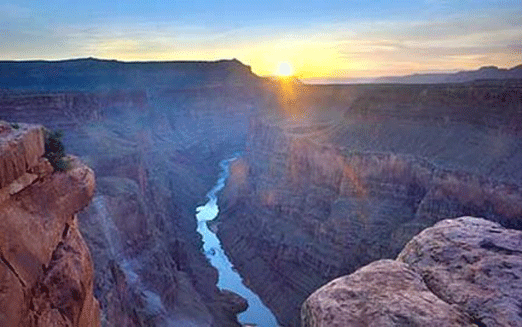
That’s why, as a hydrologist and longtime Grand Canyon hiker, boatman and scientist, I am profoundly concerned about continued uranium mining in or near it. It has great potential to irreparably harm Grand Canyon springs and the plants and animals that depend on them.
I am concerned because industry and agency officials are relying on a justification that isn’t supported by past investigations, research or data to promote uranium mining in the Grand Canyon region. Specifically, they claim that mining will have minimal impact on springs, people and ecosystems there.
Instead, the science shows that it is unreasonable to assume that uranium deposits, when disturbed by mining, can’t leak into groundwater. The deposits in the Grand Canyon are typically found in geologic features known as breccia pipes, formed millennia ago when caves in the main groundwater system collapsed, leaving shattered, rock-filled chimneys that extend upwards thousands of feet to the canyon’s rim. These chimneys act as conduits that have allowed groundwater to move vertically through the rock layers over thousands of years. The vertical movement of groundwater combined with low oxygen levels caused the uranium deposits to form over millennia. Inserting a mine shaft into these features disrupts geologic formations, increases the permeability and oxygenation of these vertical pipes and increases the ability of ore deposits to be suddenly dissolved, mobilized and carried with groundwater.
It is unreasonable to assume that elevated concentrations of dissolved uranium cannot be mobilized and will not reach the Grand Canyon’s springs. It is also risky for industry to assume that mining activities, such as the sinking of mining shafts and pumping of groundwater, have no potential to redirect groundwater movement and negatively impact spring flow and associated wildlife habitats……..
Some mining representatives have implied that the cosmetic fix of cleaning up the surface of old mining sites is evidence of zero subsurface pollution. But because groundwater flow can be very slow, the effects of groundwater contamination may take years, decades or even centuries to fully manifest. The lack of clear and consistent groundwater monitoring undercuts industry claims that mining near the Grand Canyon has caused and will cause no harm……….http://www.theguardian.com/commentisfree/2015/aug/25/uranium-mining-grand-canyon-groundwater-contamination
No comments yet.
1 This month
7 April – WEBINAR – Australia and the Doomsday Clock – Preventing nuclear war through NoFirstUse and other policies
Online | Tuesday April 7, 4:00-5:30pm, Australian Eastern Time / 8:00-9:30am Central Europe Time
– Access the registration link
15 April – Zoom –Nuclear Power is Not the Solution
Apr 15, 2026 01:00 AM in Canberra, Melbourne, Sydney

Join the International Physicians for the Prevention of Nuclear War (IPPNW) on Tuesday, April 14th for a timely webinar exploring the risks associated with nuclear power and challenging the myth that it offers a simple, safe, carbon-free solution to the climate crisis

21 April Webinar: No Nuclear Weapons in Australia
Start: 2026-04-21 18:00:00 UTC Canberra, Melbourne, Sydney (GMT+10:00)
End: 2026-04-21 19:30:00 UTC Canberra, Melbourne, Sydney (GMT+10:00)
Event Type: Virtual
A virtual link will be communicated before the event.
Host Contact Info: australia@icanw.org

of the week – Australians for War Powers Reform (AWPR)
To see nuclear-related stories in greater depth and intensity
 Antinuclear
Leave a comment