Western Australian Labor holds firm to nuclear-free policies
 URANIUM AND THORIUM (nb: from Environment chapter)
- WA Labor believes that:
- Enriching uranium poses significant risks to human health, the natural environment and is not a solution to climate change; and
- Thorium also poses significant risks to human health and the environment.
- In Government, WA Labor will:
- Oppose the mining and export of uranium;
- Oppose nuclear enrichment, nuclear power and otherwise the production of dangerous radioactive waste;
- Oppose the storage of nuclear energy waste in Western Australia;
- Oppose the testing or use of nuclear weapons in Western Australia or near our coastline;
- Encourage local governments to declare themselves ‘Nuclear Free Zones’; and
- Ensure that the mining of thorium in Western Australia only occurs under the most stringent environmental conditions and oppose thorium exports to countries that do not observe the Nuclear Non-Proliferation Treaty.
URANIUM MINING & NUCLEAR ENERGY (nb: from Industry and Regional Development chapter)
- Recognising the problems, hazards and dangers of nuclear power, especially relating to:
- The safety of the nuclear fuel cycle;
- The unsolved problems pertaining to the reprocessing and storage of radioactive wastes and spent plant;
- The growing concern about the biomedical effects of even low radiation;
- The coupling of nuclear energy and nuclear weapon development;
- The added danger of a future plutonium economy and the threats to civil liberties involved in a nuclear economy; and
- The fact that Labor policy contained herein on fossil fuels, energy conservation and renewable resources will ensure Western Australian energy self-sufficiency.
- WA Labor will:
- Reject nuclear power as an option for electricity generation in Western Australia;
- Oppose the establishment of a nuclear enrichment facility in the State;
- Reject the establishment of nuclear processing plants or the storage of nuclear wastes in the State;
- Allow no uranium mining or development in Western Australia; and
- Place thorium under the restrictions and conditions applicable to the mining, processing, sale and transportation of uranium currently mined in Australia as outlined in the Resources and Energy section of the National Platform, so far as they relate to nuclear non-proliferation.
- The platform recognises WA Labor’s long and continuous opposition to Uranium Mining. The commencement and continuation of any uranium project is inconsistent with WA Labor Policy. WA Labor will accept no obligation to complete approval processes or honour contractual arrangements entered into by a previous government where such approvals or contracts are directed towards an outcome inconsistent with WA Labor’s platform.
International Relations:
Support measures that prevent the use of Australian uranium exports in the proliferation of nuclear weapons or environmental degradation
Rosatom now selling uneconomic Honeymoon uranium project in South Australia
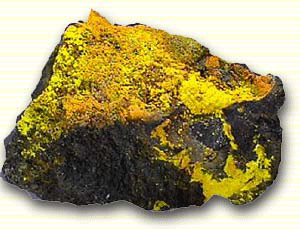
 Rosatom sells Honeymoon uranium mine in South Australia, SMH September 1, 2015 Simon Evans Russia’s state-owned nuclear energy company Rosatom has finally lost patience with the Honeymoon uranium project in northern South Australia and is selling it off to an ASX-listed minnow called Boss Resources.
Honeymoon is one of the five Australian uranium mines in Australia, four of which are located in South Australia, but it has been in mothballs for the past two years because of the plunge in uranium prices which made it uneconomic to continue mining from the site.
The Honeymoon mine is located about 75 kilometres north west of the town of Broken Hill and has been through a series of changes in ownership, the last being a buyout of the Canadian firm Uranium One by the Russian state-owned nuclear company Rosatom. This gave Rosatom ownership of Honeymoon.
Boss Resources chairman Evan Cranston told Fairfax Media on Tuesday that one of the big attractions was the 2600 square kilometre tenement package which came with the project…….
The complex buyout by Boss involves several components including a $2.4 million cash payment, a $200,000 “site access” fee and several milestone payments into the future if the mine does go into production again. http://www.smh.com.au/business/rosatom-sells-honeymoon-uranium-mine-in-south-australia-20150901-gjci9k.html#ixzz3kWS1eIJQ
Australian uranium company Paladin mothballing uneconomic project in Labrador, Canada
Aurora Energy suspending uranium exploration in Labrador, CBC News Company cites low prices for decision to mothball Labrador operation Sep 01, 2015 Aurora Energy has announced it is suspending uranium exploration in Labrador and is blaming lower commodity prices for the decision.
Ches Andersen, Aurora’s vice-president of Labrador affairs, said since there’s no mining underway, the parent company will mothball the Labrador operation…..
Aurora is a member of the Paladin Energy Ltd. Group of Companies, based in Australia.
Lifting of moratorium
The issue of uranium mining in Labrador has been a divisive one.
The Nunatsiavut government narrowly passed a controversial bill to put a moratorium on exploration in place in April 2008. The decision to lift the moratorium was made unanimously late in 2011….http://www.cbc.ca/news/canada/newfoundland-labrador/aurora-energy-suspending-uranium-exploration-in-labrador-1.3209939
The danger to Japanese children, of Cesium-137 ingested in food

I am afraid that there are many Japanese people now living on lands equally  contaminated with radioactive cesium. If Japanese children are allowed to routinely ingest foodstuffs contaminated with Cesium-137, they will likely develop the same health problems that we see now in the children and teenagers of Belarus and Ukraine.
Thus it is very important that we recognize the danger posed to children by the routine ingestion of contaminated food with Cesium-137 where ever they might live. It is also important to prevent further nuclear disasters which release these fiendishly toxic poisons into the global ecosystems. Given the immense amounts of long-lived radionuclides which exist at every nuclear power plant this is an urgent task.
The Implications of The Massive Contamination of Japan With Radioactive Cesium
Steven Starr Senior Scientist, Physicians for Social Responsibility Director, University of Missouri, Clinical Laboratory Science Program Helen Caldicott Foundation Fukushima Symposium New York Academy of Medicine, 11 March 2013 A large number of highly radioactive isotopes released by the destruction of the Fukushima Daiichi nuclear power plant grossly contaminated the Japanese mainland. Most of these radionuclides had short half lives which meant they would essentially disappear in a matter of days or months. For many of those who were exposed to them there will be major health consequences.
However, there were some radioactive elements that will not rapidly disappear. And it is these long-lived radionuclides that will remain to negatively affect the health of all complex life forms that are exposed to them.
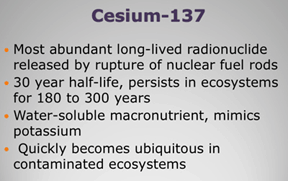 Chief among them is Cesium-137, which has taken on special significance because it is has proven to be the most abundant of the long-lived radionuclides that has remained in the environment following the nuclear disasters at Chernobyl and Fukushima. It has a 30 year radioactive half life which is why it persists in the environment. Scientists now believe that it will be 180 to 320 years before the Cesium-137 around the destroyed Chernobyl reactor actually disappears from the environment. Continue reading
Hanford. 25 years and $billions later, not one drop of nuclear waste has been treated
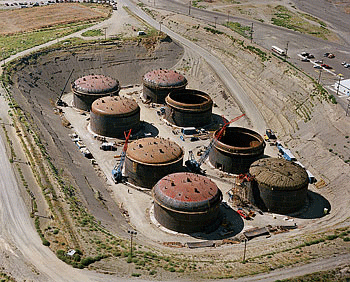 The Waste Treatment and Immobilization Plant project there, known as WTP, is meant to exhume the waste, freeze it in glass, and give it a proper burial. But it’s been plagued by delays. It was expected to cost $4.3 billion and be built by 2011. Instead, the cost has swelled past $12 billion to date, with an estimated $7 billion in work left to be done. So far, not a drop of waste has been processed.
Nuclear cleanup project haunted by legacy of design failures and  whistleblower retaliation, Center for Public Integrity, Twenty-five years after the project began, the Waste Treatment and Immobilization Plant at Hanford is nearing a three-fold cost overrun, and not a single drop of waste has been treated By Patrick Malone 2 Sept 15
But it hasn’t fully turned the corner yet, according to recent comments by the federal officials now overseeing its operation. Continue reading
Child soldiers in Neo Nazi Unit in Ukraine
Military Training for Young Children at Ukraine’s “Neo-Nazi Summer Camp”. Recruitment of Ukraine’s “Child Soldiers” Financed by US “Nonlethal” Military Aid?, Global Research [excellent photos] By Prof Michel Chossudovsky Global Research, August 30, 2015 Unknown to most Americans, the US government is channeling financial support, weapons and training to a Neo-Nazi entity –which is part of The Ukraine National Guard– The Azov Battalion (Батальйон Азов). Canada and Britain have confirmed that they also are providing support to the National Guard.
Continue reading
Monitoring Fukushima radiation in Pacific Ocean: no clear evidence of harmful effects on marine animals
So, yes, and no. No definitive conclusion, no clear argument that radiation is the cause of those coastal events which distress us so. There is no solace in uncertainty, just as there is no certainty without evidence.
 Radiation in the Ocean http://www.huffingtonpost.com/peter-neill/radiation-in-the-ocean_b_8072914.html?ir=Australia Peter Neill Director, World Ocean Observatory The West Coast of the United States seems under siege by negative environmental news: earthquake predictions, oil spills, drought, critically diminished water supply, wildfires, and numerous accounts of unusual coastal events: algae blooms, whale strandings, cancer in seals, collapse of fish stocks, and more.
How to explain? Well, much of this can be attributed to climate factors where rising temperatures have resulted in multiple inter-related consequences: limited glacial melt, increased evaporation, no water, dry land, and the inevitable fire darkening that pristine Pacific air with smoke and ash the length of the coast.
The ocean phenomena may be different. The warming of the ocean surely has an impact on changing growth patterns of marine plants and animals, just as the changing pH or acidity of the ocean has been shown to modify habitat and migrations. But what else?
 One argument has been the effect of radiation leaking from the three nuclear power plant reactors shut down by the earthquake and resultant tsunami tidal wave that inundated Fukushima, Japan in 2011, and has been thereafter distributed by ocean currents; indeed there is evidence of a plume of increased concentration of Cesium-134, and other radioactive elements that have been observed at unprecedented levels, spreading out some 5,000 miles into the Pacific toward North and South America. Continue reading
Indigenous Americans, Lakota Nation, fighting uranium mining
Oglala Sioux object to uranium mine cultural survey BY KERRI REMPP / CHADRON DAILY RECORD , 1 Sept 15 CRAWFORD — A full week of testimony on renewing Crow Butte Resources’ uranium mining license wrapped up last week with objections by the Lakota Nation to a planned cultural and archeological survey.

Crow Butte’s operating license expired in 2007, and it has been operating on a temporary license since then while the Nuclear Regulatory Commission reviewed its renewal application. The NRC granted the renewal last fall, but because the Oglala Sioux Tribe and 11 other people and organizations objected, the Atomic Safety Board scheduled its own hearings and will render a final decision at a later date.
Friday’s testimony concerned cultural and archeological surveys at the Crow Butte mine site near Crawford. The Oglala Sioux Tribe contended that the Nuclear Regulatory Commission failed to include its members in discussions and did not allow for an adequate survey of the site…….
Testimony throughout the rest of the week focused mainly on water safety, both in the Nebraska Panhandle and on the Pine Ridge Reservation.
Charmaine White Face testified for the Oglala Sioux and consolidated interveners that samples from five reservation wells taken in 2014 show, in her opinion, an unusual level of mined uranium and thorium, though she admitted she had no evidence that the contamination was caused by Crow Butte Resources. Likewise, Debra White Plume testified, “I have no evidence in terms of western science that the contamination is from Crow Butte Resources, but I know what I know.”
Additional testimony will be heard during a telephonic hearing at a later date. Crow Butte Resources Inc. is owned by Cameco Resources, America’s biggest uranium mining company, based in Saskatoon, Saskatchewan. http://journalstar.com/news/state-and-regional/nebraska/oglala-sioux-object-to-uranium-mine-cultural-survey/article_2deb035c-8686-54b4-a6ce-587911b303bd.html
Women in Nuclear for Climate – a new nuclear lobby push for getting nuclear into the Paris programme
 Women in Nuclear for Climate http://www.world-nuclear-news.org/NP-Women-in-Nuclear-for-Climate-0109151.html 01 September 2015 Women in Nuclear (WiN) has leant its support to a civil society campaign for nuclear energy to be recognised as a low-carbon option for fighting climate change.
At the organisation’s global annual conference in Vienna last week, WiN president and vice president, Se-Moon Park and Dominique Moillot, put their names to a declaration asserting that every country should have access to the widest possible portfolio of low-carbon technologies – including nuclear power – in order to reduce emissions and meet energy goals.
WiN requested that the UNFCCC “recognise nuclear energy as a low-carbon energy option”, in its protocols, and include it in its climate funding mechanisms, “as is the case for all other low-carbon energy sources”. The organisation pledged to bring this to the attention of the conference to take place in Paris in December.
By pledging support for the Nuclear for Climate movement on behalf of its 25,000 members, WiN joined the European Nuclear Society Young Generation Network and 39 other associations of nuclear scientists, engineers and professionals, including the French Nuclear Energy Society which leads the campaign. WiN’s global membership means that individual nuclear experts from more than 102 countries are now in support of Nuclear for Climate.
India pushing to hurry up uranium purchases from Australia
 India pushes for early implementation of nuclear deal with Australia, Economic Times By PTI | 1 Sep, 2015 NEW DELHI: India today conveyed to Australia its eagerness to conclude negotiations for early implementation of the bilateral nuclear deal besides pushing for joint production of defence equipment.
Both Swaraj and Andrews also discussed first ever naval joint exercise to be held later this month at the Bay of Bengal. …….http://economictimes.indiatimes.com/articleshow/48764027.cms?utm_source=contentofinterest&utm_medium=text&utm_campaign=cppst.
Australia, India hold naval exercise, ramping up tensions in Indian Ocean
Australia, India to Hold First Ever Naval Exercise Amid China Concerns ( Source- The Diplomat / Author- Prashanth Parameswaran) September 1, 2015, Manoj Ambat, Prashanth Parameswaran
Virginia Beach City Council again says NO to uranium mining
 Another no vote on uranium The Virginian-Pilot September 1, 2015 The Virginia Beach City Council is set tonight to vote — again — on a resolution opposing uranium mining in Virginia.
The issue is still, thankfully and for all practical purposes, dead. Mining uranium is still illegal in the commonwealth. The General Assembly’s 1982 ban is still in place despite years of extensive lobbying by the company wanting to mine ore in Pittsylvania County.
But because Virginia Uranium Inc. has recently challenged the legality of the ban and asked the federal courts to force the state to treat uranium mining like any other mining process, Virginia Beach is making doubly sure everyone knows the city opposes lifting the ban.
The Roanoke River Basin Association, which is downstream from the Virginia Uranium site, does, too. As do the cities of Norfolk, Chesapeake, Roanoke and Danville. The mining site is less than 50 miles upstream of the John H. Kerr Reservoir, which provides 93 percent of Lake Gaston’s inflow — a source of drinking water for much of South Hampton Roads. If Kerr Reservoir were contaminated, then Lake Gaston would be as well……..http://hamptonroads.com/2015/08/another-no-vote-uranium
September 1st, Wattle Day, should be our new Australia Day
Wattle Day, [September 1st]on the other hand, acknowledges the natural beauty of this land, which, like Aboriginal and Torres Strait Islander people, is ancient. This would be more sensitive to indigenous peoples, and it would bring unity, in celebrating the natural beauty of our lands and waters.
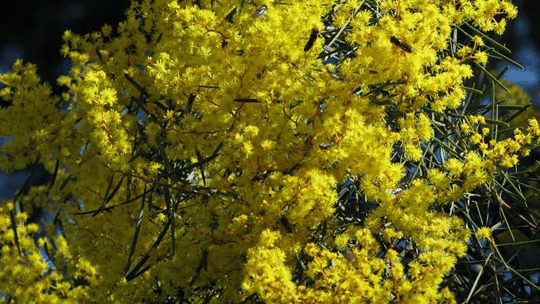
Why today should be Australia Day, news.com.au SEPTEMBER 01, 2015 Is there any more Australian sign of spring than wattle trees blossoming across the country, our nation al flower’s bright yellow blooms against the green of its leaves, the inspiration for our Australian colours of green and gold?
Acacia pycnantha, otherwise known as Golden Wattle, has earned its status as our national floral emblem: it symbolises May Gibbs’ Little Ragged Blossom; the green and gold garb of our cricket team; it signifies the golden sands of our beaches and the green of our gum trees.
This and many other reasons, is why Australia Day, our national celebration of who we are as a nation, should move from January 26 to September 1 — Wattle Day. The first of September is the first day of Spring, marking a time of birth, fresh beginnings….
Instead, we officially celebrate Australia Day on January 26. For our First Peoples, this is hardly a day to celebrate. It marks the day in 1788 that Captain Arthur Phillip invaded the Eora Nation, landing in Sydney Harbour and claiming the lands of indigenous peoples in the name of the British Empire. It marks the start of 227 years of suffering and loss, massacres of hundreds of thousands of people, and of the removal of tens of thousands of children from their mothers’ arms.
It is the height of insensitivity and hypocrisy to celebrate Australia’s nationhood on such a date, and Aboriginal and Torres Strait Islander peoples have voiced their protest to it since the 1880s………
Wattle Day, on the other hand, acknowledges the natural beauty of this land, which, like Aboriginal and Torres Strait Islander people, is ancient. This would be more sensitive to indigenous peoples, and it would bring unity, in celebrating the natural beauty of our lands and waters.
Changing the date of Australia Day is possible. We only have to look to the USA for inspiration, where the similarly insensitive ‘Columbus Day’ is no longer observed in Hawaii, South Dakota, Alaska and Oregon. South Dakota has actually changed the day to ‘Native American Day’ and the city of Berkeley in California, followed by a number of other cities, renamed it ‘indigenous Peoples’ Day’.
The last time changing the date was discussed on a political level was in 2009 when Mick Dodson was named Australian of the Year. He used the opportunity to urge national debate on changing the date of Australia Day, saying that the use of January 26 as Australia Day alienates Aboriginal and Torres Strait Islander people…….
>National symbols matter, and it is time for us to celebrate as a nation in a way that unites rather than divides us, under the green and golden branches of the wattle tree.
Tammy Solonec is indigenous Peoples’ Rights Manager for Amnesty International Australia. http://www.news.com.au/lifestyle/real-life/why-today-should-be-australia-day/story-fnixwvgh-1227507268253
Australia’s electricity retailers not investing in renewable eneregy projects
 Renewable investment drought to continue as utilities extend buyers’ strike, REneweconomy, By Giles Parkinson on 31 August 2015 The investment drought that has plagued the Australian large-scale renewable energy industry for the last two years could extend for another six to 18 months, with big and small electricity retailers showing no interest in contracting new wind or solar projects.
Infigen Energy said on Monday that the deal to cut the large-scale renewable energy target from 41,000GWh to 33,000GWh has yet to have any impact on the market, or to send a signal to retailers to contract new construction.
Infigen CEO Miles George says it could be six to 18 months before retailers will start to act. “The big three are in no hurry to contract now,” he told a conference call on Monday for the release of its annual results.
This confirms the indications from Origin Energy, AGL Energy and EnergyAustralia in recent weeks that they were not interested in writing long-term pricing contracts, either because of perceptions about the policy environment in Australia or because they had enough renewable energy certificates on their books.
Renewable energy investment in Australia plunged nearly 90 per cent since the election of the Abbott government, and even after the slashing of the RET the only projects going ahead now are those supported by the ACT government’s own renewable energy scheme (Ararat, Coonooer Bridge and Hornsdale).
Some big turbine manufacturers may enter the market on a “merchant basis” – taking the price risk – because they have the balance sheet to do so. This includes Suzlon’s Ceres project in South Australia and Goldwind’s project in NSW, and Infigen says it recently sold stakes in two wind projects with an unnamed wind turbine supplier with a mind to do the same thing.
The only other activity in the market has come from Queensland, where Ergon Energy has called for a tender for 150MW of renewable energy and the Queensland government has foreshadowed a tender for 40MW; and in Victoria, which has announced an initiative that may get a small number of wind turbines built.
In the meantime, the renewable energy developers are virtually hamstrung. Infigen Energy, despite the sale of its US wind and solar assets, remains loaded down with relatively high debt levels, so can’t develop projects on its own.
Pacific Hydro, the other major Australian developer, is up for sale and not in the construction market. Meridian Energy, the $5 billion New Zealand renewable energy giant, says it is not interested in investing in new wind farms in Australia as long as it is run by a government which does not like renewable energy…….
The federal government has commissioned the Clean Energy Regulator to do a regular update on the state of the market. The first one is due in April.
The industry is hopeful that this could be used as an incentive to push the industry along. But some fear – given the rhetoric from the Abbott government about renewable energy – that it could be used as an excuse to further weaken the target, despite the government’s promise not to do so before 2020.
Infigen reported a net loss of $304 million as it took a major hit from the write down of its US wind assets, which it sold to reduce its debt burden. It said wind conditions had been particularly poor in the last financial year, but were expected to improve. http://reneweconomy.com.au/2015/renewable-investment-drought-to-continue-as-utilities-extend-buyers-strike-28325
Climate denying politicians “not fit to lead” – says President Obama
 President Barack Obama attacks climate change denying politicians as not being fit to lead, ABC Radio Will Ockenden reported this story on Tuesday, September 1, 2015 ELEANOR HALL: The president of the United States has issued a warning to other world leaders about the need to act urgently to reduce carbon emissions.Barack Obama says climate change is happening faster than efforts to fix it and that any world leader unwilling to take the problem seriously is “not fit to lead”.The US president says, while there should be debate on the best way to address climate change, the science on global warming is settled and the time to act is now.
Will Ockenden reports.
WILL OCKENDEN: President Barack Obama says the world has reached a fork in the road on climate change.
One route is to continue on, without doing anything.
BARACK OBAMA: There’s not going to be a nation on this Earth that’s not impacted negatively. People will suffer. Economies will suffer. Entire nations will find themselves under severe, severe problems; more drought, more floods, rising sea levels, greater migration, more refugees, more scarcity, more conflict.
WILL OCKENDEN: The other, a global agreement to cut emissions.
BARACK OBAMA: The other path is to embrace the human ingenuity that can do something about it. The time to heed the critics and the cynics and the deniers is past. The time to plead ignorance is surely past. Those who want to ignore the science, they are increasingly alone; they’re on their own shrinking island.
WILL OCKENDEN: President Obama’s comments were addressed at the opening of the GLACIER conference in Anchorage, Alaska.
GLACIER stands for Global Leadership in the Arctic: Cooperation, Innovation, Engagement and Resilience.
The comments come ahead of a key meeting, the United Nations Climate Change Conference, which is scheduled to be held in Paris in December…..http://www.abc.net.au/worldtoday/content/2015/s4303846.htm
1 This month

of the week – Australians for War Powers Reform (AWPR)
To see nuclear-related stories in greater depth and intensity
 Antinuclear