Will Tony Abbott ignore the cautionary message of committee on uranium sales to India?
 India uranium red-light a test for Tony Abbott, SBS News, 8 Sept 15, While Prime Minister Abbott and Foreign Minister Bishop have been strong supporters of selling Australian uranium to India, many others, including key Australian diplomats and insiders, remain far more circumspect. By Dave Sweeney
 The JSCOT report followed a detailed examination and expert testimony and states that while the federal government can ratify the deal it must not advance uranium sales or supply to India before key checks and balances are put into practice and proven to work.
In short, the committee charged with advising the government on Indian uranium sales has reached the unambiguous conclusion that the government can sign but not sell.
The question now is whether the Abbott government will follow due parliamentary process and act in the public interest or will it ignore these concerns and JSCOT’s advice and seek to fast-track the agenda of the under-performing uranium sector?
When Prime Minister Tony Abbott signed a uranium deal with Indian Prime Minister Narendra Modi in New Delhi in September 2014, he praised India’s “absolutely impeccable non-proliferation record”. Yet India’s record on nuclear proliferation tells another story. India acquired its nuclear arsenal by breaking a promise not to use a Canadian reactor for military purposes. It remains outside the globe’s key non-proliferation frameworks and the region remains on nuclear high alert amid tensions with nuclear rival Pakistan.
Instead of addressing real questions about India’s nuclear weapons program and inadequate nuclear safety standards Mr Abbott resorted to cricketing clichés, declaring that Australia and India trust each other on issues like uranium safeguards because of “the fundamentally ethical principle that every cricketer is supposed to assimilate – play by the rules and accept the umpire’s decision”.
The JSCOT process received strongly critical submissions from a who’s who of nuclear arms control diplomats and experts including John Carlson (former long serving Director-General of the Australian Safeguards and Non-Proliferation Office from 1989 to 2010), Ron Walker (former Chair of the International Atomic Energy Agency, Prof. Lawrence Scheinman (former Assistant Director of the US Arms Control and Disarmament Agency). These are veteran players in global nuclear diplomatic and regulatory regimes, not anti-nuclear activists.
Nuclear arms control expert Crispin Rovere noted that “this treaty appears less like the deepening of a bilateral partnership and more like one of a client state being dictated to in an expanded Indian empire. It is a major display of weakness on the part of the Australian Government, and a failure to stand up for Australia’s national interests in this area”.
One thing we can all agree on is that Australia has a key role to play in supporting India’s legitimate energy aspirations, but this cannot be advanced by a retreat from responsibility on nuclear safeguards and security. The government must read and heed the JSCOT report and Australia’s uranium must remain away from India’s nuclear reactors and weapons – to do otherwise would be profoundly irresponsible.
JSCOT has just clean bowled this dangerous and deeply deficient sales plan. Mr Abbott must now heed his own words, “accept the umpire’s decision” and start the long walk back to pavilion for a serious re-think. http://www.sbs.com.au/news/article/2015/09/08/comment-india-uranium-red-light-test-tony-abbott
Public hearings with #NuclearCommissionSAust
 Nuclear commission in public hearings http://www.9news.com.au/national/2015/09/09/03/36/nuclear-commission-in-public-hearings Economist Ross Garnaut will be the first witness to appear at public hearings for South Australia’s royal commission into the nuclear fuel cycle.
Mr Garnaut will appear in Adelaide on Wednesday with his evidence to centre on climate change predictions and the opportunities that presents for future energy policy.
He will be followed by Anna Skarbek, from climate change research group Climate Works Australia, and University of Queensland economics professor John Quiggin, a member of the Climate Change Authority.
The royal commission is examining every aspect of the nuclear fuel cycle from the mining of uranium to the use of nuclear power and the disposal of nuclear waste.
Commissioner Kevin Scarce will continue his public hearings until mid-December and then present his report to the state government next year.
The neglected importance of INTERNAL emitters of ionising radiation
 Tracking & Mitigating Radiation Poisoning from the Inside Out August 29th 2015, Green Med Info, By: Beth Ellen DiLuglio, MS, RDN, CCN, LDN This article focuses on internal exposure to ionizing radiation, its detrimental effects on health, and what nutrition-related steps you can take to reduce exposure and absorption in the body…….
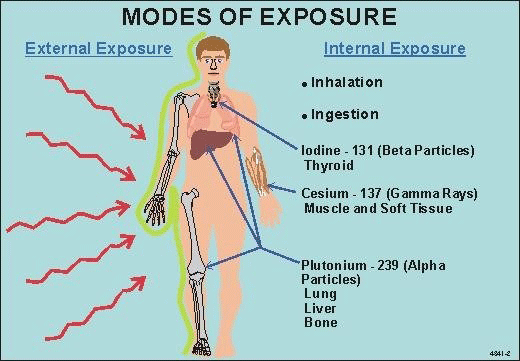 Internal IrradiationIt is important to point out that ingestion of radioactive elements can be more insidious than exposure to “background” radiation or external X-rays. Radioactive elements may enter the body through eating, drinking, inhalation, or absorption through the skin.[52][53][54]Radioactivity in drinking water has been significantly associated with cancer incidence.[55]
Following the path of essential nutrients, the radioactive imposters settle in bones, tissues, and organs and emit ionizing radiation powerful enough to steal electrons from surrounding molecules. This free-radical activity can then impair cell membranes, break up cell nuclei, damage cellular DNA, and wreak havoc on cells and organs.[56]………
Internal exposure to ionizing radiation is prolonged when radioactive elements are incorporated into living tissue, though the World Health Organization assures us that “internal exposure stops when the radionuclide is eliminated from the body.”[62]However if radioactive elements remain in tissues and are not eliminated, the radioactivity of these elements can persist for extensive periods of time due to their prolonged half-life. The half-life of a radioactive element is “the time that it takes for one half of the atoms of that substance to disintegrate into another nuclear form…”[63]It does not necessarily mean that half the radioactivity is eliminated. For example uranium-238 (used in nuclear weapons) has a half-life of 4.5 billion years. It decays into radium-226 (half-life of 1600 years) which then decays into radon-222 (half-life of 3.82 days). Strontium-90 (Sr-90) decays into yttrium-90, and so on. The decay products themselves continue to be radioactive and maintain their own half-lives.[64][65]
| Radioisotope Emitted
|
Half-Life | Essential Nutrient Mimicked | Tissue Affected |
| Iron-55 | 2.6 years | Iron | Red blood cells |
| Barium- 137
Cesium-137 |
2.5 minutes
30 years |
Potassium | Kidney, muscle
Endocrine glands, pancreas, thymus, heart |
| Carbon-14 | 5730 years | Carbon | Bone |
| Cobalt-58
Cobalt-60 |
71.3 days
5.3 years |
Vitamin B12 | Liver, kidney, bone
Ovaries |
| Iodine-129
Iodine-131 |
15.7 million years
8.1 days |
Iodine | Thyroid
Ovaries |
| Phosphorus-32, 33 | 14.3-25 days
|
Phosphorus | Bone |
| Plutonium-238
Plutonium-239 |
87.7 years
24,4000 years |
Iron | Liver, ovaries, bone |
| Strontium-89
Strontium-90 |
52 days
29 years |
Calcium | Bone, nerve and muscle cells |
| Sulfur-35 | 87daus | Sulfur | Skin |
| Uranium-237
Uranium-238 |
6.8 days
4.5 billion years |
Lungs, bone
Liver, bone |
|
| Yttrium-90 | 64 hours | Bone, pancreas,
reproductive organs |
|
| Zinc-65 | 245 days | Zinc | Bone, reproductive organs |
Ionizing Radiation and Children
Ionizing radiation can be especially damaging to the embryo, fetus, and growing child. Continue reading
Joint Standing Committee on Treaties (JSCOT) not happy with plan to sell uranium to India
Caution urged on uranium sales to India, Herald Sun September 8, 2015 THE government needs to consider greater safeguards and stronger diplomatic efforts before Australia sells uranium to India, a new report says. THE treaties committee report, tabled in parliament on Tuesday, said India should be encouraged to become a party to the comprehensive test ban treaty and separate its civil and military nuclear facilities.Uranium should not be sold to India until it puts in place an independent nuclear regulator and best practice safety inspections of nuclear facilities, the report said.Committee chairman, Liberal MP Wyatt Roy, said in the report there were some “significant risks” to selling uranium to India.India was outside the “nuclear non-proliferation mainstream” and Australia should use all diplomatic steps to ensure it signed the Nuclear Non-Proliferation Treaty.There were weaknesses in the way India’s nuclear facilities are regulated “that jeopardise nuclear safety and security”.
“The committee has made a recommendation that the sale of uranium to India only commence when these weaknesses have been addressed,” Mr Roy said……..Two Labor members of the committee said the full separation of India’s civil and military nuclear facilities and the setting up of a new independent watchdog should be done before the treaty is ratified.The majority committee view was that these two matters should be addressed after ratification.”We consider it essential that any nuclear agreement with India should be at least as rigorous as all the agreements Australia has concluded with other countries,” Labor’s Melissa Parke and Sue Lines wrote.Greens senator Scott Ludlam said the deal should not go ahead.”It puts the interest of a small and marginal industry ahead of global security,” he said……..http://www.heraldsun.com.au/news/breaking-news/australias-india-uranium-deal-report-due/story-fni0xqi4-1227517124640
USA’s Nuclear Regulatory Commission stops its epidemiological study in cancer near #nuclear facilities
USA’s Nuclear Regulatory Commission doesn’t want epidemiological studies to continue on cancer in populations near nuclear facilities. So they stopped this one.
 I wonder what the world’s lung cancer status would be like, if government had stopped Sir Richard Doll’s iconic epidemiological study into lung cancer in populations of smokers.
NRC: Studying Cancer Risks In Populations Near Nuclear Plants ‘Impractical’
The Oyster Creek Nuclear Generating Station in Lacey Township was included in two pilot studies. Lacey PatchBy PATRICIA A. MILLER (Patch Staff)
September 8, 2015 The federal Nuclear Regulatory Commission has abandoned a National Academy of Sciences pilot study of cancer risks in people who live near nuclear plants in the United States, including the Oyster Creek Nuclear Generating Station in Lacey Township,
“The NRC determined that continuing the work was impractical, given the significant amount of time and resources needed and the agency’s current budget constraints,” according to an NRC release……
according to the NRC. ”We’re balancing the desire to provide updated answers on cancer risk with our responsibility to use Congressionally-provided funds as wisely as possible.”
But Janet Tauro – chair of Clean Ocean Action and a founding member of Grandmothers, Mothers and More for Energy Safety – is outraged at the NRC’s decision.
“We really think they (NRC) are petrified by the results,” Tauro said today. ”There is no safe dose of continuous radiation. This is what we’ve been talking about. It’s cumulative. It’s a cocktail of radioactive release contributions and it gets into the environment.”……..
”The National Academy of Sciences estimated it might take it 8 to 10 years to complete the pilot study and subsequent nationwide studies before the NRC had final cancer risks to share with the public. That would possibly prolong the study to 2025 – 15 years after the start of the project with the National Academy.”
But Tauro said the study should be completed, no matter how long it takes and how much it costs.
“Big deal,” she said. ”They should have spent more and sent the bill to Exelon (Oyster Creek’s owner) and other nuclear facilities. This is outrageous.”
The idea behind the study was to update available information on cancer risks near U.S. nuclear power facilities. The last such study was done by the National Cancer Institute (NCI) and was issued in 1990…….. http://patch.com/new-jersey/lacey/nrc-studying-cancer-risks-populations-near-nuclear-plants-impractical-0
Big Solar Power: Australian Renewable Energy Agency and the Clean Energy Finance Corporation
 Large scale solar plants get $350m push, The Age, September 9, 2015 –Mathew Dunckley BusinessDay Editor Australia will get up to 10 new large solar power stations as part of an unprecedented $350 million tie-up between two major government renewable energy agencies.
As part of a new funding round the Australian Renewable Energy Agency and the Clean Energy Finance Corporation will collaborate to offer, respectively, grants and loans to get major solar projects off the ground to feed into the energy grid.
It is understood some state governments have also signalled they will financially support bids for projects in their jurisdictions potentially through long term offtake agreements. Continue reading
Climate Change: Australia seen as Bad Big Brother- Pacific Island Forum
 Pacific Islands Forum: Australia may be asked to leave group unless action taken on climate change http://www.abc.net.au/news/2015-09-08/australia-may-be-asked-to-leave-the-pacific-islands-forum/6759914 By Papua New Guinea correspondent Liam Cochrane Australia has been warned it could be asked to leave the Pacific Islands Forum (PIF) if it does not start supporting stronger action on climate change.
Kiribati president Anote Tong warned people in the region would have to flee in waves similar to the current migrant crisis in Europe unless stronger action was taken to reduce emissions.
“I think it would be incumbent on them because how relevant [would] their presence be,” he said.
“We expect them as a our big brothers, not bad brothers, our big brothers to support us on this one.”
Australia and New Zealand are the two most economically powerful members of the PIF, which is meeting this week in Port Moresby.
Pacific nations have called to limit global temperature increases to 1.5 degrees Celsius, saying the current goal of 2 degrees above the pre-industrial level would push many beyond their ability to adapt.
Mr Tong’s comments follow similar remarks he made on Monday that Australia and New Zealand should show they were “real friends” by supporting more action on climate change.
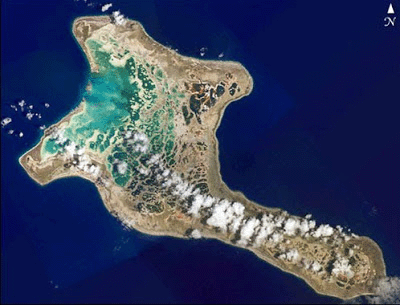
Kiribati, with its population of 110,000 spread across 33 low-lying islands, is particularly vulnerable to climate change.
Prime Minister Tony Abbott will travel to Port Moresby on Wednesday and will take part in the main PIF leaders retreat on Thursday. On Tuesday, Mr Tong invited Mr Abbott to visit Kiribati to see the impacts of climate change for himself. “I’d love for him to have him come and stay for the rest of his life,” he said.
Pacific nations are expected to called for a ban on new coal mines and more ambitious targets for limiting global temperature rise when leaders meet at the regional summit on Thursday.
The top postcodes making money from solar

The postcodes at the front-line of the solar revolution are not where you’d think…. (subscribers only)
http://www.afr.com/news/politics/the-top-100-postcodes-making-money-from-solar-20150903-gjelpl
Netherlands plans to have a 100% wind-powered railway system by 2018 #Auspol

With each passing week, renewable energy makes greater and greater strides in supplying more power for our lives, and a lot of that innovation is happening in transport. The Netherlands is the latest country to set the pace for adopting alternative energy sources: the companies in charge of the country’s railways are looking to move the entire network over to wind power in the next three years.
Dutch energy company Eneco has just approved a deal to meet that target with the VIVENS rail firms in the country, Gizmodo reports. Wind power already supplies energy for half of the network – some 2,890 km (1,800 miles) of track – so Eneco has until 2018 to source the rest from the Netherlands and its neighbours. The proposed scheme is partly intended to increase renewable energy adoption in other European nations too.
“What makes this contract and partnership unique is that a…
View original post 340 more words
1 This month
15 April – Zoom –Nuclear Power is Not the Solution
Apr 15, 2026 01:00 AM in Canberra, Melbourne, Sydney

Join the International Physicians for the Prevention of Nuclear War (IPPNW) on Tuesday, April 14th for a timely webinar exploring the risks associated with nuclear power and challenging the myth that it offers a simple, safe, carbon-free solution to the climate crisis

of the week – Australians for War Powers Reform (AWPR)
To see nuclear-related stories in greater depth and intensity
 Antinuclear