The neglected importance of INTERNAL emitters of ionising radiation
 Tracking & Mitigating Radiation Poisoning from the Inside Out August 29th 2015, Green Med Info, By: Beth Ellen DiLuglio, MS, RDN, CCN, LDN This article focuses on internal exposure to ionizing radiation, its detrimental effects on health, and what nutrition-related steps you can take to reduce exposure and absorption in the body…….
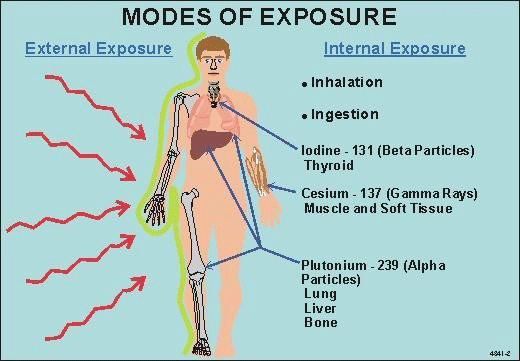 Internal IrradiationIt is important to point out that ingestion of radioactive elements can be more insidious than exposure to “background” radiation or external X-rays. Radioactive elements may enter the body through eating, drinking, inhalation, or absorption through the skin.[52][53][54]Radioactivity in drinking water has been significantly associated with cancer incidence.[55]
Following the path of essential nutrients, the radioactive imposters settle in bones, tissues, and organs and emit ionizing radiation powerful enough to steal electrons from surrounding molecules. This free-radical activity can then impair cell membranes, break up cell nuclei, damage cellular DNA, and wreak havoc on cells and organs.[56]………
Internal exposure to ionizing radiation is prolonged when radioactive elements are incorporated into living tissue, though the World Health Organization assures us that “internal exposure stops when the radionuclide is eliminated from the body.”[62]However if radioactive elements remain in tissues and are not eliminated, the radioactivity of these elements can persist for extensive periods of time due to their prolonged half-life. The half-life of a radioactive element is “the time that it takes for one half of the atoms of that substance to disintegrate into another nuclear form…”[63]It does not necessarily mean that half the radioactivity is eliminated. For example uranium-238 (used in nuclear weapons) has a half-life of 4.5 billion years. It decays into radium-226 (half-life of 1600 years) which then decays into radon-222 (half-life of 3.82 days). Strontium-90 (Sr-90) decays into yttrium-90, and so on. The decay products themselves continue to be radioactive and maintain their own half-lives.[64][65]
| Radioisotope Emitted
|
Half-Life | Essential Nutrient Mimicked | Tissue Affected |
| Iron-55 | 2.6 years | Iron | Red blood cells |
| Barium- 137
Cesium-137 |
2.5 minutes
30 years |
Potassium | Kidney, muscle
Endocrine glands, pancreas, thymus, heart |
| Carbon-14 | 5730 years | Carbon | Bone |
| Cobalt-58
Cobalt-60 |
71.3 days
5.3 years |
Vitamin B12 | Liver, kidney, bone
Ovaries |
| Iodine-129
Iodine-131 |
15.7 million years
8.1 days |
Iodine | Thyroid
Ovaries |
| Phosphorus-32, 33 | 14.3-25 days
|
Phosphorus | Bone |
| Plutonium-238
Plutonium-239 |
87.7 years
24,4000 years |
Iron | Liver, ovaries, bone |
| Strontium-89
Strontium-90 |
52 days
29 years |
Calcium | Bone, nerve and muscle cells |
| Sulfur-35 | 87daus | Sulfur | Skin |
| Uranium-237
Uranium-238 |
6.8 days
4.5 billion years |
Lungs, bone
Liver, bone |
|
| Yttrium-90 | 64 hours | Bone, pancreas,
reproductive organs |
|
| Zinc-65 | 245 days | Zinc | Bone, reproductive organs |
Ionizing Radiation and Children
Ionizing radiation can be especially damaging to the embryo, fetus, and growing child. Critical periods of development can be irreversibly disrupted, leading to altered functioning of the brain, nervous system, cardiovascular system, etc. According to the CDC, “the human embryo and fetus are particularly sensitive to ionizing radiation, and the health consequences of exposure can be severe, even at radiation doses too low to immediately affect the mother. Such consequences can include growth retardation, malformations, impaired brain function, and cancer.”[66][67]Ionizing radiation, specifically strontium-90, appears to be associated with low birth weight. “The 1945-1965 rise in the percentage of live births below 2500 grams is highly correlated with the amount of strontium-90 in human bone, both peaking in the mid-1960s.”[68]
Children are highly susceptible to the negative health effects of ionizing radiation, cancer in particular.[69][70][71][72][73][74][75][76][77][78]Exposure to radioactive iodine following nuclear accidents is significantly associated with childhood thyroid cancer.[79][80]Other cancers, including leukemia, were more prevalent in young children exposed to radioactive waste/fallout (e.g. from the Three Mile Island and Chernobyl nuclear accidents). There is increased incidence of cancer in children under age 10 living near nuclear power plants; a trend that was correlated with levels of strontium-90 in their baby teeth.[81]Children who were exposed to ionizing radiation in infancy had a dose-response reduction in learning ability and logical reasoning later in life.[82]Research suggests that if the relationship between age of exposure and dose-risk are not taken into account when attempting to calculate health effects from radiation exposure, then total lifetime risk will be grossly underestimated.[83]
Measuring Radioactive Elements in the Environment, Food, and Water
The potential for radioactivity to enter the human food and drinking water supply following accidental or incidental environmental release is well recognized. Radioactivity measured in drinking water has been found to correlate significantly with cancer incidence.[84]Computer models have been developed in an effort to estimate contamination levels for a variety of scenarios.[85][86][87][88][89][90]………..
Radioactive Iodine
Monitoring for radioactive iodine is crucial following a nuclear accident due to its role as a causative agent in thyroid cancer. Unfortunately, routine monitoring includes only the short-lived radioactive iodine-131 and not iodine-129 which has a half-life of 15.7 million years.[124]Reporting only iodine-131 allows officials to claim that most radiation following a nuclear accident will dissipate in a relatively short period of time. Of course this is not the case with the long-lived iodine-129. Oddly in the 1970s when the EPA attempted to project radiation exposure from nuclear power operations, their report did address iodine-129, acknowledging that it has a half-life of millions of years.[125]The EPA continues to recognize the serious nature of iodine-129 contamination from processing and storing of spent nuclear fuel and weapons[126]but doesn’t require that it be monitored following nuclear accidents. There is a strong correlation between soil levels of iodine-131 and iodine-129, begging the question of why iodine-129 isn’t monitored over time following all nuclear accidents.[127]Nuclear processing plants and waste storage facilities routinely release “low levels” of iodine-129 into the environment as well.[128]
Measuring Ionizing Radiation and Exposure in the Body
Radioactive elements may be measured in air, food, water, and human tissue. Though measurement of air and water is convenient, [129]it does not reflect the bioaccumulation (buildup in living tissue)[130]of radioactive elements that occurs with acute and chronic exposure. Measurement in human tissue best reflects how much we are actually absorbing and retaining. In-body measurement of radioactive elements has not been done extensively although when carried out, it has been quite revealing………
Dr. Sternglass cofounded the Radiation and Public Health Project (RPHP) with Dr. Jay Gould (author of The Enemy Within: The High Cost of Living Near Nuclear Reactors).[145]The research group developed The Tooth Fairy Project (a parallel to the 1950s St. Louis Baby Teeth Study) and conducted modern-day measurement of Sr-90 in baby teeth 1998-2006.[146][147]I had the privilege of meeting Dr. Sternglass in 1997 and he graciously invited me to become involved in research for The Tooth Fairy Project. Project data demonstrated that in areas around nuclear power plants, Sr-90 levels in baby teeth were as high as they had been during 1950s nuclear bomb testing. RPHP researchers concluded that there is significant correlation between childhood cancer incidence and Sr-90 in-body concentrations as well as radioactivity in surface water and nuclear releases.[148]Researchers also correlate an increase in childhood cancer to exposure to low-level radiation.[149][150][151]
Specifically, researchers found that “in each state studied, the average Sr-90 concentration is highest in counties situated closest to nuclear reactors. It is likely that, 40 years after large-scale atmospheric atomic bomb tests ended, much of the current in-body radioactivity represents nuclear reactor emissions.”[152]The Radiation and Public Health Project is the only research study actually measuring in-body radiation near U.S. nuclear power plants.[153]
“The baby tooth study remains the only study of radiation in bodies of Americans living near nuclear plants. The tooth project was modeled after several previous studies, including the original 1958-1970 study of Strontium-90 in baby teeth from atom bomb fallout by Washington University in St. Louis. The RPHP study measured nearly 5,000 teeth, and results were published in five peer-reviewed medical journal articles.” ‚Äö√Ñ√¨Joseph J. Mangano, MPH, MBA and RPHP researcher.
RPHP was given 85,000 teeth to analyze from the original 1950s St. Louis Baby Teeth study. Results revealed that the average level of Sr-90 in the baby teeth of individuals who died from cancer (born 1959-1961) was significantly higher than for matched controls (p < 0.04).[154]………..http://www.greenmedinfo.com/blog/tracking-mitigating-radiation-poisoning-inside-out-1
No comments yet.
1 This month
15 April – Zoom –Nuclear Power is Not the Solution
Apr 15, 2026 01:00 AM in Canberra, Melbourne, Sydney

Join the International Physicians for the Prevention of Nuclear War (IPPNW) on Tuesday, April 14th for a timely webinar exploring the risks associated with nuclear power and challenging the myth that it offers a simple, safe, carbon-free solution to the climate crisis

of the week – Australians for War Powers Reform (AWPR)
To see nuclear-related stories in greater depth and intensity
 Antinuclear
Leave a comment