Crisis of confidence in the process of #NuclearCommissionSAust
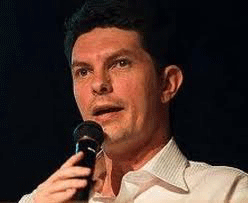 Submission to the South Australian Nuclear Fuel Chain Royal Commission, by Senator Scott Ludlam
Extract The Australian Greens have cautiously welcomed the idea of a Royal Commission to settle the issue of the nuclear industry in Australia once and for all.
For decades there have been the protagonists for and against the industry. There have been reports and case studies, public debates, political debates but nuclear power always comes up as unfeasible and hugely unpopular.
It is disappointing that this opportunity to examine the industry has been designed to exclude so many important issues and many voices on those issues. The process, independence and good fa ith of the Royal Commission has been damaged by narrow terms of reference, an unbalanced expert panel and consultation failures in remote and regional communities.
The terms of reference have been designed to exclude any review of the existing problems with uranium mining and waste management, the ongoing costs and liabilities from closed mines and processing facilities- costs that are left to the tax-payer.
The panel is in no way independent or balanced; it has been dominated by the nuclear industry and their advocates. We note complaints from Aboriginal communities in South Australia about the first round of ·engagement. Many people did not know about hearings or had limited warning about hearings. Others have not been given access to documents and or do not have access to the Internet, or do not speak English. We have had reports that hearings have been held in pubs at 11am – completely inappropriate for working people, and those who wouldn’t set foot in a pub.
There have been significant barriers put up for people in remote and regional communities. Inaccessible meetings and information, language barriers and the added constraint of getting submissions approved by a justice of the Peace all serve to exclude participation in the process. People in remote areas of SA have been most affected by South Australia’s involvement in the nuclear industry, and they are also the ones who are most likely to be affected by any future industrial nuclear activities. We are at a point where is a crisis of confidence in the process…..”
Australia, formerly a leader on nuclear disarmament, now a leper in the regional disarmament movement
 Australia’s earlier leadership on nuclear disarmament had diminished over the past four years.
“We know what Australia is saying ‘no’ to. It is saying ‘no’ to the humanitarian consequences pledge. Well, what is it saying ‘yes’ to?”
Australia resists new global push for nuclear disarmament, Guardian, Ben Doherty, 16 Sept 15 Diplomatic cables reveal prospects for nuclear disarmament are ‘bleak’ as Australia becomes increasingly lonely in opposing 116-nation push for ban
Prospects for nuclear disarmament are “bleak” under the current non-proliferation treaty, Australian diplomats have conceded in cables back to Canberra, but the country will resist growing global support for a new treaty banning nuclear weapons because of a dependence on the nuclear deterrent capability of the US.
A tranche of internal government emails from within the Department of Foreign Affairs and Trade reveals Australia’s opposition to a 116-nation push to ban nuclear weapons is leaving it increasingly isolated globally, and especially among anti-nuclear neighbours. The emails, released under freedom of information, reveal Australia is increasingly worried about an Austrian-led push for a treaty to ban all nuclear weapons. Continue reading
Giles Parkinson gives Malcolm Turnbull 5 pieces of good advice
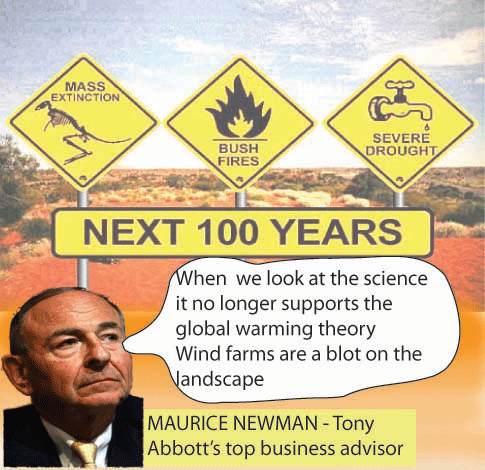 Sweep out the dead wood:………… This includes the likes of climate deniers such as Maurice Newman, Dick Warburton, David Murray and Tony Shepherd, and shake the Cabinet from the grim grasp of the Institute of Public Affairs and its policy wish-list.
Remove the threat to dismantle CEFC, ARENA and the CCA:…..
Find a new environment minister, or tell Greg  Hunt to stop saying silly things: Greg Hunt likes to tell people how hard it was to push a progressive line in an Abbott government. Many people wondered how hard he tried. Hunt came up with some of the Abbott government’s worst whoppers on climate change, coal, and renewable energy. Turnbull cannot afford to have such rhetoric repeated under his leadership
 Eight things Malcolm Turnbull should do on climate, renewables, REneweconomy By Giles Parkinson on 15 September 2015 Malcolm Turnbull’s dramatic replacement of Tony Abbott as prime minister of Australia has raised hopes of a change in direction for the Coalition government, particularly on climate change and renewable energy, and thereby the shape of its economic future……..
Paul Gilding, author and corporate advisor, describes a collective sigh of relief for those arguing for progressive climate and renewable energy policies.
“For climate advocates PM Turnbull is a “Nixon to China” moment,” Gilding said today. “We will never get on track as a country on this issue without genuine bipartisan support – and because of the way Rudd and Abbott made this a Left/Right issue, only the Liberal Party shifting can deliver the change we need.
“That’s why Turnbull’s arrival as PM is a game changer for Australia’s approach, but the impact will be medium to long term rather than sudden policy shifts. While Abbott had to say he supported action on climate policy, everyone knew he was faking it because the politics demanded he do so.
“Turnbull actually supports climate action and has long understood the economic implications of the transition required. And rather than being fearful of those implications he embraces them – seeing the inherent opportunity in a transition away from coal and towards a technology driven transformation of the energy system……..
What will Turnbull do? Over the next few days, weeks, months, we will find out. But here are eight things he could do right now: Continue reading
Uranium deal with India is bad for Australian business
 Australia-India nuclear deal http://www.lowyinterpreter.org/post/2015/09/14/Reader-riposte-Australia-India-nuclear-deal.aspx
Besides its collateral damage to Australia’s security, commercial and diplomatic interests, the soon-to-be ratifiedAustralia-India nuclear cooperation agreement notably fails to meet its objectives.
The aim was to give a green light to Australian uranium exports to India. Two objectives were to be served, one commercial, the other diplomatic. A vast new market was to be opened for Australian uranium exporters and India was to be convinced Australia was a reliable partner, worthy of a closer relationship.
Instead, as has been exposed in the Joint Parliamentary Committee, the Australian side gave away so much in the course of the negotiations on safeguards against nuclear proliferation and left open such loopholes for Australian uranium to end up in bombs or otherwise help their manufacture, that this proposed treaty does not do what Australia’s 23 existing nuclear safeguards treaties do.
Unlike them, it does not give Australian exporters legally watertight guarantees that the trade will be subject to effective controls against misuse of the uranium in ways Australian companies neither want nor could afford. So many deficiencies in the proposed treaty have been exposed it amounts at best, not to a greenlight but to a blinking yellow one. Not ‘all is guaranteed safe’ but ‘proceed carefully at your own peril’. And JSCOT’s main recommendation is a red light: no uranium exports to be permitted for the foreseeable future.
How Australian companies will respond and what risks they will be prepared to take remains to be seen, but no responsible government would have placed them in this situation.
The Indian Government has every reason to feel it too has been dudded. Instead of a reliable supply, there is a big element of precariousness. As for a demonstration of the Australian Government’s trustworthiness as a close partner, the contrary impression is conveyed of a bumbling inability to manage our own end of the deal.
Turning point for Earth’s Climate System
 Earth’s climate system ‘at turning point’ http://www.sbs.com.au/news/article/2015/09/14/global-temps-rise-restart-soon Experts warn big changes are under way in the earth’s climate.Source: AAP
Experts said big changes were under way in the earth’s climate system, with a natural phenomenon known as El Nino combining with the impact of greenhouse gases to push global temperatures to record highs.
But other changes in the Atlantic Ocean over the coming decades could make relatively cooler and possibly drier summers in the UK and northern Europe more likely.
Globally, the Earth’s climate system was at a “turning point”, with a number of major changes happening at once, the Met Office’s Professor Adam Scaife said.
In the run-up to key United Nations talks in Paris, at which it is hoped a new international agreement to tackle climate change can be agreed, “the signal is very clear” that global warming is happening.
The world has witnessed a slowdown or “pause” in rising temperatures in recent years, which sceptics pointed to as contradicting evidence of ongoing climate change.
The new report from the Met Office, which has been peer-reviewed by the University of Reading’s Professor Rowan Sutton, suggests the world is warming again.
Prof Scaife said experts could not be sure it was the end of the slowdown.
However, rates of warming averaged over decades were likely to reach the high levels seen at the end of the 20th century, when the world was warming rapidly, within two years.
The years 2014, 2015 and 2016 are all likely to be at or near record levels, in part due to the influence of the El Nino phenomenon of surface warming in the Pacific Ocean.
Scientists are very confident there is now a major El Nino under way, which is set to peak this winter, on the scale of an El Nino event in 1998 which helped drive global temperatures to record highs.
But Prof Scaife said natural variations such as El Nino were just the “icing on the cake” on top of human activity which is putting greenhouse gases into the atmosphere and driving climate change.
Will Malcolm Turnbull’s love for business mean a good future for renewable energy investment?
Furthermore, Malcolm Turnbull is a businessman — a successful one at that — and he will focus on ensuring Australia has a strong economy, business policy, and more besides.
This could mean that renewable energy will once again be seen as a favourable investment opportunity in Australia, if Malcolm Turnbull is to turn his love for business on to the renewable energy industry.
However, as has been outlined by website They Vote For You, Malcolm Turnbull’s voting record on renewable energy has not been very impressive, so at the end of the day, Australia may have a new Prime Minister come Tuesday morning, but the country’s renewable energy industry may remain as stagnant as it was with Tony Abbott at the helm.
What Will A New Prime Minister Mean For Australia’s Renewable Energy Industry?, Clean Technica September 14th, 2015 by Joshua S Hill Australia’s Liberal Party has elected a new leader, Malcolm Turnbull, which will soon mean a new Prime Minister for Australia — a move which has every chance to have a positive impact on the country’s renewable energy industry which has suffered heavily under the now-previous Prime Minister, Tony Abbott………..
I have not been quiet in my distaste for Tony Abbott, who I believe has run a campaign of anti-science and pro-fossil fuel. Continue reading
Australia’s history of trying to get nuclear weapons
 In 1969, the government announced plans to construct a 500-megawatt nuclear reactor at Jervis Bay in New South Wales. The intention was clear — this reactor was to support a nuclear weapons program.
in 1972, the conservative Gorton government was swept from power and replaced. Gough Whitlam, a longtime advocate of arms control, wasted no time ratifying the NPT and abandoning the Jervis Bay reactor. In a heartbeat, the 40-year quest for Australian nuclear capability was over.
 Australia’s Failed Bid for the Bomb, War Is Boring, Chris Walsh, 15 Sept 15 Canberra was captivated by atomic weapons in the 1950s — then ruined its chances of ever getting them
At 9:00 in the morning on Oct. 3, 1952, a 25-kiloton nuclear explosion vaporized the retired British frigate HMS Plym off Australia’s remote western coast. The Operation Hurricane detonation in the Monte Bello Islands was a seminal moment for Britain and marked its return to the club of great powers.
But for Australia, these tests and others served a murkier purpose – as important and deliberate steps toward Australia’s own acquisition of nuclear weapons.
Aboriginal Australians may soon lose ancestral homelands
Indigenous Australians may soon lose ancestral land, Aljazeera Facing the biggest threat to their way of life in decades, indigenous communities may be forced off their homelands. | 10 Sep 2015 Western Australia, Australia – The arid, rural territory of Western Australia is home to over 270 remote indigenous Australian communities that live on their ancestral land. This land has sustained the oldest living culture for over 50,000 years and carries deep spiritual and cultural significance for the people living there today.
Yet many of these communities are now under threat. They may soon be shut down by the state government, and hundreds of Aborigines could be forced to leave terrain they consider sacred and which is integral to their way of life. Continue reading
AUDIO: Aboriginal Freedom Summit 2 pushes for Treaty
 AUDIO Freedom Summit 2 pushes for Treaty http://caama.com.au/freedom-summit-2-pushes-for-treaty 14/09/2015 Organisers of the three day Freedom Summit held in Alice Springs say they will continue to push Government towards how treaties can be made with Aboriginal and Islander communities across the country.
Grass root Aboriginal leaders including South Australian Narungga Elder Tauto Sansbury came together in Central Australia to discuss and address a range of issues and government policies that continue impact on his people.
Australia’s Solar Citizens waiting for Turnbull’s answers on renewable energy
 Prime Minister Turnbull – Where To Now For Australian Solar?http://www.energymatters.com.au/renewable-news/malcolm-turnbull-solar-em5066/ September 15, 2015 After the toppling of Tony Abbott, the mood among solar supporters this morning with regard to Prime Minister-designate Malcolm Turnbull could be described generally as one of cautious optimism. Very, very cautious.
“Yesterday Mr Turnbull announced to the nation that he wanted to be the type of leader who ‘explains the challenges and how to seize the opportunities’, a leader who ‘respects the people’s intelligence’,” said Claire O’Rourke, National Director of Solar Citizens.
“We’re glad to hear it. Here on the sunniest continent on earth, the majority of Australians want to see more solar and renewables, not less. The Australian people want to harness our plentiful solar resources to power our economy, create jobs, cut electricity bills and leave a better world for our children.”
With a new leader of the country about to take the reins, Solar Citizens says it’s a fresh opportunity to secure Federal government support for Australia’s solar powered future. The group is urging supporters to email soon-to-be Prime Minister Turnbull, asking him ‘Stand Up For Solar’; including a goal of at least 50% renewable energy by 2030.
 The Australian Solar Council is urgently seeking a meeting with Malcolm Turnbull to determine where the new government will stand on policy relating to solar power.
“The Australian Solar Council welcomes Prime Minister Turnbull’s commitment to a strong, modern economy. Solar delivers jobs and has built thousands of small and medium sized businesses right around the country,” said CEO John Grimes.
“The key question is this – will a Turnbull Government implement a strong positive solar policy?”
The Clean Energy Council says while there is still much uncertainty, there is cause for hope.
“It is no secret that our industry had a tough time under Prime Minister Tony Abbott. But Malcolm Turnbull has a much better track record when it comes to renewable energy,” said the CEC’s Chief Executive, Kane Thornton.
RenewEconomy’s Giles Parkinson says instant miracles shouldn’t be expected on climate change and renewable energy.
“Not a lot of change in the immediate term, one suspects, but a complete change in atmospherics, and of perspective, particularly in the lead up to Paris.”
Government committe finds that it is too dangerous to sell uranium to India
 Too dangerous to sell India uranium, Dave Sweeney, AFR, Our Parliament has provided a welcome circuit breaker to a very dangerous government proposal. After examining the controversial plan to sell Australian uranium to India, the influential Joint Standing Committee on Treaties has found that unresolved safety, security, legal and nuclear weapons issues need to be addressed before any uranium is sold or supplied to India……….. : http://www.afr.com/opinion/letters-to-the-editor/too-dangerous-to-see-india-uranium-20150910-gjj7is#ixzz3lqFw3irM
Don’t forget the damage from UV radiation, even on cool days
 The damages of UV radiation are a daily risk even when you can’t feel the heat of the sun, News Local, Sydney September 12, 2015 IT seems logical to assume that the red hot sunburn we get comes from standing under the hot sun we feel, but it is not quite correct.. Sun damage is a reality that Australians face every day of the year, regardless of how hot the temperature is or how cloudy the sky…….
associate Professor Pablo Fernández-Peñas, who sees the detrimental effects of too much sun exposure.
“We can’t feel UV light and the heat sensation is not related to the amount of UV light,” he said.
“In winter, as days are cooler, people tend to stay longer outdoors.” A 2014 Australian study, “The influence of age and gender in knowledge, behaviours and attitudes towards sun protection”, found the use of sunscreen dropped to between 24 and 49 per cent outside summer.
“When you are just walking from your house to the car or dropping the kids to school, that sun exposure accumulates in the future,” Prof Fernández-Peñas said.
“Australia has the highest mortality of skin cancer in the world.”……..HEALTH EFFECTS OF UV RADIATION
■ Sunburn: can cause permanent and irreversible skin damage that can lay the groundwork for skin cancer
■ Eye damage: photoconjunctivitis, also known as snow blindness or welders flash, and skin cancer of the conjunctiva and skin surrounding the eye
■ Premature ageing: such as skin wrinkling, sagging, blotchiness and roughness …….http://www.dailytelegraph.com.au/newslocal/city-east/why-sunscreen-should-be-a-daily-habit/story-fngr8h22-1227522871234
Five developing countries racing to renewable energy, ditching fossil fuels
 China continues to invest in renewables at a scale that dwarfs that of other countries. China invested nearly $90bn in clean energy in 2014, or 73% more than the US, building large solar parks in Qinghai and wind farms in Xinjiang and Inner Mongolia, just to name a few.
as solar power rapidly becomes a mainstream energy option, the industry could create over 670,000 new, clean-energy jobs in India.
virtually infinite potential from wind and solar energy can truly democratise the generation of, and access to, power.
 Race to renewable: five developing countries ditching fossil fuels
Costa Rica, Afghanistan, China, India and Albania are all embracing renewable energy sources – five experts give their opinion on what the future holds
Aspen Colorado is 3rd USA city to run on 100% renewables
Aspen Stands Tall As Third US City Achieves 100% Renewable Energy http://cleantechnica.com/2015/09/15/aspen-stands-tall-third-us-city-achieves-100-renewable-energy/ September 15th, 2015 by Glenn Meyers
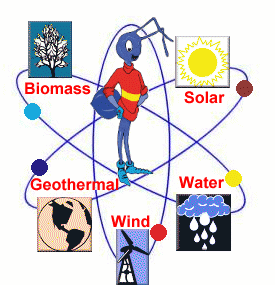 Aspen, the Colorado skiing-Mecca, now stands tall as a renewable energy visionary, having become one of three US cities to run on 100% renewable energy. This news was recently reported by The Aspen Times, citing staff members at Aspen’s environmental and project departments. The City of Aspen, a famed tourist location in the Rocky Mountains, Colorado, serves a population of just over 6,600 people, and its renewable power supply comes from a combination of wind, hydro, geothermal heat, and solar.
The plan for shifting to renewable energy and meeting the challenges of climate changedates back to 2005. According to Chris Menges and Will Dolan, from Aspen’s Sustainability and Utility departments:
“In 2005, the City created the Canary Initiative, which identifies Aspen and other mountain communities as “canaries in the coal mine” with respect to their sensitivity to the effects of climate change. Aspen relies on a stable climate and thriving natural environment for its economic viability and quality of life. In 2007, Aspen City Council adopted the Canary Action Plan, committing to the GHG reduction goals.”
The first two US cities to reach the goal were Burlington, Vermont, followed by Greensburg, Kansas.
Aspen’s transition to 100% renewable occurred September 10, after the city signed a contract with wholesale electric energy provider Municipal Energy Agency of Nebraska in order “to achieve this final leg of our goal,” city Utilities and Environmental Initiatives director David Hornbacher said.
Aspen receives wind energy from four wind farms in Nebraska and South Dakota, and the city also uses energy from Ruedi Reservoir, Maroon Creek, and Ridgway Reservoir, a hydropower facility near Montrose. Two utilities, Aspen Electric Utility and Holy Cross Energy, serve the community.
Mother Nature Network reports other cities aiming for 100% renewable energy include Copenhagen, Denmark; Bonaire, a Caribbean island; Munich and Frankfurt, Germany; San Diego, San Jose, and San Francisco, California; Sydney, Australia; and Isle of Wight, England.
Note! Columbia, Maryland Running On 100% Renewable Energy
 Columbia, Maryland Running On 100% Renewable Energy Energy Matters, 15 Sept 15 A new solar power station has enabled Columbia Association to complete its transformation to running facilities and services in Columbia, Maryland on 100 per cent renewable energy.
Columbia is an unincorporated city of nearly 100,000 people that was established in the 1960’s; part of the New Towns Movement in the United States. Its founder, James Rouse, sought to build a complete city that would respect the land and provide for the growth of people as well as making a profit.
Columbia Association (CA) is the nonprofit service corporation that manages Columbia. It operates a vast array of infrastructure, recreational, cultural and community services within the community; including fitness facilities, tennis clubs and dozens of swimming pools.
Columbia Association had been sourcing 75 percent of its energy from wind renewable energy credits. The final 25 percent is now being generated by a newly completed two megawatt solar farm; a project of SunEdison and Bithenergy.
The Nixon Farm solar project is located West Friendship, Maryland. Electricity generated by the plant is provided to Columbia via virtual net metering and under a 20 year power purchase agreement with SunEdison.
“With the completion of the Nixon Farm solar power plant, the people of Columbia now enjoy the environmental and cost benefits of getting 100 percent of their electricity from renewable sources,” said Steve Raeder, SunEdison’s general manager of Eastern U.S. commercial and industrial solar…….In addition to its renewable energy efforts, Columbia Association has been very active as an Energy Star Partner with the U.S. Environmental Protection Agency (EPA), promoting the benefits of the program to the community as well as carrying out various energy efficiency upgrades within the facilities it operates. http://www.energymatters.com.au/renewable-news/sunedison-columbia-solar-em5061/
1 This month

of the week – Australians for War Powers Reform (AWPR)
To see nuclear-related stories in greater depth and intensity
 Antinuclear