Tax-payers likely to be hit with big costs of mines rehabilitation
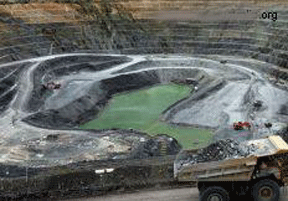
State governments calculate the required rehabilitation bonds using a standard formula but Dr Erskine said the mining companies work off their own, and often very different numbers.
“The rehabilitation costs held independently by the mining companies are often much larger than the rehabilitation bonds paid to state governments,”
An environmental scientist who works with the mining industry has broken ranks to warn that Australian taxpayers will be left with a bill running into tens of billions of dollars unless government and industry start taking mine rehabilitation seriously.
Key points
- More than 50,000 abandoned mines in Australia
- Scientist says mines must be rehabilitated
- Report says rehabilitation bonds ‘insufficient’
- Concerns over Peabody Energy’s plummeting share price prompts rehabilitation bonds questions
Dr Peter Erskine from the University of Queensland’s Sustainable Minerals Institute said although state governments hold financial securities for mine rehabilitation, they are nowhere near enough.
Across Australia there are more than 50,000 abandoned mines — a legacy of the early mining days when resource companies simply walked away when the profits dried up.
To avoid repeating its past, Dr Erskine said Australia must ensure that operating mines are properly and progressively rehabilitated while they are turning a profit.
What is in the rehabilitation kitty?
Queensland holds $5.38 billion in rehabilitation securities, in the form of cash or bank guarantees, and New South Wales holds $1.8 billion.
But Dr Erskine said it will cost between three to 10 times that amount to ensure mines are rehabilitated so that:
- Pollutants do not contaminate surrounding lands and waterways
- The landform is safe and stable for cattle to graze and
- The rehabilitated land is sustainable
He said when companies apply for a mine approval they agree to a range of rehabilitation targets, but the terms are vague and allow a lot of flexibility over the life of the mine.
“What I see happening is a steady downgrade of what the rehabilitation will look like throughout the life of a mine,” Dr Erskine said. “Returning the land to a productive use like cattle grazing is a very different proposition to creating a native ecosystem which is thought to be a lower risk proposition for the mining company.
“You don’t have to worry about cattle or farmers walking on unstable land.”
Dr Erskine is hired by mining companies to assess their rehabilitation and works on mines in Queensland and NSW.
“We’re seeing less and less hectares rehabilitated,” he said.
“And of that old rehabilitation, I don’t see it meeting the objectives that the Government and the mining companies have stated. So that’s safe, stable, non-polluting and sustainable.”
State governments calculate the required rehabilitation bonds using a standard formula but Dr Erskine said the mining companies work off their own, and often very different numbers.
“The rehabilitation costs held independently by the mining companies are often much larger than the rehabilitation bonds paid to state governments,” he said.
A 2014 Queensland Auditor General’s report found the bonds were “insufficient to cover the costs of rehabilitation” and in the case of one particular mine the bonds held were only 1.5 per cent of the estimated rehabilitation cost.
The report also found the government department overseeing mine rehabilitation was reluctant to claim the bonds for the state.
Peabody close to bankruptcy, fears about security bonds Peabody Energy, the world’s largest private coal company, has been hit hard by the fall in global coal prices.
According to energy market analyst Tim Buckley, Peabody’s share price has plummeted 96 per cent in five years.
“The company has gone from being capitalised at $US18 billion to about $400 million and is carrying about $6 billion of net debt,” he said……………..
NSW Greens MP Jeremy Buckingham said Peabody’s mine extension application should be carefully assessed.
“Peabody is close to bankruptcy so we need to know if their security bond is actually going to be enough if they go bankrupt, we need to see this application properly scrutinised,” he said.
How companies avoid rehabilitation costs
Despite lower prices and contracting export markets, NSW is currently considering four new coal mine applications and 13 mine extensions in the Hunter Valley.
It is not unusual for companies to seek to boost coal volumes during a downturn to compensate for lower prices……….
“what we see are mines placed into care and maintenance where the mining companies can avoid paying out rehabilitation bonds because the mine isn’t officially closed.”………
Mr Buckingham would like to see mine rehabilitation bonds “enshrined in legislation” to an “acceptable standard” that is “independently assessed”.
“We can’t just leave a huge scar on the landscape and a red line though government budgets,” he said.
Dr Erskine agreed that governments needed to set tighter and clearer laws……….
“We’re leaving a legacy bigger than what we’ve had. We’ve moved bigger mountains then we ever have before.
“This is a critical time in Australian society looking carefully at how much we’re willing to risk in the future. A lot of the landscape has been mined but at the moment there’s no real functional use for that land after the mine is finished.” http://www.abc.net.au/news/2015-09-19/taxpayers-may-foot-bill-for-mine-rehabilitation/6787954
No comments yet.
1 This month

6 March -Online – Reversing nuclearization:
From nuclear weapons in Belarus and NATO host countries to a European-Nuclear-Weapon Free Zone
Mar 6, 2026 03:00 AM in Canberra, Melbourne, Sydney

of the week – Australians for War Powers Reform (AWPR)
To see nuclear-related stories in greater depth and intensity
 Antinuclear
Leave a comment