#NuclearCommissionSAust paying lip service only to renewable energy as “low carbon’ option
 South Australia’s Nuclear Fuel Cycle Royal Commission seems to be focused on electricity generation from low carbon sources, but is paying lip service only to renewable energy, Noel Wauchope 30 Sept 15
 - Climate Change and Energy Policy
- National Electricity Market
- Geology and Hydrogeology of South Australia,
- Low Carbon Energy Generation Options,
- Estimating Costs and benefits of Nuclear Activities
- Environmental Impact: Lessons Learnt from Past SA Practices
- EXPLORATION EXTRACTION AND MILLING
- FURTHER PROCESSING AND MANUFACTURE
- ELECTRICITY GENERATION
- MANAGEMENT STORAGE AND DISPOSAL OF WASTES.
- Mr Donald Hoffman, President and CEO of EXCEL Services Corporation, which provides specialist advice and support services to nuclear facilities in the US and internationally. Mr Hoffman served as President of the American Nuclear Society from 2013-2014. He currently provides presentations on the benefits of nuclear science and technology to the US Congress and is chairing a committee to support all the US Governors on implementing the US Clean Energy Act and addressing the Climate Control Acts.
- Mr Andrew Stock, director of energy companies Horizon Oil Limited and Alinta Holdings, and past director of Silex Systems, Geodynamics, Transform Solar and Australia Pacific LNG
- Mr Arjun Makhijani, Institute for Energy and Environmental Research, President of the IEER and holds a Ph.D. in Engineering, specialising in nuclear fusion
- Dr Keung Koo Kim and Dr Kyun S. Zee, Korea Atomic Energy Research Institute . The Institute (KAERI) has a history of over 50 years of research and development in nuclear energy. . Dr Kim is the Director of Advanced Reactor Development.
- Mr Thomas Marcille, of Holtec (US) Holtec International is an energy technology company with a focus on carbon-free power generation, specifically commercial nuclear and solar energy. Mr Marcille is Vice President and Chief Nuclear Officer at Holtec International and is involved in the development of Holtec’s small modular reactor, the SMR-160. He has provided nearly three decades of service in senior engineering positions in the nuclear industry in the US.
 A while back, nuclear power was being touted as “renewable”. That was patently untrue, and the phrase went out of fashion as far as nuclear power was concerned. It seems that it has been replaced now by “low carbon”. The nuclear lobby still quite often condemns renewable energy as inadequate, as “not a base load source”, as too expensive, etc. However, nuclear promotion today is more sophisticated, and will include renewable energy, along with nuclear, as “part of the energy mix”. So “low carbon” is the preferred term for nuclear promotion, and it looks to me as if this is the way in which the Royal Commission is using that term, and paying only lip service to renewable energy. .
Nuclear lobby aiming to overturn an Environment Protection and Biodiversity Conservation Act ban
The first target of the lobbying push is to overturn an Environment Protection and Biodiversity Conservation Act ban on the nuclear development process.
Jim Green, an anti-nuclear campaigner at Friends of the Earth, said it was unlikely that nuclear would ever be feasible in Australia. “We don’t need a bridge from fossil fuels to renewables, we just need renewables. It’s viable and affordable. There is a lot of rhetoric around a nuclear renaissance, but not much else.”
 Nuclear industry to push for Australia to adopt ‘clean, affordable power’
Australian Nuclear Association plans to lobby Turnbull government to embrace the technology ‘to create jobs and economic opportunity’ Oliver Milman , Guardian, 29 Sept 15 The nuclear industry will lobby for nuclear energy in Australia, saying the prime minister, Malcolm Turnbull, should embrace the technology as a way to slash greenhouse gas emissions.
The Australian Nuclear Association (ANA) will accompany Danny Roderick, chief executive of the leading US nuclear technology firm Westinghouse, to talk to government ministers and business leaders in Canberra and Sydney next week.
Roderick said nuclear power could help produce “clean, reliable, affordable electricity for more people”.
“We’d like to help Australia explore ways to create jobs and economic opportunity that are also good for the environment,” he said. South Australia’s nuclear inquiry is ‘a gale of commonsense’, Tony Abbott says
The ANA is optimistic that the change in Australia’s prime ministership will mean nuclear will be looked at “on its merits”.
The move is the latest attempt to overturn legal obstacles to nuclear energy generation in Australia.
Federal environmental law bans building nuclear reactors, and an attempt by the Family First senator, Bob Day, to scrap a separate law that blocks building reactors and uranium enrichment plants was halted in August by the Tony Abbott government……..
The ANA says nuclear is a better option to cut emissions from electricity than renewable sources such as solar and wind…….
Parker denied that nuclear was prohibitively expensive, estimating that Australia could build 29 reactors for $160bn with companies such as Westinghouse “lining up” to invest.
He also claimed “strong community support” for nuclear despite the Fukishima disaster in Japan…… Continue reading
Uranium sales to India: an issue for Turnbull govt to resolve
 Australia’s New PM: Uranium Sale Will Be Litmus Test Of India Policy – Analysis
By South Asia Monitor Tuesday, September 29th, 2015, By Rekha Bhattacharjee*While Australia’s Prime Minister changed in a dramatic leadership spat less than two weeks ago, it is believed that the elevation of Malcolm Turnbull as the 29th PM of Australia would not adversely impact the bilateral relationship between India and Australia……..
From the Indian perspective, Turnbull’s India policy would become apparent in the not too distant future when he makes a decision on the uranium sale to the power-hungry South Asian country. A joint parliamentary standing committee on treaties had recently raised objections over the uranium sale to India. …. http://www.eurasiareview.com/29092015-australias-new-pm-uranium-sale-will-be-litmus-test-of-india-policy-analysis/
Paris Climate Conference the last ditch hope for the world
 United Nations: ‘Too late’ for world if no climate deal in Paris, French president Francois Hollande says http://www.abc.net.au/news/2015-09-29/too-late-for-world-if-no-climate-deal-made-in-paris-france-says/6812138 Reaching a successful climate deal in Paris at the end of the year is the last chance to save the planet, France’s president Francois Hollande has warned.
Without “this decision in Paris … it will be too late for the world,” Mr Hollande said in his address to the UN General Assembly in New York.
The UN-led conference in Paris, which starts at the end of November, aims to seal a wide-ranging agreement to limit the worst effects of climate change.
Key points:
- Hollande optimistic after China, US sign “joint vision” ahead of Paris summit
- India to unveil its climate strategy on Thursday
- UN talks a key precursor to Paris summit at end of November
Despite the warning, Mr Hollande sounded a note of optimism after China and the United States signed a “joint vision” ahead of the Paris summit, and China committed to a domestic cap-and-trade carbon exchange.
“We have moved forward over recent months,” Mr Hollande said.
“Very strong declarations were made by those countries who are most responsible for global warming … the United States and China, which undertook commitments towards changing the situation.”
He also pledged that France would increase its financial commitment on climate from 3 billion to 5 billion euros ($4.8 billion to $8 billion) between now and 2020.
A week of climate events in New York ahead of the annual UN summit brought out new promises from governments and the private sector to slash greenhouse gas emissions blamed for global warming.
The United Nations offers one of the last opportunities for high-level talks before the Paris conference opens on November 30.
Still possible to contain climate change: experts Continue reading
Australia’s govt MIGHT count wind power as an ’emerging technology’ to be supported
 A Note of Warming. Will Greg Hunt count wind power as an ’emerging technology’. Or is that phrase solely code for new nuclear?
Environment Minister Greg Hunt opens the door to government wind power investment http://www.smh.com.au/federal-politics/political-news/environment-minister-greg-hunt-opens-the-door-to-government-wind-power-investment-20150929-gjx2q4.html September 29, 2015 Nicole Hasham Environment and immigration correspondent Environment Minister Greg Hunt says the federal government’s “green bank” may be allowed to invest in new wind farm technology, in another sign the Coalition’s war on renewable energy is winding down.
Speaking on ABC radio on Tuesday, Mr Hunt said “emerging” wind power such as new turbines or offshore wind farms may be eligible for funding from the Clean Energy Finance Corporation. Continue reading
Fukushima mothers speak anonymously about their fears
Reluctant to speak, Fukushima moms admit fear of radiation, pressure from families, Japan Times, BY MEGAN GREEN STAFF WRITER, 29 Sept 15 To stay or to flee. Mothers in Fukushima Prefecture had to make harsh decisions for their families after the nuclear disaster of March 2011. More than four years on, they still have to.
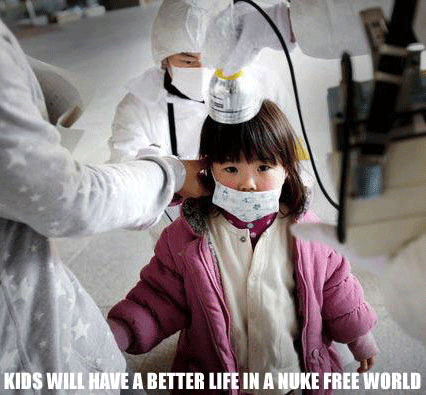 Those who remain there live in constant fear for their children’s health. But choosing to flee opened them to accusations of being bad wives who abandoned their relatives, community and husbands tied to jobs.
It is a no-win situation for those who face the decision to stay or go, because they may be unable to live up to the ideal of a ryosai kenbo (good wife, wise mother).
“Consciously or subconsciously, women are aware of the role we are expected to play in a family. After the earthquake and nuclear disaster, however, everything changed,” said Yukiko (not her real name), a mother and voluntary evacuee in her 30s. “I can’t live up to those expectations any more, and society judges me.”
All women interviewed for this story spoke on condition of anonymity.
As the crisis at the Fukushima No. 1 nuclear power plant began to play out, Tokyo Electric Power Co. established a 20-km no-go zone around the site, outside of which the government said conditions were safe. Many did not believe the assertion.
Yuriko, a woman in her 70s who lives in the city of Minamisoma, Fukushima Prefecture, believes the zone restrictions divided the community.
“Some people trusted the government’s word and continued to live here, but others couldn’t stand living every day in fear and moved out,” Yuriko said. “Nobody knew what to believe and communities have fallen apart.”
The fear of radiation, rumors and media reports about the safety of local food prompted many mothers just outside the no-go zone to evacuate voluntarily for the sake of their children’s health. Some moved to neighboring prefectures, including Iwate and Miyagi, and others made the great leap south to Tokyo.
“To be honest, I didn’t have much knowledge about the nuclear reactors in Fukushima. But I did know how deadly high exposures of radiation could be,” said Yuko, in her 30s, who has a 6-year-old daughter. “I evacuated to Tokyo within a week of the disaster. My husband stayed in Fukushima, but I was determined to leave to prioritize the safety of my daughter.”
In many cases, voluntary evacuees like Yuko are mothers who fled with their children while their husbands remained in Fukushima to work………….. http://www.japantimes.co.jp/news/2015/09/29/national/social-issues/reluctant-speak-fukushima-moms-admit-fear-radiation-pressure-families/#.VgsUZOyqpHx
The Un-Safety Record of Nuclear Power Plants
Cancer, Coverups and Contamination: The Real Cost of Nuclear Energy 27th September 2015
Andreas Toupadakis Ph.D Contributing Writer for Wake Up World
“…..If we assume that more nuclear power plants are constructed around the world, can anyone guarantee that the nuclear accidents will disappear? No, that is impossible. Not only will the risks not disappear, but logic dictates they will also increase if there are more plants in operation, as will the volume of unmanageable radioactive waste. And let us not forget the unpredictability of earthquakes. Nuclear accidents will always happen just like any other accidents do, which may affect both power plants and waste storage facitilities.
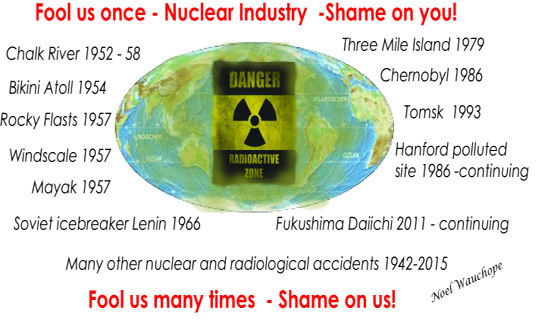
Reliance on nuclear energy not only results in building new nuclear power plants but also relicensing existing ones. The peril of tragic accidents within the industry will inevitably be higher, especially while maintaining plants that are decades old — as we have already witnessed with the ongoing disaster at Fukushima, as well as the overheated reactor at Miami’s Turkey Point facility in 2014. Other nuclear power plant disasters include:
- 1952 Chalk River, near Ottawa, Canada: a partial meltdown of the reactor’s uranium fuel core resulted after the accidental removal of four control rods.
- 1957 Windscale Pile No. 1, north of Liverpool, England: fire in a graphite-cooled reactor spewed radiation over the countryside, contaminating a 200-sq-mile area.
- 1957 South Ural Mountains, Soviet Union: an explosion of radioactive wastes at a Soviet nuclear weapons factory 12 miles from the city of Kyshtym forced the evacuation of over 10,000 people from a contaminated area.
- 1959, Santa Susana, USA: A reactor at the Atomics International field laboratory in the Santa Susana Mountains, California, experienced a power surge and subsequently spewed radioactive gases into the atmosphere. According to a 2009 report from the Los Angeles Times, residents blame the facility for their health issues and say the site remains contaminated.
- 1976, near Greifswald, East Germany: the radioactive core of a reactor in the Lubmin nuclear power plant nearly narrowly avoided meltdown following the failure of safety systems during a fire.
- 1979, Three-Mile Island, near Harrisburg, Pennsylvania: Following a combination of equipment malfunctions, design-related problems and worker error, one of two reactors lost its coolant which caused overheating and partial meltdown of its uranium core, releasing radioactive water and gases.
- 1986, Chernobyl, near Kiev, Ukraine: an explosion and fire in the graphite core of one of four reactors released radioactive material that spread over parts of the Soviet Union, Europe and Scandinavia.
- 1987, Rocky Flats Plant, near Denver, Colorado, USA: Following insider reports of unsafe conditions, investigation found numerous violations of federal anti-pollution laws, including discharging of pollutants, hazardous materials and radioactive matter into nearby creeks and water supplies. A subsequent grand jury report criticized the Department of Energy and Rocky Flats contractors for “engaging in a continuing campaign of distraction, deception and dishonesty”.
- 1999, Tokaimura, Japan: An uncontrolled chain reaction in a uranium-processing nuclear fuel plant spewed high levels of radioactive gas into the air, exposing 69 people, killing one worker, and seriously injuring two others.
- 2011, Fukushima Prefecture, Japan: The troubled Fukishima Daiichi nuclear plant in Japan has experienced a number of ‘incidents’ since its construction in 1971, culminating in total reactor failure when the plant was hit by a tsunami following an earthquake. At the time of the disaster, the plant began releasing substantial amounts of radioactive materials and, more than four years after the incident, the plant is still leaking radioactive water into the Pacific Ocean.
The extent of this recent disaster at Fukushima should not be taken lightly. The water leaking from the ailing plant contains plutonium 239 and its release into the world’s ocean system has global repercussions. Explains chemist John A. Jaksich for DecodedScience.com:
“Certain isotopes of radioactive plutonium are known as some of the deadliest poisons on the face of the Earth. A mere microgram (a speck of darkness on a pinhead) of Plutonium-239, if inhaled, can cause death, and if ingested… can be harmful, causing leukemia and other bone cancers.
“In the days following the 2011 earthquake and nuclear plant explosions, seawater meant to cool the nuclear power plants instead carried radioactive elements back to the Pacific ocean. Radioactive Plutonium was one of the elements streamed back to sea.”
As history has shown us, assurances on safety from nuclear operators and regulators are nothing but preposterous. That is something that the public understands — because it is common sense. No matter how much uncaring, financially invested scientists will try to convince the public of the safety of the nuclear industry, the public does not have a salary from working on nuclear business and so, unlike those working on behalf of the industry, can maintain integrity and common sense……….….http://wakeup-world.com/2015/09/27/cancer-coverups-and-contamination-the-real-cost-of-nuclear-energ
At least Turnbull is getting rid of Maurice Newman as govt adviser
Climate sceptic Maurice Newman not reappointed as government adviser, Guardian
Newman, whose term as chairman of PM’s business advisory council has expired, repeatedly questioned climate science in columns for the Australian Lenore Taylor 29 Sept 15 Outspoken climate sceptic Maurice Newman’s term as chairman of the prime minister’s business advisory council expired last week and he has not been reappointed, a spokesman for prime minister Malcolm Turnbull has confirmed.
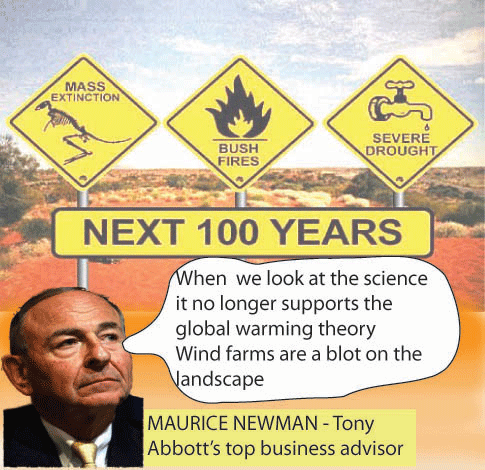
Former prime minister Tony Abbott appointed Newman as one of his first acts after winning government in 2013.
Newman has used a weekly column in the Australian to expound private views on climate change, including that the world was ill-prepared for a period of global cooling and that the United Nations was using debunked climate science to impose a new world order under its own control.
He also called for a government-funded review of the Bureau of Meteorology (BoM) to “dispel suspicions of a warming bias” in its temperature record-keeping, something freedom of information documents have recently revealed was under consideration by the prime minister’s department.
Turnbull’s spokesman said the new prime minister, who has strong personal links to the business community, was still considering whether he needed a formal business advisory council. He said Newman had not been reappointed.
The two-year terms of the other 11 members of the council expire in December because they were appointed by Abbott after he had named the chairman…….http://www.theguardian.com/australia-news/2015/sep/28/climate-sceptic-maurice-newman-not-reappointed-government-adviser
Australia’s Resources Minister Josh Frydenberg will help Adani’s coal mine with tax-payer money
 Frydenberg signals $5 billion taxpayer frolic with Adani’s unwanted fossil flop https://independentaustralia.net/environment/environment-display/frydenberg-signals-5-billion-taxpayer-frolic-with-adanis-unwanted-fossil-flop-,8193
IF AUSTRALIA’s new Prime Minister and refreshed front bench are showing signs of being more progressive about renewable energy investment and R&D, it looks like they are also going to be far more candid about coal, and their plans to invest heavily there, too.
In an interview with Fairfax media on Wednesday, the newly sworn in energy and resources minister Josh Frydenberg was crystal clear on the government’s intent to use taxpayer money from its $5 billion Northern Infrastructure Fund to help get the Adani-owned Carmichael coal mining project off the ground.
And he was equally clear that the Turnbull Government’s attitude to developing new coal projects – despite the smart money being on all untapped fossil fuel resources staying in the ground, and despite the fact that most banks and institutional investors won’t touch the Galilee Basin project with a 10 foot barge pole – remains the same as the Abbott Government’s. Frydenberg told the AFR, repeating the mantra of his former boss:
[Carmichael coal mine is] a very important project, which will see significant investment in Australia and provide electricity to millions of people in the developing world,”
Anti-development activism can create major delays in projects and send investment offshore, and you have to be very conscious of that when there are such large time frames involved and we are competing internationally for investment in this country.
AUDIO: Australia world top in household solar panel installations
 AUDIO: Australia leads world in household solar panel installations, ABC RadioThe World Today By Samantha Donovan Australia has the highest rate of household solar panel installation in the world, according to a new report from the Energy Supply Association of Australia.
“We’re clearly leading the world in rooftop solar,” said the association’s chief executive, Matthew  Warren.
“There’s literally daylight [coming in] second.”
The report found about 15 per cent of Australian homes had solar panels………Installation rates are highest in South Australia and Queensland, and in some Brisbane and Adelaide suburbs more than half of all homes have solar panels.
Mr Warren attributed that to more generous schemes in those states.
“South Australia has 25 per cent of dwellings, which is the highest in the world, and Brisbane’s not far behind with 23 per cent, and then Perth and WA at 18 per cent.”
Media player: “Space” to play, “M” to mute, “left” and “right” to seek.
But the report found lower rates of solar panel installation in affluent suburbs. “It’s very popular with retirees,” Mr Warren said. “It’s more popular with mortgage-belt consumers who are probably more price conscious. “It hasn’t been in the trendy inner-city suburbs. There’s not much roof space and there are more renters, but it just hasn’t appealed to that demographic.”
Australia lags with large-scale solar projects
While Australians are taking to small-scale solar projects enthusiastically, the report found large-scale solar projects are less common than in other countries……..http://www.abc.net.au/news/2015-09-29/australia-leads-world-in-installation-of-household-solar-panels/6813532
El Nino: Pacific ocean warming warms the whole world
we currently have a large, potentially record-breakingly hot El Niño brewing in the Pacific Ocean, which is expected to keep growing at least through to January.
As the current El Niño combines with the background warming of climate change, we can expect land temperatures to continue to spike, potentially surpassing last year’s global record average. This warmth is likely to persist through and slightly beyond the period of the El Niño, increasing the likelihood that 2015 and 2016 will be very warm years indeed for the planet.
 The tropical steam-engine: how does El Niño warm the entire globe? https://theconversation.com/the-tropical-steam-engine-how-does-el-nino-warm-the-entire-globe-47865 Nicholas Tyrrell and Dietmar Dommenget September 30, 2015 We regularly hear about how El Niño events raise the temperature across much of the planet, contributing to spikes in global average temperature such as the one witnessed in 1998, with severe bush fires, droughts and floods.
Indeed, the extra warmth is typically much more apparent over land than in the oceans, despite El Niño being chiefly thought of as an ocean temperature phenomenon.
How is it that an event predominantly characterised by a warm blob of water in the tropical eastern Pacific can have such a pervasive effect on global land temperatures? Continue reading
1 This month

of the week – Australians for War Powers Reform (AWPR)
To see nuclear-related stories in greater depth and intensity
 Antinuclear