Nuclear lobby seeks in vain for buckets of money from EPA
Only buckets of money from taxpayers and customers can lead to new reactor construction. The Clean Power Plan contains no such buckets.

 What the EPA’s Clean Power Plan means for nuclear energy, Bulletin of the Atomic Scientists, 24 Sept 15 Peter A. Bradford For nuclear power, the good news and the bad news in EPA’s final Clean Power Plan are the same: The technology got pretty much what it deserved. The competitive position of all new low-carbon electricity sources will improve relative to fossil fuels. New reactors (including the five under construction) and expansions of existing plants will count toward state compliance with the plan’s requirements as new sources of low-carbon energy. Existing reactors, however, must sink or swim on their own prospective economic performance—the final plan includes no
  special carbon-reduction credits to help them. During the Clean Power Plan’s 15-year scope, a few will sink; most, especially those in states where existing generators need not compete, will swim.
Priced out of the market. Economic analysis shows that the cost of new reactors is far above that of other low-carbon alternatives. Continue reading
Western Australian Wiluna uranium project in the doldrums for the forseeable future
 WA’s first uranium mine likely to be delayed as Toro Energy puts Wiluna on hold WESTERN Australia’s first new uranium mine is likely to be delayed due to the ongoing downturn in demand and prices, Perth Now, 1 Oct 15
Toro Energy has put its Wiluna uranium project on hold as it waits for market conditions to improve. The company began drilling at the project in 2014 and had expected to start operations in 2017.
“We will get to build Wiluna when we get the price that makes Wiluna economic. We are not seeing that price today,” managing director Vanessa Guthrie told AAP.
Wiluna, 960 kilometres northeast of Perth, is the first new uranium mine in WA to receive federal  government approval since the lifting of a ban on uranium mining in 2008.
The project will require prices between $60 and $70 a pound to make money, Dr Guthrie said.
Long term uranium prices currently hover around $45 per pound, almost half the levels of five years ago. Prices are expected to dip further because of large stockpiles……..
Global uranium production has stalled in the past two years as depressed uranium prices have curtailed exploration activities and the opening of new mines……http://www.perthnow.com.au/business/was-first-uranium-mine-likely-to-be-delayed-as-toro-energy-puts-wiluna-on-hold/story-fnhocr4x-1227552733503
Report shows opportunity for clean energy jobs worth $370 bn
Australian clean energy jobs could be worth $370 bn in 10 years http://reneweconomy.com.au/2015/australian-clean-energy-jobs-could-be-worth-370bn-in-10-years-39526 By Sophie Vorrath on 29 September 2015 Australia’s renewable energy industry could generate $370 billion worth of jobs over the next 10 years using current technology, a new report has found. The report, released on Tuesday by Beyond Zero Emissions, aims to illustrate how Australia can transition from coal-fired power to renewables, shifting the economy along with it.
“Our research with Melbourne University into energy generation in Australia shows that we can create $370 billion of green energy jobs with current technology, instead of using coal-fired power stations,” said Beyond Zero Emissions CEO Stephen Bygrave.

When you add to this smart homes and buildings, as well as low-carbon land use, high speed rail and electric vehicle options, the green jobs climb towards $1 trillion dollars in value, Dr Bygrave says.
The report’s findings coincide with a new policy proposal from the Greens that calls for a levy to be imposed on coal mining companies to help pay for the transition away from fossil fuels, including for the rehabilitation of retired mines and retraining workers for clean energy jobs.
BZE is also set to launch a new book on October 2, at the Smart Future Cities Conference showing how easily existing Australian homes can be retrofitted to eliminate electricity and gas bills – a follow-up to its Zero Carbon Australia Buildings Plan, that was researched over 3 years.
“The Buildings Plan showed that all residential and commercial buildings in Australia could be converted to generate as much energy as they consumed, creating $270 billion of green jobs in the construction industry,” Bygrave said.
“The new book, The Energy Freedom Home, shows how every home can produce more energy than it consumes. And with rising electricity and gas prices and falling rooftop solar prices, Australian households can affordably revolutionise the way they power their homes.
“Our research shows that millions of ordinary Australian homes can be transformed to be high performing, comfortable and cheaper to run. The transformation is easy since 1.4 million homes already have rooftop solar.”
To illustrate their theory, BZE along with the University of Newcastle have retrofitted a brick veneer family home in North Lambton, Newcastle, that was originally built in 2000.
The retrofits, which began in 2009 and are based on the guidelines provided by the Energy Freedom Home program now save the household $1,200 a year on power bills, with credits during the year. By 2013 the house was transformed into a comfortable, passive solar house, generating more energy from the PV system in the year than it uses.
“We removed the gas systems for health, safety and cost reasons, and have found we use less energy now than when we had both electricity and gas,” said the house’s owner, who monitors it for energy, water, temperature and humidity.
As part of the Smart Future Cities conference, the home in North Lambton will be open on 10am and at 10:30am on Saturday 3rd October for free limited tours.
On the bright side – the benefits of nuclear weapons

 Why no Trident? The benefits of a nuclear apocalypse http://www.theguardian.com/science/brain-flapping/2015/oct/01/nuclear-war-trident-corbyn-benefits#comment-60607599 Jeremy Corbyn has recently been criticised for saying he would never use nuclear weapons. Quite right! This stance clearly overlooks the many scientifically-proven benefits of plunging the world into a fiery radioactive hell, Guardian, Dean Burnett, 1 Oct 15, Jeremy Corbyn has said in an interview that, if he were prime minister, he wouldrefuse to use the UK’s Trident nuclear weapons system. This has caused muchdebate and controversy. And rightly so! This naive and blinkered stance clearly doesn’t take into account the many scientifically-proven benefits of widespread global nuclear destruction so would deny people the many advantageous offered by a world scoured of life and civilisation. Such as:
An end to economic uncertainty
Keynesian economics argues that military spending is good for the economy. There are even more modern arguments that state the current economic troubles afflicting human society are the result of long periods of relative peace. Logically, the best way to remedy this would be with a war to end all wars.
Investors are unlikely to be pessimistic regarding stability of Chinese manufacturing when they’re too busy scrabbling in the dirt to find gnarled roots to eat, and the surviving members of society all automatically become highly skilled and valued workers due to the whole “everyone else is dead” thing. There would be plenty of work to go around too, what with having to rebuild houses, roads, farms, sewers, the power grid and the rest of our infrastructure.
It would even put an end to things like the current debacle around junior doctor’s contracts. Doctors will be too preoccupied dealing with the endless victims of burns and radiation to sleep, let alone quibble over their hours.
No more immigration problems Continue reading
How Stephen Colbert might advise the nuclear lobby
What the EPA’s Clean Power Plan means for nuclear energy, Bulletin of the Atomic Scientists, 24 Sept 15 Peter A. Bradford “…….Imagine Nuclear Power in America as a person—a character like Trout Fishing in America, the person in Richard Brautigan’s 1967 novel by the same title—being interviewed by Stephen Colbert, the host of the former “Colbert Report.” As Nuclear Power in America lists its usual woes—a timid public, antinuclear activism, lack of a national energy policy, overregulation, lack of a waste repository, Jimmy Carter’s presidency—Colbert grows visibly agitated. Finally he bursts out, “How can we give you what you really need if you never tell us what it is—hundreds of billions in subsidies and suppression of competition. These other things are just distractions. Take them all away and you still wouldn’t have completed a single additional reactor in the United States in this century.
“All you do is simper about ‘level playing fields,’ ‘poorly designed power markets,’ ‘gas volatility,’ ‘clean, safe, reliable baseload,’ ‘jobs and taxes,’ ‘converted environmentalists,’ ‘Harry Reid,’ ‘French industrial wisdom,’ ‘German fecklessness.’ How is the US public supposed to understand that if it wants 100 new reactors, it can’t just burn Helen Caldicott at the stake? It has to put up $500 billion in new nuclear subsidies along with guaranteeing that no other technology—not even another nuclear technology—can come along and steal its electric customers in the 10 years that it may take to build each plant?
“Nuclear power requires obedience. Demand what you really need. Just look at Donald Trump. What can possibly go wrong?”…..http://thebulletin.org/what-epa%E2%80%99s-clean-power-plan-means-nuclear-energy8763
Climate change threatens world’s energy systems
 Why did this article not mention nuclear facilities – reactors, used fuel pools, waste containers, transport of radioactive trash – as being at risk from extreme climate events?
 providing electricity
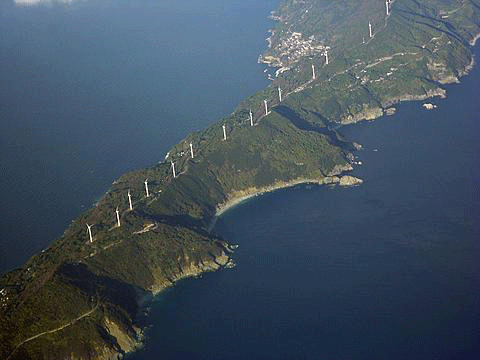
Energy systems, including fossil fuel power stations, distribution grids, and the networks that reach to people’s homes, are all at risk from effects such as flooding, severe storms and sea level rises, according to a new report from the World Energy Council, which brings together energy companies, academics and public sector agencies. Continue reading
Records set to wilt as El Nino delivers heatwaves, bushfires
 A sizzling summer of heatwaves, bushfires, droughts and thunderstorms is forecast for Australia. ... (subscribers only)
http://www.theaustralian.com.au/news/health-science/records-set-to-wilt-as-el-nino-delivers-heatwaves-bushfires/story-e6frg8y6-1227551342563
Australian govt to promote battery storage, through ARENA and CEFC
 Coalition to accelerate battery storage in Australian households. http://reneweconomy.com.au/2015/coalition-to-accelerate-battery-storage-in-australian-households-75760 By Giles Parkinson on 1 October 2015
Environment minister Greg Hunt says he wants the two institutions that have been brought within his department – the Clean Energy Finance Corporation (CEFC) and the Australian Renewable Energy Agency (ARENA) – to bring forward the widespread deployment of battery storage. “Australia has the highest rate of household solar in the world,” Hunt said in emailed comments toRenewEconomy. “This makes Australia an ideal place to develop storage and battery technology.”
Indeed, the battery storage market in Australia is widely tipped to take off in the next year. One of the triggers will be the arrival of the first Tesla Powerwall products in Australia in the next two months, although other international manufacturers such as Panasonic, LG, and Kokam already have products in the market.
Next week, Enphase will launch its “plug and play” battery storage product into Australia. Like Tesla, Enphase is targeting Australia because of the unique nature of its markets – high electricity prices driven by soaring grid costs, particularly to meet “peak” demand, the world’s biggest penetration of rooftop solar, and lots of sun. Continue reading
Glencore may pull out, leaving toxic waste problem to tax-payers
Environment groups fear Glencore won’t clean up toxic waste rock at NT mine, ABC Radio PM MARK COLVIN: Environment groups fear the floundering resources giant Glencore may avoid its responsibility to clean up toxic waste rock from its Northern Territory mine. Last month the Territory Chief Minister threatened to shut down the McArthur River mine, if Glencore didn’t increase its rehabilitation bond.
The deadline for that commitment expires tomorrow. Felicity James reports.
FELICITY JAMES: The McArthur River zinc mine sits near the remote community of Borroloola in the Northern Territory’s Gulf region.
The Glencore mine has faced ongoing protests from Indigenous residents and environment groups about toxic waste rock at the site and an insufficient bond for the clean-up.
Senior Borroloola resident Jack Green says news of Glencore’s financial woes is increasing anxiety in the community……..http://www.abc.net.au/pm/content/2015/s4322752.htm
1 This month

of the week – Australians for War Powers Reform (AWPR)
To see nuclear-related stories in greater depth and intensity
 Antinuclear