When the nuclear financial chickens come home to roost
 When the party’s over … the financial spectre at the end of nuclear power Ecologist, Dr Ian Fairlie 1st October 2015 There are two rules about the end costs of nuclear power, writes Ian Fairlie. It’s far more than you ever knew.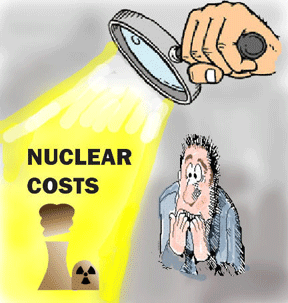
 And whatever sum of money was ever set aside, it’s nowhere near enough. Germany understands this. That’s why it refused to let E.ON spin off its nuclear liabilities into a hands-off company. But the UK, it seems, has lost the ability to learn from its nuclear mistakes.
Nuclear power has a wide spectrum of disadvantages.
One is that when reactors are shut down for good, a host of financial liabilities continue with no income flow from the sale of nuclear electricity to pay for them.
And enormous new liabilities for decommissioning and final disposal commence at the same time……
So what exactly are the liabilities?
The long term costs of nuclear power
Spent fuel. First is the managing of thousands of tonnes of spent fuel amassed over reactor lifetimes. The adjective ‘spent’ is perhaps misleading, as the fuel will remain extremely radioactive for decades, and progressively less radioactive for centuries……
Care, maintenance, defueling. Initially, nuclear utilities will be responsible for the continued cooling, care and maintenance of the final load of fuel in the reactor for about 5 years after closure. Then defueling takes another ~5 years.
Waste management and monitoring. Then utilities will have to carefully manage their still hot (both thermal and radioactive) spent fuel for a period of approximately 60 years either in ponds or in dry stores. After the initial 60 years of careful management, they will continue to be responsible for monitoring their cooling spent fuel for possibly up to another 240 years……..
Governments and nuclear enthusiasts have assured the public that final waste repositories are nigh. But they have been saying this since the start of nuclear power in the 1950s, with little to show for it. We should be prepared to accept the inconvenient truths that there is unlikely to be such a method for the long-term foreseeable future and that there may, in fact, be no such method.
Why do utilities have to manage their spent fuel for so long? The period of 300 years is derived from 10 half-lives of the 2 main dangerous radioisotopes, caesium-137 and strontium-90: both have ~30 year half-lives. A period of 10 half-lives reduces the radioactivity of the nuclear fuel by a factor of about 1,000 2, in this case 10 x 30 = 300 years.
Reactor hulks. Here the main nuclides of concern in reactor metalwork are cobalt-60 and iron-55, both with ~5 year half-lives. Applying the 10 half-life rule, means nuclear utilities will have look after the reactor hulks for at least 50 years. If it is found that their concrete containments are severely contaminated with tritium (hydrogen-3) with a half-life of 12 years, then about 10 x 12 = 120 years will be needed instead……..
Final nuclear waste repository. Finding a long term safe home for nuclear waste is the most expensive headache. There are no operating repositories in the world, and only one planned prototype repository (in Sweden). Such final nuclear waste dumps – if they are ever built – will not only be highly expensive but remain very contentious in all nuclear power countries.
Schemes for paying for nuclear wastes
The German Government has apparently proposed a deal to put nuclear liabilities (ie both spent fuel and decommissioning) in a trust, funded jointly by German nuclear utilities. This sounds a rational idea, but there’s something already like that for spent fuel in the US and its experience is discouraging 3…….
Will they ever learn? …
At the end of nuclear, onerous financial chickens come home to roost for nuclear utilities – and the squabbling begins as to who is going to carry the can. ……
In a nutshell, the problem is that a coal-fired or gas-fired power station can be decommissioned and dismantled in a few years, but nuclear reactors and their fuels could well take centuries. This means that nuclear end costs will inevitably be very large and remain contentious in all nuclear power countries. http://www.theecologist.org/News/news_analysis/2985577/when_the_partys_over_the_financial_spectre_at_the_end_of_nuclear_power.html
No comments yet.
1 This month

of the week – Australians for War Powers Reform (AWPR)
To see nuclear-related stories in greater depth and intensity
 Antinuclear
Leave a comment