Trans Pacific Partnership: lack of clarity about Investor State Dispute Settlement (ISDS)
“The rights given to investors are so open-ended and ambiguous that they allow for a lot of creative lawyering.”
Germany is in the midst of a $4.7-billion lawsuit occasioned by its decision to phase out nuclear power.
There’s nothing wrong with domestic courts reviewing government regulations, but outsourcing the responsibility to international tribunals is troubling
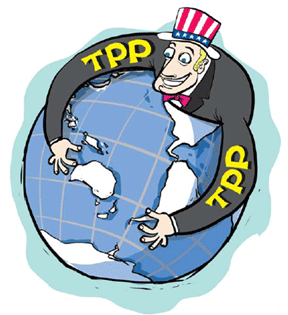 The Trans-Pacific Partnership: Good? or bad?, leisure guy 6 Oct 15 “……James Surowiecki in a brief New Yorker column describes some drawbacks:……….The case has yet to be decided, but the concerns it raises help explain President Obama’s embarrassing setback last week, when the House failed to give him fast-track authority over one of two big trade agreements that had been envisaged as a key part of his legacy. Both agreements—the Trans-Pacific Partnership, with eleven Asian and Pacific countries, and an agreement with Europe called the Transatlantic Trade and Investment Partnership—include provisions very like the ones at the heart of Australia’s fight with Big Tobacco. Known as Investor-State Dispute Settlement (or I.S.D.S.) provisions, they typically allow foreign investors to sue governments when they feel they have not received “fair or equitable treatment,” and to have their cases heard not by a domestic court but by an international arbitration tribunal made up of three lawyers.
These provisions have been opposed by an unusual coalition of progressives and conservatives, who contend that they will let multinationals override government policy, and, as Senator Elizabeth Warren put it, “undermine U.S. sovereignty.” On the other side, the Obama Administration and business groups insist that this is just fear-mongering. ………
This mission creep has been abetted by the fact that the language of I.S.D.S. provisions is often vague. Jason Yackee, a law professor at the University of Wisconsin who specializes in international-investment law, told me, “The rights given to investors are so open-ended and ambiguous that they allow for a lot of creative lawyering.” Canada lost a case where it had rejected, after an environmental study, a proposed mining and marine-terminal project. The country was also sued when Quebec imposed a moratorium on fracking. Germany is in the midst of a $4.7-billion lawsuit occasioned by its decision to phase out nuclear power. Uruguay is facing a lawsuit from Philip Morris International, much like the one brought against Australia.
There’s nothing wrong with domestic courts reviewing government regulations, but outsourcing the responsibility to international tribunals is troubling. …………
FROM The Financial Page JUNE 22, 2015 ISSUE
Trade-Agreement Troubles
No comments yet.
1 This month
7 April – WEBINAR – Australia and the Doomsday Clock – Preventing nuclear war through NoFirstUse and other policies
Online | Tuesday April 7, 4:00-5:30pm, Australian Eastern Time / 8:00-9:30am Central Europe Time
– Access the registration link
15 April – Zoom –Nuclear Power is Not the Solution
Apr 15, 2026 01:00 AM in Canberra, Melbourne, Sydney

Join the International Physicians for the Prevention of Nuclear War (IPPNW) on Tuesday, April 14th for a timely webinar exploring the risks associated with nuclear power and challenging the myth that it offers a simple, safe, carbon-free solution to the climate crisis

21 April Webinar: No Nuclear Weapons in Australia
Start: 2026-04-21 18:00:00 UTC Canberra, Melbourne, Sydney (GMT+10:00)
End: 2026-04-21 19:30:00 UTC Canberra, Melbourne, Sydney (GMT+10:00)
Event Type: Virtual
A virtual link will be communicated before the event.
Host Contact Info: australia@icanw.org

of the week – Australians for War Powers Reform (AWPR)
To see nuclear-related stories in greater depth and intensity
 Antinuclear
Leave a comment