Anti nuclear opinions excluded from #NuclearCommissionSAust’s hearings
 Philip White, 14 Oct 15 I know a few Australian anti-nuclear activists put
  themselves forward as candidates for the public hearings that the Royal Commission is now conducting. As far as I am aware, none of us has been offered an opportunity to present evidence at these hearings.
The nearest thing to anti-nuclear activists to present so far were Arjun Makhijani from the Institute for Energy and Environmental Research (USA) and Mark Diesendorf of the University of NSW. They both did a great job, but that does not excuse the Royal Commission for ignoring people who have been campaigning against various aspects of the nuclear fuel cycle for a couple of decades.
In my case, the Royal Commissioner offered me a “short extension” to make a “brief written submission”. No matter how he chooses to view it, I do not regard this as an extension to the original round of submissions, but rather as a submission “in lieu of an oral submission”.
I sent my submission on 21 September. It addressed an aspect of Issues Paper 3 (electricity generation). The Royal Commission has given no indication of whether or how it is going to consider it and, without giving me an outright refusal, has led me to believe that it has no intention of publishing it on its web site.
FoE Adelaide has therefore published it on its submissions page. You can find it immediately below FoE Adelaide’s original 4 submissions on the following page:
It requests them to bear in mind “how the nuclear industry has used its political and economic power to undermine renewable energy in Japan and other countries” and to learn from that “how expanding the role of the nuclear industry in South Australia is likely to impact on environmentally, socially and economically preferable alternatives”.
This political angle is something that I doubt very much that the Royal Commission wants to consider.
Uranium miner ERA should be made accountable for fire in Kakadu National Park
Federal Environment Minister Greg Hunt has committed to an inquiry into the fire. This is welcome but any inquiry needs to be open and transparent, not simply another yellowcake whitewash.
Kakadu has been burnt but it is ERA who should be in the firing line. The company lacks the commitment, capacity and competence to conduct such a dangerous trade in such a special place and the recent fire is further proof that it is time to close the chapter on uranium mining in Kakadu.
Uranium miner in the firing line over Kakadu burn http://www.sbs.com.au/news/article/2015/10/13/comment-uranium-miner-firing-line-over-kakadu-burn A week- long fire in the World Heritage listed Kakadu has caused significant environmental damage and threatened Aboriginal art and cultural sites, writes Dave Sweeney. The smoke is finally starting to settle over Australia’s largest national park. For a week Kakadu has been burning following the escape of a “controlled” fire lit by the uranium mining company Energy Resources of Australia.
In a case of good luck rather than good management, no one was seriously injured but, as the flames die down and the damage assessment and questions start up, more of ERA’s shrinking credibility has literally gone up in smoke.
While the full extent of the damage is not yet known, the fire burned over 200 square kilometres of the World Heritage listed Kakadu, causing significant environmental damage and threatening ancient and important Aboriginal art and cultural sites. Continue reading
Fall in quarterly production for uranium miner ERA
 ERA’s Sept quarter production falls, NT NewsAAP OCTOBER 13, 2015 THE Rio Tinto-owned company that recently shelved a major uranium mine expansion has reported a fall in quarterly production.
ENERGY Resources of Australia produced 457 tonnes of uranium oxide in the September quarter, down 19 per cent on the same quarter last year.
- Production was up 17 per cent on the June quarter, when output was impacted by a mill shutdown to carry out maintenance.All ore milled in the September quarter was taken from existing stockpiles, and no exploration expenditure was incurred during the quarter.ERA lost half its board in June after deciding a proposed new underground mine at Ranger in the Northern Territory will not proceed to a final feasibility study due to a sluggish uranium market.
 Rio Tinto has pulled its support for any expansion, but ERA continues to seek to extend its authority to operate Ranger in order to re-visit the expansion at some stage.
The company’s total evaluation expenditure for the September quarter dropped to $1 million, from $3 million in the June quarter, due to “close out activities” of its Ranger pre-feasibility study……..http://www.ntnews.com.au/business/era-sept-quarter-production-down-19-pct/story-fnjbnvte-1227567072625
Potentially catastrophic combination: nuclear waste facility and out of control fire
 I wonder if the South Australia Nuclear Fuel Chain Commission’s fudgy old pro nukers have considered increasing fire risks and the vulnerability of nuclear facilities?
 ‘Catastrophic’: Underground fire creeps towards nuclear waste site, news.com.au, OCTOBER 12, 2015 BENEATH the surface of a US landfill lurk two things that should never meet: a slow-burning fire and a cache of Cold War-era nuclear waste, separated by no more than 365 metres.
Government officials in Missouri have quietly adopted an emergency plan in case the smouldering embers ever reach the waste, a potentially “catastrophic event” that could send up a plume of radioactive smoke over a densely populated area near the city’s main airport.
Although the fire at Bridgeton Landfill, near St. Louis has been burning since at least 2010, the plan for a worst-case scenario was developed only a year ago and never publicised until last week, when St. Louis radio station KMOX first obtained a copy……..
Directly next to Bridgeton Landfill is West Lake Landfill, also owned by Republic Services. The West Lake facility was contaminated with radioactive waste from uranium processing by a St. Louis company known as Mallinckrodt Chemical. The waste was illegally dumped in 1973 and includes material that dates back to the Manhattan Project, which created the first atomic bomb in the 1940s.
The Environmental Protection Agency is still deciding how to clean up the waste. The landfill was designated a Superfund site in 1990.
The proximity of the two environmental hazards is what worries residents and environmentalists. At the closest point, they are 1,000 to 1,200 feet apart.
If the underground fire reaches the waste, “there is a potential for radioactive fallout to be released in the smoke plume and spread throughout the region,” according to the disaster plan.
The plan calls for evacuations and development of emergency shelters, both in St. Louis County and neighbouring St. Charles County. Private and volunteer groups, and perhaps the federal government, would be called upon to help, depending on the severity of the emergency…………
Last month, Koster said he was troubled by new reports about the site. One found radiological contamination in trees outside the landfill’s perimeter. Another showed evidence that the fire has moved past two rows of interceptor wells and closer to the nuclear waste.
Koster said the reports were evidence that Republic Services “does not have this site under control.”……..http://www.news.com.au/technology/environment/catastrophic-underground-fire-creeps-towards-nuclear-waste-site/story-e6frflp0-1227565910467
Nuclear industry, France’s former glory, has become a tale of woe
 Tale of woe in French nuclear sector, Ft.com, October 13, 2015, Michael Stothard Broken government promises, multibillion-euro delays and a key national champion rescued from the brink of failure: it has been a torrid year for the proud French nuclear industry.
Problems came to a head in August when Areva, the designer and builder of nuclear reactors around the world, was forced to strike a multibillion-euro rescue package deal with rival group EDF and the French government. It had been hit by foreign competition, the downturn in global nuclear demand following the 2011 Fukushima disaster and cost overruns. It had not sold a new reactor since 2007. It urgently needed to be put back on a “sound footing” to keep nuclear a “strength for our country,” said Manuel Valls, French prime minister, before the deal to sell much of the company to EDF………
The country is also a torchbearer for nuclear power as part of the European energy mix when many countries have retrenched following Fukushima. “There’s no doubt the global nuclear industry, including in France, is challenged and it is asking itself some profound questions since Fukushima,” says Jean-Marc Ollagnier, chief executive of Accenture’s resources operating group.
But for French nuclear the past five years have been a tale of technical problems and cost overruns that brought Areva to its knees and called into question the country’s ability to deliver on next generation technology.
These construction problems highlight the complexity of the EPR projects, and have led some to question if there is demand for these larger reactors, given their cost and size. The questions come at the same time as internal political ones, as France attempts to reduce its reliance on nuclear power.
President François Hollande, due to a deal struck between the anti-nuclear Green party and his ruling pro-nuclear Socialist party, has promised to reduce nuclear in the French energy mix from 75 to 50 per cent by 2025…….. Even if no plants are shut down for political reasons in the lead-up to 2025 there are still decisions to be made, all of which are likely to be expensive.
The grand carénage, increasing the life expectancy of the 30-year-old plants from their current 40 years to 50 years, is expected to cost EDF around €55bn, should it ever win political approval. Closing one nuclear plant has already proved difficult. Decommissioning Fessenheim, France’s oldest reactor on the German border, was promised by the government to happen by 2016. This year it was delayed until Flamanville comes online in 2018, leaving the government accused of breaking its promises……..http://www.ft.com/intl/cms/s/0/58036178-68f8-11e5-a57f-21b88f7d973f.html#axzz3oU6siWHM
Energy utilities face challenge as community energy increases
 Community energy projects pose challenge for mainstream suppliers, The Age, October 11, 2015 Angela Macdonald-Smith Energy Reporter A gradual loss of trust in mainstream electricity suppliers and a growing sense of local engagement have driven huge growth in community-based renewable-energy projects in Britain, with a similar trend potentially taking hold in Australia.
Volker Beckers, the former head of British energy supply giant Npower who now chairs London-based Albion Community Power, said traditional large energy suppliers risk losing customers to the smaller, local outfits.
Community ventures typically take advantage of community support to push renewable energy projects through planning processes, while building a customer base that in some cases in Britain have reached into the hundreds of thousands, eroding the market share of larger utilities. A surge in community energy projects in Britain, where they now number as many as 5000, was creating “healthy competition” for the big six utilities, which were having to quickly respond with increased customer focus, he said.
“Community energy means business models have to become more customer centric,” Mr Beckers told Fairfax Media while in Melbourne to attend a conference. “In my view the big utilities which can respond and adapt as quickly as the small-scale renewable-energy companies can do will survive. Others will have to completely redefine their business model.”
Mr Beckers pointed to research carried out in Europe that found the “net promoter score”, a recognised method of gauging the loyalty and support of a firm’s customers, was typically 20-35 per cent higher for community energy companies than traditional utilities. Support from a local community can be 20-30 per cent higher for a wind farm that is being built by a local company, for example, rather than a more anonymous mainstream utility, because people believe that the benefit of having local generation will flow back to that community.
Mr Beckers said the ventures were “an example of the shared economy in the energy area”, where people were more supportive of a product where it gets generated. That leads to lower administration and operating costs, with savings flowing back to customers in the community.
“It’s a win-win for both sides, customers and companies alike,” he said.
Australia has an increasing number of community energy projects, put at 70 by non-profit organisation Embark Australia, which works to accelerate the uptake of community renewable energy. About 16 are already generating power……….. http://www.theage.com.au/business/energy/community-energy-projects-pose-challenge-for-mainstream-suppliers-20151007-gk3vq3.html#ixzz3oUuoUgeT
Turnbull govt postpones effort to stop environmentalists using legal avenues
Anti-mine activist law changes delayed https://au.news.yahoo.com/a/29788659/anti-mine-activist-law-changes-delayed/ Federal government plans to stop environmental activists halting major projects through court action have been delayed until next year.
The Senate committee looking into the draft laws, drawn up by the Abbott government after the Federal Court overturned the approval of Adani’s $16.5 billion Carmichael coal mine, was due to report on Monday but has been given an extension until February 2016.
Government Senate leader George Brandis on Monday reconfirmed the coalition’s commitment to changing the law to restrict judicial reviews of environmental approvals to “aggrieved” people.
Nuclear facilities at an increasing risk of cyber sabotage
I wonder if the South Australia Nuclear Fuel Chain Commission’s fudgy old pro nuke fossils are awake up to this one?
New Report: Civilian Nuclear Facilities Are Just Begging to Be Hacked, Motherboard, by MICHAEL BYRNE 11 October 2015 Worldwide civilian nuclear infrastructure  is woefully underprepared for the likelihood of a cyberattack, according to a new report from researchers at Chatham House, a London-based think-tank. As facilities become more reliant on digital systems and off-the-shelf software, and as top-level awareness of cybersecurity threats stagnates, a serious event seems foretold.
“Recent high-profile cyber attacks, including the deployment of the sophisticated 2010 Stuxnet worm, have raised new concerns about the cyber security vulnerabilities of nuclear facilities,” begins an executive summary of the report. “As cyber criminals, states, and terrorist groups increase their online activities, the fear of a serious cyber attack is ever present.”
“This is of particular concern because of the risk—even if remote—of a release of ionizing radiation as a result of such an attack,” the summary continues. “Moreover, even a small-scale cyber security incident at a nuclear facility would be likely to have a disproportionate effect on public opinion and the future of the civil nuclear industry.”…….
You’re probably not going to get a bomb near a reactor core, but malicious code is another story. Continue reading
Broken Hill’s solar mega-plant operational this year
Broken Hill mega-plant solar panels lift the roof http://www.theaustralian.com.au/national-affairs/climate/broken-hill-mega-plant-solar-panels-lift-the-roof/story-e6frg6xf-1227565295647?sv=2fcdf280bb239bfc36e6b071c20e2458 OCTOBER 12, 2015 Sid Maher
The final panels on the biggest large-scale solar power station in the southern hemisphere will be installed at Broken Hill today, paving the way for the plant to be fully operational by year’s end.
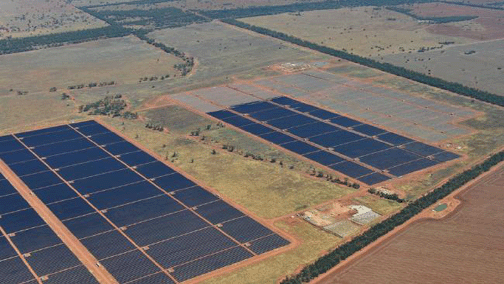
The 53-megawatt solar plant, a partnership between AGL and First Solar, will work in conjunction with the 102MW Nyngan solar plant to produce enough electricity to power about 50,000 average Australian homes. The Nyngan plant began operating six months ago. “There is a real sense of momentum driving large-scale solar in Australia today,’’ Australian Renewable Energy Agency acting chief executive Ian Kay said.
The large-scale solar plant begins operation as more than 1.4 million households in Australia have solar panels on their roofs, providing the highest penetration at the household level in the world.
However, the government is trying to drive more solar uptake at the commercial level as part of the 23.5 per cent renewable energy target. Environment Minister Greg Hunt has set a priority of increasing the uptake of utility- scale solar as part of the government’s renewable energy mix.
The government through ARENA had provided $166.7 million towards the $440m AGL Solar Project.
“As well as powering Australian homes with renewable energy, this project is also assisting AGL to transition towards a decarbonised economy. It’s a win-win scenario,’’ Mr Hunt said.
Mr said there was $350m available through ARENA and the Clean Energy Finance Corporation to further accelerate growth in the sector. ARENA has a $100m large-scale solar round that could double the capacity of large-scale solar.
AGL executive general manager group operations Doug Jackson said the Broken Hill Solar Plant was already generating up to 27MW of renewable energy into the grid and the remaining 26MW was expected to be brought on line this month.
First Solar’s regional manager for the Asia Pacific, Jack Curtis, said the project combined industry leading thin film modules and construction techniques. He said the Broken Hill plant contained 677,760 of First Solar’s advanced PV modules. The Cadmium Telluride modules offered significant efficiency and reliability advantages over typical crystalline silicon modules, Mr Curtis said.
National Affairs Editor
A network of micro-grids for Australia’s energy future?
 Australia’s energy future could be network of micro-grids http://reneweconomy.com.au/2015/australias-energy-future-could-be-network-of-micro-grids-84534 By Giles Parkinson on 13 October 2015
The creation of micro-grids is seen by many leading players as an obvious solution to Australia’s soaring electricity costs, where the grid has to cover huge areas, at the cost of massive cross-subsidies that support it.
The major network operators in Queensland, NSW, South Australia and Western Australia see micro-grids as an obvious solution to the challenge and cost of stringing networks out, sometimes more than 1,000km away from the source of generation.
In Western Australia and Queensland, these subsidies amount to more than $500 a household. The cost of service to regional consumers in Queensland is far above the cost of service to those in the south-east corner. To address this, these states are proposing to take some small communities, and towns like Ravensthorpe in Western Australia off the grid. In New South Wales, some towns are taking the initiative themselves.
In northern rivers region, the township of Tyalgum revealed it is considering a micro-grid that would allow it to largely, or entirely, look after its own energy needs.
Indeed, the whole Byron shire is considering micro-grids as part of its efforts to become “zero net emissions” within the next decade, and to source 100 per cent of its electricity needs from renewables.
But micro-grids are not just about grid defection. While it will make sense for those towns and communities at the edge of the network to become self-sufficient and disconnect entirely, most micro-grids will remain connected to the network, helping to reshape a centralised grid to one focused on more efficient decentralised renewable power generation sources and storage. Continue reading
Australia’s govt urged to push renewable energy – ‘All Energy Australia’ in Melbourne
‘All Energy Australia’ in Melbourne urges federal government to hike investment in renewable energy, IBT, By Kalyan Kumar @diplomatist10 on October 09 2015 All-Energy Australia’s conference and exhibition held in Melbourne on Oct. 7 and 8 drew a huge turnout and the event concluded with a clarion call to Australia to catch up with the rest of the world by increasing the investment in the renewable energy sector.
The keynote of Chairman for the Committee on Climate Change, Lord Deben was significant. He urged Australian policy makers to “wake up early enough” and encourage the industry to stay optimistic and remember that “we have the future in our hands in a way that no one has ever had before.”……..
Addressing the event, Leader of the Opposition Bill Shorten said Australia was an energy superpower with so much renewable resources at its command to power “five hundred times over.” But he regretted that the country is trailing behind in the renewables’ revolution due to the impasse over Renewable Energy Target……
Shorten said solar power will dominate Australia’s clean energy revolution and battery storage will also gain traction. “Morgan Stanley has found that the solar and battery storage market could grow to 2.4 million Australian homes,” Shorten added. http://www.ibtimes.com.au/all-energy-australia-melbourne-urges-federal-government-hike-investment-renewable-energy-1473163
Melting Antarctic ice shelves: climate policy will make a difference
 New study projects that melting of Antarctic ice shelves will intensify http://www.eurekalert.org/pub_releases/2015-10/whoi-nsp100915.phpWOODS HOLE OCEANOGRAPHIC INSTITUTION New research published today projects a doubling of surface melting of Antarctic ice shelves by 2050 and that by 2100 melting may surpass intensities associated with ice shelf collapse, if greenhouse gas emissions from fossil fuel consumption continue at the present rate.
Ice shelves are the floating extensions of the continent’s massive land-based ice sheets. While the melting or breakup of floating ice shelves does not directly raise sea level, ice shelves do have a “door stop” effect: They slow the flow of ice from glaciers and ice sheets into the ocean, where it melts and raises sea levels.
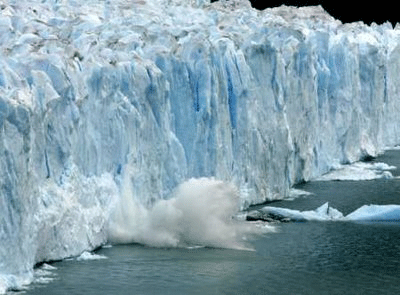
“Our results illustrate just how rapidly melting in Antarctica can intensify in a warming climate,” said Luke Trusel, lead author and postdoctoral scholar at Woods Hole Oceanographic Institution (WHOI). “This has already occurred in places like the Antarctic Peninsula where we’ve observed warming and abrupt ice shelf collapses in the last few decades. Our model projections show that similar levels of melt may occur across coastal Antarctica near the end of this century, raising concerns about future ice shelf stability.”
The study, published Oct. 12, 2015, in Nature Geoscience, was conducted by Trusel, Clark University Associate Professor of Geography Karen Frey, WHOI scientists Sarah Das and Kristopher Karnauskas, Peter Kuipers Munneke and Michiel R. van den Broeke of the Institute for Marine and Atmospheric Research Utrecht University, and Erik van Meijgaard of the Royal Netherlands Meteorological Institute. Continue reading
The importance of Antarctic ice shelves
Why scientists are so worried about the ice shelves of Antarctica, WP, By Chelsea Harvey October 12 When it comes to climate change, Antarctica is one of the world’s major places of concern, mostly because of the sheer amount of ice it contains — enough to theoretically cause about 200 feet of sea-level rise if it were all to melt — not that anyone thinks that will happen anytime soon. Still, smaller parts could be destabilized, and understanding how the Antarctic ice sheet will react to future climate change is a big priority for scientists.
One important key to building this understanding is studying Antarctic ice shelves, which are large, floating platforms of ice — sometimes spanning hundreds or thousands of square miles — that form where where an ice sheet meets the ocean.
“They play an incredibly important role in constraining the flow of this land ice into the ocean,” says Luke Trusel, a postdoctoral scholar at the Woods Hole Oceanographic Institution, comparing ice shelves to the “cork in a champagne bottle.” If an ice shelf breaks off, it can unleash a flow of ice into the ocean from the ice sheet behind it, which can contribute to sea-level rise in a major way. Indeed, without ice shelves to provide buttressing, glaciers behind the ice shelves flow faster, pouring more and more ice into the ocean.
[Scientists declare an ‘urgent’ mission – study West Antarctica, and fast] Continue reading
To meet climate goals, Australia must double decarbonisation
 Australia must double decarbonisation rate to meet 2030 goals, report finds, Guardian, Oliver Milman, 13 Oct 15 Coalition claims nation is making good progress towards cutting emissions by 26% by 2030, but report by PricewaterhouseCoopers shows more is needed The federal government has said it is making good progress in cutting greenhouse gases after a new report found that Australia will have to double its historic rate of decarbonisation if it is to meet its climate goals.
Australia will have to slash its carbon intensity by 4.4% each year if it is to meet its goal of reducing emissions by at least 26% by 2030, based on 2005 levels, according to the PricewaterhouseCoopers (PwC) analysis.
This rate of required emissions reduction is nearly double the average 2.4% cut managed by Australia annually since 2000.
Australia’s rate of decarbonisation is among the best of the world’s largest economies, PwC said. If Australia maintained its 4.7% reduction in carbon intensity in 2014, it could hit the 2030 target. However, the 2014 figure includes six months during which the former Labor government’s carbon price of $24 a tonne was in place…….
According to the PwC analysis, the global economy has reduced its carbon intensity, which is emissions related to economic growth, by 1.3% a year since 2000. Last year saw the biggest drop yet, at 2.7%.
But these reductions are still not enough to meet the 2C target, which, if exceeded, will result in runaway climate change associated with punishing drought, damaging sea level rises and extreme weather events.
If current emissions cuts are maintained, the world will spew out enough heat-trapping gases to exceed the 2C limit by 2036, PwC said. The European Commission has said that national pledges to further cut emissions ahead of climate talks in Paris in December will still result in a 3C rise in average temperatures.
The federal government has said Australia’s emission reduction target places it among comparable nations although independent analysis suggests it lags at the back of the pack.
Australia still lacks a comprehensive plan to reduce emissions beyond a $2.55bn emissions reduction fund that hands out money to businesses that wish to reduce their greenhouse gas output. Analysts believe this plan will fall well short of the target without major modification, potentially including emissions trading, which the government has previously ruled out.
Australia’s energy is still overwhelmingly fossil fuel based, with coal, oil and gas accounting for 94% of the country’s energy demands, PwC said. However, coal consumption has slipped 18% since 2009 and energy from renewables such as wind and solar has increased by 72% over the same period.
Greens senator Larissa Waters said: “The Abbott government’s attacks on renewable energy are continuing under Malcolm Turnbull who has made a deal with the Nationals to retain the low 2030 target and not bring back an emissions trading scheme.
“We’re missing out on clean energy jobs because the Turnbull government is holding us back from this exciting transition that we need to save our environment and very way of life.”……… http://www.theguardian.com/environment/2015/oct/13/australia-must-double-decarbonisation-rate-to-meet-2030-goals-report-finds
Australia needs a new national identity – blending black and white
Paul Keating calls for blending of black and white Australia to create new national identity, SMH, October 8, 2015 Andrew Taylor Deputy Arts Editor, The Sydney Morning Herald Australians will only be at peace with themselves when they identify more with Indigenous Australians, according to former prime minister Paul Keating.
Genuine reconciliation also requires blending “two very different cultures” to create a composite Australian identity that both black and white communities can identify with, Mr Keating will say in a speech prepared for the opening of the Tarnanthi Festival of Contemporary Aboriginal and Torres Strait Islander Art at the Art Gallery of South Australia on Thursday. We had seized the land so violently and dispossessed its inhabitants so shamelessly – that our only way back – back to being at one and at pe ace with ourselves, was to identify more with Aboriginal Australia, while atoning for our opportunist and brutal behaviour,” Mr Keating says.
Mr Keating says addressing land rights is crucial to the process of creating a new Australian identity.
“The Native Title Act, on which I spent a large proportion of my period as prime minister – enshrines in the law of the land – the notion of Aboriginality, not only in its ownership but in lifting the relevance of culture and the virtue of customary tradition,” he says.
In his speech, Mr Keating says Aboriginal art and the land are inseparable: “This has produced the greatest and longest collective memory of any continuous culture and is still largely uncompromised.”
He also says native title will eventually extend over more than half of Australia’s land mass.
“[As] people here know, over time, the Native Title Act will return well over half the continent to its rightful owners,” he says. “Aboriginal art and its expression will be important in this. It is already important.
“Contemporary Aboriginal art still carries sacred messages through its symbols and materials – still managing to hold its secrets while speaking to a broader audience.”……
Mr Keating will conclude his speech by arguing Aboriginal art has influenced how non-Aboriginal Australians view themselves.
Aboriginal art has, since the 1970s, been a conduit, a medium, first of curiosity, then of a greater understanding of the Aboriginal people,” he says.
“It has been a method of translating an entire culture and of understanding an entire continent and has been a major influence in obliging Australians to come to terms with the question of who and what we are. Contemporary Aboriginal art moves us further along that road – both describing while revealing the journey.” http://www.smh.com.au/entertainment/art-and-design/paul-keating-calls-for-blending-of-black-and-white-australia-to-create-new-national-identity-20151008-gk4j80.html#ixzz3oTrAAGnq
1 This month
Chernobyl: The Lost Tapes – A good documentary on Chernobyl on SBS available On Demand for the next 3 weeks– https://www.sbs.com.au/ondemand/tv-program/chernobyl-the-lost-tapes/2352741955560
15 April – Zoom –Nuclear Power is Not the Solution
Apr 15, 2026 01:00 AM in Canberra, Melbourne, Sydney

Join the International Physicians for the Prevention of Nuclear War (IPPNW) on Tuesday, April 14th for a timely webinar exploring the risks associated with nuclear power and challenging the myth that it offers a simple, safe, carbon-free solution to the climate crisis

21 April Webinar: No Nuclear Weapons in Australia
Start: 2026-04-21 18:00:00 UTC Canberra, Melbourne, Sydney (GMT+10:00)
End: 2026-04-21 19:30:00 UTC Canberra, Melbourne, Sydney (GMT+10:00)
Event Type: Virtual
A virtual link will be communicated before the event.
Host Contact Info: australia@icanw.org

of the week – Australians for War Powers Reform (AWPR)
To see nuclear-related stories in greater depth and intensity
 Antinuclear