The importance of Antarctic ice shelves
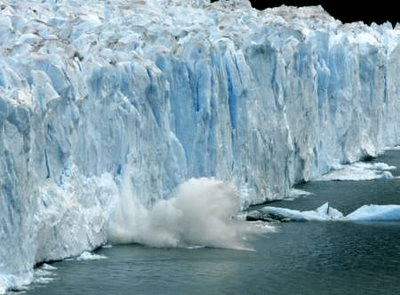 Why scientists are so worried about the ice shelves of Antarctica, WP, By Chelsea Harvey October 12 When it comes to climate change, Antarctica is one of the world’s major places of concern, mostly because of the sheer amount of ice it contains — enough to theoretically cause about 200 feet of sea-level rise if it were all to melt — not that anyone thinks that will happen anytime soon. Still, smaller parts could be destabilized, and understanding how the Antarctic ice sheet will react to future climate change is a big priority for scientists.
One important key to building this understanding is studying Antarctic ice shelves, which are large, floating platforms of ice — sometimes spanning hundreds or thousands of square miles — that form where where an ice sheet meets the ocean.
“They play an incredibly important role in constraining the flow of this land ice into the ocean,” says Luke Trusel, a postdoctoral scholar at the Woods Hole Oceanographic Institution, comparing ice shelves to the “cork in a champagne bottle.” If an ice shelf breaks off, it can unleash a flow of ice into the ocean from the ice sheet behind it, which can contribute to sea-level rise in a major way. Indeed, without ice shelves to provide buttressing, glaciers behind the ice shelves flow faster, pouring more and more ice into the ocean.
[Scientists declare an ‘urgent’ mission – study West Antarctica, and fast]
In order to get a better grip on how climate change could affect Antarctic ice shelves, Trusel and a group of other researchers conducted a study to see how rising air temperatures might affect surface melting in Antarctica. This is a process that can directly influence the destabilizing of ice shelves.
Past observations have shown that as ice melts on a shelf’s surface, the melted water starts to pool, or “pond,” and trickle down into imperfections in the ice, causing the cracks to deepen and widen — which can eventually cause ice shelves to collapse, unleashing the flow of land ice behind them.
“Increases in air temperature, and surface melt and ponding, has led to the abrupt and catastrophic collapse of a number of ice shelves,” says Trusel, lead author of the study, which was published Monday in Nature Geoscience. These collapses have mostly been observed on the Antarctic Peninsula, where the thinning and retreat of ice shelves has been particularly pronounced, thanks to higher-than-average warming in the area. The concern, though, is that more ice shelves that ring around Antarctica, including its colder regions, will start to give way as temperatures continue to rise and that other more inland parts of Antarctica will then follow suit.
The researchers used models to investigate the potential future impacts of two different climate scenarios: a “business-as-usual” trajectory, in which greenhouse gas emissions continue to rise throughout the century, and a more middle-of-the-road trajectory, in which emissions start declining before mid-century and there’s less associated global warming.
They found that under both scenarios, Antarctic-wide surface melt doubles by the year 2050, with the amount of meltwater produced coming close to 200 gigatons per year (a gigaton is a billion metric tons). This is a troubling finding, said Nerilie Abram, a researcher from the Centre of Excellence for Climate System Science at Australian National University who was not involved with the study, in an e-mail to The Post. But, she said, “I think that the more interesting result is to look at the huge divergence in predicted Antarctic ice melt during the second half of the century.”
After 2050, the projections for the two climate scenarios differ drastically. In the middle-of-the-road scenario, melt doesn’t increase much after mid-century. But in the business-as-usual scenario, melt continues to speed up, eventually hitting a rate of more than 600 gigatons per year by the end of the century.
“The most important results are … that we can see how quickly melting can evolve,” Trusel said. The results suggest that ice shelf surface melting increases exponentially with air temperature……….
One of the most important takeaways from the paper is “how important human action is on the climate of Antarctica,” Trusel added in a follow-up e-mail to The Post. Past observations show that humans have already altered the face of the continent, and the projections suggest that we have the power to continue doing so, he said.
“This shows that we do have a choice in how the Earth changes over the coming century,” said Abram, the researcher from Australian National University. “[We have] the option of a future where many of Antarctica’s ice shelves are still viable if we can curb emissions, compared to a future where many of Antarctica’s remaining ice shelves will probably have been lost if we continue our current emissions trajectory.” http://www.washingtonpost.com/news/energy-environment/wp/2015/10/12/why-scientists-are-worried-about-the-ice-shelves-of-antarctica/
No comments yet.
1 This month
Chernobyl: The Lost Tapes – A good documentary on Chernobyl on SBS available On Demand for the next 3 weeks– https://www.sbs.com.au/ondemand/tv-program/chernobyl-the-lost-tapes/2352741955560
15 April – Zoom –Nuclear Power is Not the Solution
Apr 15, 2026 01:00 AM in Canberra, Melbourne, Sydney

Join the International Physicians for the Prevention of Nuclear War (IPPNW) on Tuesday, April 14th for a timely webinar exploring the risks associated with nuclear power and challenging the myth that it offers a simple, safe, carbon-free solution to the climate crisis

21 April Webinar: No Nuclear Weapons in Australia
Start: 2026-04-21 18:00:00 UTC Canberra, Melbourne, Sydney (GMT+10:00)
End: 2026-04-21 19:30:00 UTC Canberra, Melbourne, Sydney (GMT+10:00)
Event Type: Virtual
A virtual link will be communicated before the event.
Host Contact Info: australia@icanw.org

of the week – Australians for War Powers Reform (AWPR)
To see nuclear-related stories in greater depth and intensity
 Antinuclear
Leave a comment