Global warming set to disappear vast Alpine glacier
Vast Alpine glacier could almost vanish by 2100 due to warming, Reuters, Reporting by Alister Doyle; Editing by Frances Kerry GREAT ALETSCH GLACIER, SWITZERLAND | BY DENIS BALIBOUSE One of Europe’s biggest glaciers, the Great Aletsch, coils 23 km (14 miles) through the Swiss Alps – and yet this mighty river of ice could almost vanish in the lifetimes of people born today because of climate change.
The glacier, 900 meters (2,950 feet) thick at one point, has retreated about 3 km (1.9 miles) since 1870 and that pace is quickening, as with many other glaciers around the globe.
That is feeding more water into the oceans and raising world sea levels…….
even the Great Aletsch glacier, the biggest in the Alps and visible from space, is under threat from the build-up of greenhouse gases in the atmosphere from factories, power plants and cars that are blamed for global warming.
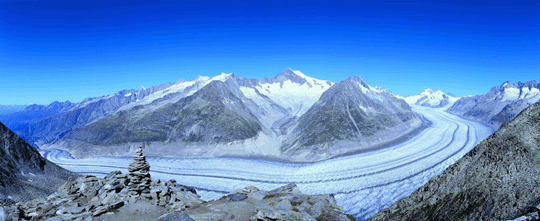
Andreas Vieli, a professor who heads the University of Zurich’s group of glaciology experts, said the Aletsch may lose 90 percent of its ice volume by 2100, with the lower reaches melting away.
“My kids are going to see a very different scenery in the Alps,” he said.
And on the ice, Aletsch guide Richard Bortis said, “if I stay on the glacier for several days … I can even see the changes myself.”
The glacier is a vast water reserve, important for irrigation and hydroelectric power……For glaciers around the globe, from the Andes to Alaska, rising temperatures mean that the volume lost from the summer melt exceeds snows that replenish the glaciers’ ice in winter. The Aletsch flows downhill at about 180 meters (590 feet) a year.
The World Glacier Monitoring Service says “the rates of early 21st-century mass loss are without precedent on a global scale” at least since measurements began around 1850.
Representatives from almost 200 governments will meet in Paris from Nov. 30-Dec. 11 to try to agree ways to curb greenhouse gas emissions.
The United Nations’ panel of climate scientists says sea levels are set to rise by between 26 and 82 cm (10 and 31 inches) by the late 21st century, after a gain of about 20 cm (8 inches) since 1900, partly fed by water from melting glaciers. Rising oceans are a threat to places from San Francisco to Shanghai, to low-lying Pacific atolls and large parts of Bangladesh…… http://www.reuters.com/article/2015/10/15/us-climatechange-summit-earthprints-swit-idUSKCN0S914A20151015
1 Comment »
Leave a comment
1 This month

of the week – Australians for War Powers Reform (AWPR)
To see nuclear-related stories in greater depth and intensity
 Antinuclear
Thank you for the information. I urge more scientists to join ResearchGate because it encourages a diversity of opinions and posts figures of the experimental data at the very start of research papers. See, for example
https://www.researchgate.net/publication/280133563
http://www.researchgate.net/publication/281017812
LikeLike