Small Nuclear Reactors lobby turns to Australia, as safety rules too strong in USA
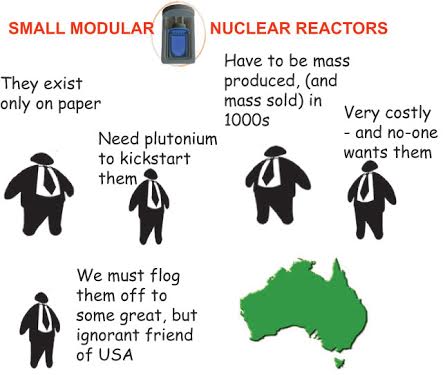 Why Australia is important to the Small Nuclear lobby. Independent Australia
the nuclear lobby’s spiel to Australia is something different, and very original. No dispute — because the argument is that small reactors would further the large reactor industry.
First articulated by Oscar Archer on ABC RN, March 2015, the idea is that Australia, in setting up small nuclear reactors, would enable the conventional nuclear industry and uranium mining to flourish:….. As Archer says, Australia would indeed be the pioneer for the new technology.
And that’s what the USA “new nuclear” lobby desperately needs. They need this, because they’re finding it impossible to go ahead in America. Why? Well it’s those pesky safety regulations imposed by the Nuclear Regulatory Commission.
What the “Small Nuclear” lobby needs is a “nuclear friendly” country – one with less stringent safety
 regulations – to set up their nuclear reactors on a test site. Hence the enthusiasm of those lobbyists for the South Australia Nuclear Fuel Chain Royal Commission, as shown, for example, in a recent Royal Commission hearing speech by Thomas Marcille of Holtec International nuclear company.
……… the Nuclear Regulatory Commission(NRC) has proved to be real nuisance since it tightened regulations for the licensing process after the Fukushima nuclear disaster. The new nuclear marketers have had to go overseas, first to China, then perhaps to Australia?…. https://independentaustralia.net/environment/environment-display/why-australia-is-important-to-the-small-nuclear-lobby,8263
ERA concedes defeat on Ranger uranium mining extension
ERA concedes defeat on Ranger uranium mining extension, http://www.australianmining.com.au/news/era-concedes-defeat-on-ranger-uranium-mining-exten
 Australian Mining, 15 October, 2015 Ben Hagemann Energy Resources Australia has run up the white flag on continuing to mine for uranium at Ranger beyond 2021.
A statement from ERA this afternoon revealed the Mirrar Traditional Owners and Gundjeihmi Aboriginal Corporation do not support an extension to the authority to mine at Ranger, in Kakadu National Park.
A statement from ERA said the company respected the views of the Traditional Owners, and would undertake a business review in light of their decision.
“In light of this development, ERA has commenced a process of assessing whether the company’s assets may be impaired,” the company said.
The news was welcomed by Environment Centre NT, where Nuclear Free campaigner Lauren Mellor said it was time for “the era of rehabilitation and a staged and managed exit from Kakadu to begin”.
“ERA must now accept full financial responsibility for the costly and complex task of rehabilitation, accept Rio’s funding offer and cooperate with all stakeholders in the transition to a post-mining phase of operations,” Mellor said.
In July parent company Rio Tinto acknowledged the need to make up any shortfall in the costs of rehabilitating the Ranger mine, and offered a $300 million conditional credit facility to ensure ERA would not falter in their obligations to rehabilitate the site.
The Environment Centre NT has called for the NT and Federal government to set up a post-mining transitional stakeholder task force to oversee the clean-up and ensure local community, traditional owners and other stakeholders are protected throughout the process.
Narrow chance left to prevent catastrophic collapse of Antarctic ice shelves
the results leave a narrow opening through which humanity can slip. If temperatures remain within 2C (3.6F), the collapse of the shelves will stabilise and the sheets will remain mostly intact. Sea-level rise from Antarctica would remain within 23cm (9 inches) by 2300.
To achieve this, the authors said the world will have to follow the Intergovernmental Panel on Climate Change’s (IPCC) lowest emissions scenario.This requires global emissions to peak around 2020 and decline to below zero by 2100.
The new study “ultimately confirm[s] the suspicions of earlier glaciologists that the fate of ice shelves largely determines whether Antarctica contributes less than 1 metre or up to 9 metres to long-term sea-level rise”
 Antarctic ice sheets face catastrophic collapse without deep emissions cuts, http://www.theguardian.com/environment/2015/oct/14/antarctic-ice-sheets-face-catastrophic-collapse-without-deep-emissions-cuts Guardian, Karl Mathiesen, 15 Oct 15
Study finds that a global temperature increase of 3C would cause ice shelves to disappear, triggering sea-level rise that would continue for thousands of years. A team of researchers has found that steep cuts to emissions during the next decade are the only way to avoid a catastrophic collapse of Antarctic ice sheets and associated sea-level rise that will continue for thousands of years.
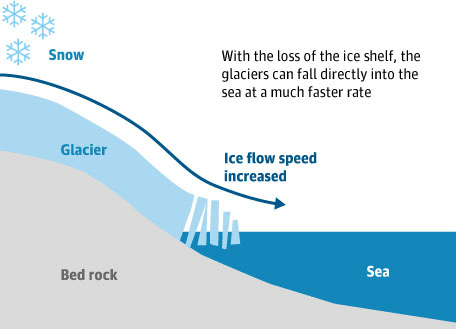
The study, published in the journal Nature on Wednesday, found that should the global temperature increase to around 3C (5.4F) above the pre-industrial era then the ice shelves that hold back the giant continental ice sheets would be lost over the next few centuries. Continue reading
South Australia: subsidy for large-scale solar photovoltaic (PV) projects
 Rooftop solar subsidies for SA business http://www.heraldsun.com.au/news/breaking-news/rooftop-solar-subsidies-for-sa-business/story-fni0xqi4-1227569000315
CLIMATE Change Minister Ian Hunter says the subsidy for large-scale photovoltaic (PV) projects, between 10 and 50 megawatts, will help businesses take advantage of a $100 million commonwealth funding pool aimed at increasing the uptake of solar panels.
“This is a great opportunity for potential developers to bring the cost of solar PV down to a price comparable to wind energy,” Climate Change Minister Ian Hunter said on Wednesday.
Another U.S Nuke Bites the Dust
 http://ecowatch.com/2015/10/14/nuclear-power-bites-dust/ Harvey Wasserman | October 14, 2015 The chain reactor operator Entergy has announced it will close the Pilgrim nuke south of Boston. The shut-down will bring U.S. reactor fleet to 98, though numerous other reactors are likely to face abandonment in the coming months.
But Entergy says it may not take Pilgrim down until June 1, 2019—nearly four years away.
Entergy is also poised to shut the FitzPatrick reactor in New York. It promises an announcement by the end of this month. Entergy also owns Indian Point 2 and Indian Point 3 some 40 miles north of Manhattan. Unit 2’s operating license has long since lapsed. Unit 3’s will expire in December.
Meanwhile California’s two reactors at Diablo Canyon are surrounded with earthquake faults. They are in violation of state and federal water quality laws and are being propped up by a corrupt Public Utilities Commission under fierce grassroots attack. With a huge renewable boom sweeping the state, Diablo’s days are numbered—and hopefully will shut before the next quake shakes them to rubble.
Meanwhile, like nearly all old American nukes, both Pilgrim and FitzPatrick are losing tons of money. Entergy admits to loss projections of $40 million/year or more at Pilgrim, with parallel numbers expected at FitzPatrick. The company blames falling gas and oil prices for the shortfalls.
Owners of King CONG (Coal, Oil, Nukes and Gas) facilities hate renewables. But in fact the boom in wind, solar, increased efficiency and other Solartopian advances are at the real core of nuke power’s escalating economic melt-down.
The plummeting prices of green power are fast undercutting the economics of America’s aging reactor fleet. They are also chopping into the use of coal and gas, whose costs are rising. Renewables are essentially free at the margin. So green power voids the “baseline” function of both nuke and fossil fuel generators. Continue reading
Solar electricity’s price tag has plummeted 70 percent

 Solar Energy Sees Eye-Popping Price Drops Solar electricity’s price tag has plummeted 70 percent, says a new report, as SolarCity rolls out a low-cost, super-efficient panel. By Christina Nunez, National Geographic OCT 02 2015 “…….The figure, cited in a report this week from Lawrence Berkeley National Laboratory, coincides with SolarCity’s debut Friday of what it calls the world’s most efficient rooftop solar panel. The largest residential solar installer in the U.S. says its module can produce 38 percent more power than a standard one, yet costs less to produce.
Not bad for an industry that had no large-scale U.S. presence just a decade ago. Photovoltaic panels currently contribute only about 1 percent of all electricity, but lower costs are helping fuel the expansion of large, utility-size projects.
As historic UN climate talks near, solar’s latest strides are key in the worldwide race to slash carbon emissions by paring back dependence on fossil fuels. (See surprising countries where wind and solar are booming.)……….
The falling price of power from large-scale solar projects reflects the lower cost of building them. The report notes that cost fell by more than 50 percent between 2009 and 2014. At the same time, solar farms have seen a “notable improvement” in how much power they put out, thanks to smarter siting and better technology.
SolarCity is aiming to apply its own gains in efficiency and cost to the residential market when it begins production at its 1-gigawatt facility in Buffalo, New York, in early 2017. Its new rooftop panel, which earned a rating of 22.04 percent efficiency in a third-party certification test, surpasses an earlier record set by SunPower, which has a high-efficiency model rated at 21.5 percent.
Another trend Bolinger called “encouraging”: Solar’s reach is expanding. Most development has been centered in the Southwest, but Bolinger says big solar power contracts are cropping up in Alabama, Arkansas, Florida, and Georgia—states that “haven’t seen much solar development in the past to speak of.” http://news.nationalgeographic.com/energy/2015/10/151002-solar-energy-sees-eye-popping-price-drops/
GetUp!: Tell Josh Frydenberg: No money for Adani!

“Without federal assistance, Adani’s Carmichael coal mine and Abbot Point coal port are as good as cooked. When asked about funding Adani’s coal project on Radio National this morning, Resources Minister Josh Frydenberg suggested, “Adani needs to stand on its own two feet… it wouldn’t be
a priority project for the Commonwealth.”
They’re encouraging words, but it’s far from a concrete promise. If enough of us reach out right now, we can show Minister Frydenberg just how popular a solid commitment would be.
It could be enough to get him over the line. Can you email Josh Frydenberg’s office and ask him to
rule out Government handouts for Adani?
Adani coal mine approval ‘grossly irresponsible’
Australian Conservation Foundation, October 15, 2015 Federal environment minister Greg Hunt’s approval of what could become one of the world’s largest coal mines sets back global efforts to combat climate change, the Australian Conservation Foundation said today.
“To approve a massive coal mine that would make species extinct, deplete 297 billion litres of precious groundwater and produce 128.4 million tonnes of CO2 a year is grossly irresponsible,” said ACF President Geoff Cousins.

“At a time when the world is desperately seeking cleaner energy options this huge new coal mine will make the effort to combat climate change all the more difficult.”
If it goes ahead the Carmichael mine would be the largest ever dug in Australia. It would take up five times the area of Sydney Harbour. The climate pollution resulting from burning its coal would be more than New Zealand’s entire annual emissions.
In August the Federal Court set aside Minister Hunt’s original approval of Adani’s controversial proposal to dig the massive coal mine in Queensland’s Galilee Basin.
Minister Hunt’s re-approval of the Carmichael coal mine flies in the face of rising public opposition to the proposal and scientific evidence that shows the mine would destroy 10,000 hectares of habitat for endangered species, including the largest known population of the southern black-throated finch.
“Tens of thousands of ACF supporters from all over Australia have written to Greg Hunt, asking him to reject the Carmichael mine once and for all,” Mr Cousins said.
“Just as Woodside lost its social license to build a gas factory at James Price Point in the Kimberley, most Australians do not want Adani to dig a massive coal mine and export the coal across the Great Barrier Reef.
“ACF will scrutinise this approval decision and carefully consider our options.
“We will use all appropriate means to stop this mine,” Mr Cousins said.
ACF and other environment groups ran ads in major newspapers in August urging Minister Hunt not to re-approve Adani’s Carmichael proposal.
1 This month
7 April – WEBINAR – Australia and the Doomsday Clock – Preventing nuclear war through NoFirstUse and other policies
Online | Tuesday April 7, 4:00-5:30pm, Australian Eastern Time / 8:00-9:30am Central Europe Time
– Access the registration link
15 April – Zoom –Nuclear Power is Not the Solution
Apr 15, 2026 01:00 AM in Canberra, Melbourne, Sydney

Join the International Physicians for the Prevention of Nuclear War (IPPNW) on Tuesday, April 14th for a timely webinar exploring the risks associated with nuclear power and challenging the myth that it offers a simple, safe, carbon-free solution to the climate crisis

21 April Webinar: No Nuclear Weapons in Australia
Start: 2026-04-21 18:00:00 UTC Canberra, Melbourne, Sydney (GMT+10:00)
End: 2026-04-21 19:30:00 UTC Canberra, Melbourne, Sydney (GMT+10:00)
Event Type: Virtual
A virtual link will be communicated before the event.
Host Contact Info: australia@icanw.org

of the week – Australians for War Powers Reform (AWPR)
To see nuclear-related stories in greater depth and intensity
 Antinuclear
