Australia’s nuclear/uranium giants don’t want nuclear technology (just waste dumping)
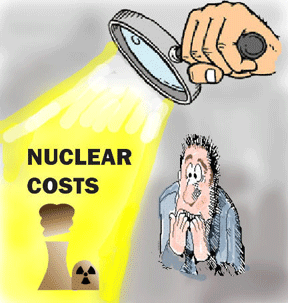 government has guaranteed to pay £92.50 a megawatt hour for power. At current exchange rates that works out at $198.91mwh. The average spot price for electricity across Australia on Tuesday was $39.89mwh.
That gap demonstrates the quantum of incentive that Australia might need to attract the capital necessary to establish a footprint in nuclear power.
Nuclear warriors reject power and enrichment, AFR, by Matthew Stevens, 31 Oct 15, Hugh Morgan has been an apostle of the nuclear industry for more than 30 years. Australia’s biggest uranium mine, Olympic Dam, opened under Morgan’s watch as chief executive of Western Mining. And, to the ridicule of many, one of Morgan’s retirement projects was a business set up a decade ago that aimed to build nuclear power stations in Australia.
You might imagine Melbourne’s miner of legend is pretty excited about the quite sudden emergence of some level of national political consensus over South Australia’s attempt to expand its place in the nuclear energy cycle.
But Malcolm Turnbull’s support for a nuclear fuel industry based in South Australia is no Toyota moment for Morgan. And neither is our favourite defender of all things atomic tempted to excitement by Bill Shorten’s observation that an Australian nuclear industry should have been established years ago.
Morgan, you see, remains ever the financial rationalist. For sure, he welcomes broadest possible investigation of any and all the energy options that are available to Australia. But the decisions that need to be made about electricity generation in particular need to be informed by “their competitiveness and any other impacts that might arise from that production”.
“There is a certain correlation between our standard of living and our international competitiveness,” Morgan warns. “Higher energy costs come with lower living standards. And the converse is true. The energy consumption per unit of standard of living is a dominant feature in all the data. So, in every sense, the community has a real interest in understanding all the energy sources and all the energy costs.”
Implicit in the Morgan commentary is that nuclear power is an uncompetitive option for Australia. In other words, nuclear power is wildly expensive to build and, apparently, dauntingly expensive to consume. Australia has plenty of cheaper options and it should stick with them.
That gap demonstrates the quantum of incentive that Australia might need to attract the capital necessary to establish a footprint in nuclear power. As things stand the only way to fill that gap would be to excessively price carbon with the aim of making nuclear competitive. Unless the rest of the world did the same thing, then the Morgan thesis would be that Australia would simply undermine the competitiveness of its energy economy.
“The big issue is cost,” Morgan explains. “The civil nuclear power program is driven by capital. The fact that we have a big base of uranium input is irrelevant. Uranium is the smallest portion of the input cost of running a nuclear fuelled plant. The overwhelming issue of relevance is the efficiency with which you are able to manage capital,” he said.
Again there is recent evidence of the cost of capital mismanagement. Areva of France is a leader in both power plants and enrichment. But it has been bought to its financial knees by a next-gen plant it is building in Finland. Construction was approved in 2003 at a budget of $US3.5 billion ($4.9 billion) . The beast is currently running nine years late and it will not be finished until next year. It has so far cost $US9 billion more than it was supposed to…….
[Morgan] observes that the technologies of enrichment are as tightly held, making Australia’s entry into the market even less likely that Angwin might imagine. In the end though, Morgan goes back to the numbers. These plants cost maybe $5 billion or so and Australia has a poor history in building projects in which longer term economics are shaped by being deliver on time and on budget. http://www.afr.com/business/energy/nuclear-energy/nuclear-warriors-reject-power-and-enrichment-20151029-gkm3s7#ixzz3q5QjX2L0
No comments yet.
1 This month
15 April – Zoom –Nuclear Power is Not the Solution
Apr 15, 2026 01:00 AM in Canberra, Melbourne, Sydney

Join the International Physicians for the Prevention of Nuclear War (IPPNW) on Tuesday, April 14th for a timely webinar exploring the risks associated with nuclear power and challenging the myth that it offers a simple, safe, carbon-free solution to the climate crisis

of the week – Australians for War Powers Reform (AWPR)
To see nuclear-related stories in greater depth and intensity
 Antinuclear
Leave a comment