Australians would be ill-advised to accept Turnbull’s “green” credentials
Flying the nuclear kite, The Guardian, 4 Nov 15 Malcolm Turnbull’s disagreements with former Prime Minister Tony Abbott over climate change were widely reported. Abbott is, at heart, a climate change denier who sought to do nothing about the looming disaster under cover of his “direct action plan”. Turnbull, still very much the merchant banker, wanted to tackle soaring emission levels with a market based “solution” of doubtful value that favours big corporations and dominant, capitalist economies. The new PM is still trying to promote a new, more sophisticated, post-Abbott image. Australia has a science minister again, for example, with Christopher Pyne adding the portfolio to a brace of others.
 An indication of his approach and undeserved reputation on environmental issues was the recent appointment of Australia’s new Chief Scientist, Alan Finkel. The appointee projects a good image. His home is powered entirely by renewables. He looks forward to a fossil-fuel-free future and as speedy an exit for coal as possible. But Dr Finkel is also an advocate of nuclear power as part of the future energy mix in Australia.
The nuclear industry has never been popular in Australia. The ALP’s anti-uranium mining stance was broken by industry pressure, not popular demand. The Liberal Party has tip-toed around its pro-nuclear platform, which includes nuclear power generation. The Howard government got a fright in 2006 when it appointed former Telstra chief Ziggy Switkowski to review the nuclear power option. Zwitkowski’s recommendation for up to 25 nuclear power stations near major coastal cities had Howard & Co running for cover.
No doubt Dr Finkel will continue efforts in his new job for the rehabilitation of nuclear energy in the eyes of a public keen to embrace renewable sources such as wind and solar. The chief scientist’s last post was as Chancellor of Monash University. Academia has been a stomping ground for pro-nuclear advocates in recent times. Their voices have been added to those of obvious stakeholders, such as uranium mining companies. The industry has fallen on hard times following the Fukushima disaster. Naturally, people the world over don’t want to embrace that sort of risk…….
With the Paris Climate Change Conference due to start at the end of the month, it is looking very unlikely that the Turnbull government will bring anything to it that anyone would describe as “innovative”. It’s inevitable that the government, along with its senior allies, will trot out the same pro-corporate agenda that got the planet into the current predicament. It is up to the progressive people of the world to press hard for a future based on renewable energy sources and other changes that get to the core question of a new social system. Needless to say, this won’t be handed down from above. http://www.cpa.org.au/guardian/2015/1709/02-editorial.html
Dire situation at the Fukushima Daiichi Nuclear Power Plant
 Fukushima Gets A Lot Uglier NOVEMBER 3, 2015 http://www.counterpunch.org/2015/11/03/fukushima-gets-a-lot-uglier/ by ROBERT HUNZIKER
As time passes, a bona fide message emerges from within the Fukushima Daiichi Nuclear Power Plant disaster scenario, and that message is that once a nuclear power plant loses it, the unraveling only gets worse and worse until it’s at its worst, and still, there’s no stopping it. Similar to opening Pandora’s box, there’s no stopping a ferocious atom-splitting insanity that knows no end.
Four years of experience with Fukushima provides considerable evidence that splitting atoms to boil water is outright unmitigated madness. After all, nuclear power plants are built to boil water; yes, to boil water; it’s as simple as that, but yet at the same time it’s also extraordinarily complex. Conversely, solar and wind do not boil water and are not complex and never deadly (Germany knows).
As it unfolds, the Fukushima story grows more convoluted and way more chilling. For example, according to The Japan Times, October 30th Edition: “Extremely high radiation levels and the inability to grasp the details about melted nuclear fuel make it impossible for the utility to chart the course of its planned decommissioning of the reactors at the plant.”
Thereby, the bitter truth behind a major nuclear meltdown shows its true colors: “Impossible for the utility to chart the course of its planned decommissioning…” is very definitive, divulging the weak underbelly of the fission-to-heat process; only one slip-up, and it’s deadly dangerous and likely out of control!
Not only that, but the entire Fukushima Daiichi Nuclear Power Plant complex is subject to recurring mishaps and setbacks, as well as various technical tribulations, something different going wrong on any given day. And, it’s always big, never small. Continue reading
Cameco’s uranium plans in Western Australia stalled indefinitely by low prices
 Uranium miner Cameco to move in WA when demand lifts for nuclear energy, Perth Now
October 28, 2015 North American uranium miner Cameco plans to advance its WA projects when demand picks up.
The company says it is frustrated by roadblocks to uranium mining in WA, particularly from the WA Labor Party, which may stop new uranium mines from going ahead if elected.
Cameco Australia managing director Brian Reilly said uranium miners would need access to more Australian ports to export its products in the future……..http://www.perthnow.com.au/business/uranium-miner-cameco-to-move-in-wa-when-demand-lifts-for-nuclear-energy/news-story/cb93a50d83666159909dfa00d4b94c7c
Resources Minister Josh Frydenberg expresses nuclear lobby’s religious belief in future uranium boom
Uranium will rebound: Frydenberg The West Australian, 3 Nov 15 New Resources Minister Josh Frydenberg has backed WA’s fledgling uranium industry to climb off the canvas as Australia works towards a free trade agreement with yellowcake-hungry India…….

WA is yet to mine any yellowcake, with uranium prices depressed since the 2011 Fukushima disaster in Japan.Before the disaster the uranium price was above $US70 a pound, today it is $35/lb….
Australian media continues to confuse return of Lucas Heights wastes with plan to import world’s radioactive trash
 Why does the media continue to confuse the return of nuclear waste to Lucas Heights (permitted due to contracts, in Australian law) with the ill conceived plan to invite the world’s radioactive trash in, as a supposedly $squillion dollar industry – (which is illegal in Australia)
 WA site ‘ideal’ for nuclear dump https://au.news.yahoo.com/thewest/wa/a/29976367/wa-site-ideal-for-nuclear-dump/ Andrew Probyn | Federal Political Editor | Canberra November 3, 2015, The man behind WA’s only short-listed site for a radioactive waste dump says the mulga scrub near Leonora would be ideal home for the world’s spent nuclear fuel rods.
Glenn Baker, who owns 100ha submitted by Leonora Shire Council for low and intermediate level radioactive waste dump, said the area had the stable geology, environment and remoteness necessary for a world repository of high level nuclear waste.
The South Australian Nuclear Fuel Cycle Royal Commission has been told the industry could be worth $28 billion over the next three decades, such is the global demand for nuclear waste storage.
Mr Baker’s property “Waarmba” is one of seven sites short-listed for a federal radioactive waste management facility to dispose more than 4200 cubic metres of low-level waste from hospitals and universities, and store almost 700 cubic metres of intermediate waste from Lucas Heights nuclear reactor in Sydney. Continue reading
Nuclear energy – the Dream That Failed – Senator Scott Ludlam
Whether or not a commercial fusion / thorium / plutonium power industry ever emerges in the next 20 or 30 years would be irrelevant to the climate debate if not for the huge commitment of resources, expertise and time that are going into these new reactor types, and that is cash that’s not being spent on scalable, decentralised clean energy networks. Despite this, these are the technologies that are presently carving the epitaph on the headstone on the nuclear industry, the Dream that Failed.
 NUCLEAR NO ANSWER http://greens.org.au/magazine/national/nuclear-no-answer
Oct 29th, 2015
Nuclear power is the solution to a question no-one asked. Here’s why it is now known as “the dream that failed”. By Senator Scott Ludlam
The nuclear industry has been getting a fair bit of air time of late with the South Australian Royal Commission into the Nuclear Fuel Cycle and a well-credentialed new Chief Scientist throwing nuclear into the mix as part of the solution to climate change.
The anti-nuclear movement is something of a victim of its own success when these arguments roll around every few years. The last serious attempt to get a commercial plant built in Australia dates back to the Jervis Bay proposal in 1969. The proposal provoked fierce opposition, and the case fell apart in 1971 when Treasury finally got around to looking at the costs of the 500MW plant.
For subsequent generations, arguments against nuclear power probably still have a tinge of the 1970s about them. Particularly in the age of climate change, a new generation are querying whether opposition to the technology might be an ideological hangover that we can no longer afford.
It would be comforting if this were true, but it isn’t. The evidence shows the commercial nuclear sector is in terminal trouble, and its offers to deliver bulk, reliable ‘baseload’ energy are precisely the opposite of where global energy markets are heading. Continue reading
Australia’s chance for a new “mining” boom – mining the sun
Think outside the nuclear square: expert, 9 News 3 Nov 15
Would it be crazy for Australia to mine the sun for energy instead of going nuclear? A leading energy researcher says things that sound crazy now might be better investments in the nation’s energy future.
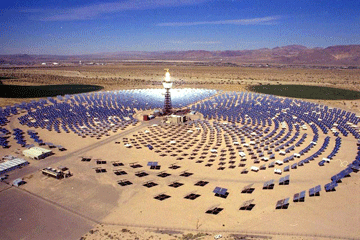
Professor Vassilios Agelidis, director of the Australian Energy Research Institute at the University of New South Wales, says Australia lacks the expertise to support a nuclear industry, meaning it would have to import everything except the uranium.
Australia could, for example, create a new solar-to-hydrogen export industry, Prof Agelidis said, if it had a strategic, visionary approach.
Building large-scale solar in the middle of the country and using the electricity generated and piped-in water to create hydrogen for fuel cells is one example of the potential for energy innovation.
“It’s like mining but like mining the sun,” Prof Agelidis said……..http://www.9news.com.au/national/2015/11/03/11/13/think-outside-the-nuclear-square-expert#lAlcLQ5rSwf804pk.99
Council approval for central Queensland solar farm near Baralaba
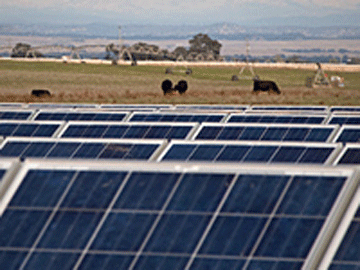 Solar farm proposal near Baralaba in central Queensland gets Banana Shire approval, ABC News, 2 Nov 15 By Jessica Lodge and Jacquie Mackay The Banana Shire Council has given approval to the solar energy company FRV to develop a solar farm near Baralaba in central Queensland. In September, the Central Highlands Regional Council gave the same company approval to develop solar operations at Tieri.
Banana Shire Mayor Ron Carige said the project could create up to 200 jobs during the construction phase.”It’s a great opportunity for not only for the shire but for the community around Baralaba itself,” he said.
“So it’s right near the substation at Baralaba and the total area is 730 hectares but the panels will take up approximately 660 hectares, so it’s quite a large project.”
Councillor Carige said it was a great opportunity for the region moving forward………..http://www.abc.net.au/news/2015-11-02/green-light-for-solar-farm-near-baralaba-in-central-qld/6904428
The Balunu Foundation’s healing programme of green energy with Aboriginal people
Australian insurance companies must come clean about climate change
 Australian insurers keep customers in the dark about climate risks, report finds, Guardian, Lenore Taylor, 3 Nov 15 A WWF study shows Australian insurers tell customers far less than overseas insurers about the risks climate change could pose to their businesses Australians are in the dark about the risks climate change poses for the local insurance industry because Australian insurers don’t disclose enough information, a new report claims.
Climate change poses risks for the insurance industry through increased claims and potential impacts on investments held by the insurer to pay on future claims, and could cause premium increases so steep that homes in some fire, flood or cyclone prone areas could become uninsurable.
A study presented to the Actuaries Institute last year, “Can actuaries really afford to ignore climate change?” found claims were likely to rise but that it was difficult to predict by exactly how much. Bushfire claims were calculated to rise by between 29% and 116% by the end of the century, cyclones by up to 230% and river flooding by between 7% and 54%.
“Global warming will have significant impacts on the insurance industry through increased claims, reputational damage, decline in insurance affordability, and an increase in uninsurable sectors or geographies,” WWF spokeswoman Monica Richter said.
“Without full public disclosure of their climate-related risks and management strategies, Australian consumers and shareholders are left vulnerable to unexpected costs and regulatory shifts.”…….http://www.theguardian.com/environment/2015/nov/02/ausralian-insurers-keep-customers-in-the-dark-about-climate-risks-finds-report
As Southern Ocean acidifies – fast changes in marine food chain
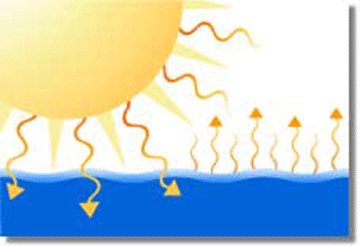 Abrupt changes in food chains predicted as Southern Ocean acidifies fast: study [excellent pictures] http://www.smh.com.au/environment/climate-change/abrupt-changes-in-food-chains-predicted-as-southern-ocean-acidifies-fast-study-20151030-gknd2g.html November 3, 2015 Peter Hannam Environment Editor, The Sydney Morning Herald The Southern Ocean is acidifying at such a rate because of rising carbon dioxide emissions that large regions may be inhospitable for key organisms in the food chain to survive as soon as 2030, new US research has found.
Tiny pteropods, snail-like creatures that play an important role in the food web, will lose their ability to form shells as oceans absorb more of the CO2 from the atmosphere, a process already observed over short periods in areas close to the Antarctic coast.
Ocean acidification is often dubbed the “evil twin” of climate change. As CO2 levels rise, more of it is absorbed by seawater, resulting in a lower pH level and reduced carbonate ion concentration. Marine organisms with skeletons and shells then struggle to develop and maintain their structures. Continue reading
Ozone hole over Antarctica expands to near-record levels, now four times size of Australia
Ozone hole over Antarctica expands to near-record levels, now four times size of Australia, ABC News The World Today , 3 Nov 15 By Lucy Carter The hole in the ozone layer over Antarctica has expanded to near-record levels this year, covering an area almost four times the size of Australia.
Scientists from the UN said the increase was due to colder-than-usual temperatures, rather than any extra damage being done to the Earth’s protective layer.

But that could still mean extra UV radiation and the risk of more people getting sunburnt in Australia’s southern states this summer. Continue reading
Climate change goal posts have changed everywhere, except Australia
 Now, Australia is nearly the only industrial nation that for Paris has pledged emissions reductions that wouldn’t even bring down its emissions significantly below the 1990 level by 2030. And it does not have the policies in place that would deliver even those modest reductions. Australia thus has much scope to improve – and it has fantastic renewable energy resources that make every German envious.
Australia must step up on emission cuts to rejoin world’s enlightened countries, SMH, November 3, 201 Stefan Rahmstorf
The climate change goal posts have long been changing everywhere, except Australia..……Worldwide, 19 per cent of our energy now comes from renewable sources and growth in these industries is exponential, not linear. Last year half of all global energy investments were in renewables, led by China. This momentum suggests that investments in fossil fuels will collapse worldwide in the coming years as investors realise they’d risk massive stranded assets.
The numbers are also in on the true costs of transitioning to renewable energy worldwide. We can afford it. About US$500 billion a year is spent looking for new fossil fuel deposits. That’s about the same amount of money we need to invest in renewable energy to keep global warming below 2 degrees. On top of that there’s some US$500 billion in various government subsidies to fossil fuels. Continue reading
Even the conservative International Energy Agency admits renewable energy ‘s rapid growth
 Even The Most Conservative Estimates For Renewables Show Huge Growth Is Coming http://www.fastcoexist.com/3052104/even-the-most-conservative-estimates-for-renewables-show-huge-growth-is-coming
The next decade will mark a massive rise in non-fossil fuel sources of energy. The International Energy Agency has a reputation for downplaying the importance of solar and wind power. So, when it says in its latest report that renewables could account for more than a quarter of generation by 2020, it’s probably good news. There’s a good chance the estimate could be under-cooked. Continue reading
Greg Hunt’s renewable energy backflip
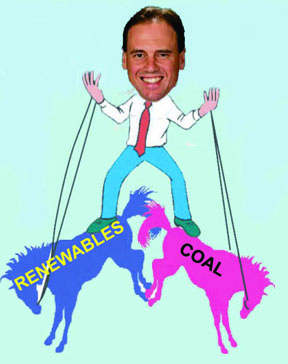 Greg Hunt does backflip on future of renewables in Australia http://www.news-mail.com.au/news/a-turnaround-in-the-hunt-for-renewables/2828865/3rd Nov 2015 ENVIRONMENT Minister Greg Hunt has rejected the long-standing duel between the economy and the planet in a speech in China.
The speech by Mr Hunt comes as the Turnbull government looks to reset Australia’s fall from grace in diplomatic and scientific circles over climate change.
He told a clean energy meeting on Tuesday he recently created a new Office of Climate Change and Renewables Innovation, as part of a “positive agenda”.
Mr Hunt said we are “transforming the way we produce electricity”, as “older coal plants retire, a process which has started”.
Despite previously attempting to abolish the national renewable energy agency and the Clean Energy Finance Corporation when Tony Abbott was prime minister, Mr Hunt promoted the bodies as where Australia “excels” on climate change.
1 This month
To see nuclear-related stories in greater depth and intensity
– go to https://nuclearinformation.wordpress.com/


 Antinuclear