Australia can go green and have economic growth – #Auspol #EarthtoParis #COP21

Negative emissions, as well as economic growth and improved biodiversity: Australia could have it all.
According to a huge modelling study, Australia can continue to grow its economy by relying heavily on agriculture and mining, while also slashing emissions and improving the natural environment. But smart government policies will be key.
In the first of what will be a regular series of Australian National Outlook reports, researchers at CSIRO, Australia’s government scientific research agency, combined nine different economic and environmental models to examine 20 possible paths to 2050.
They found that strong international action on climate change would benefit the Australian economy, even ignoring the accompanying benefits of reduced climate impacts. Australia’s economic future looked brightest in scenarios where stronger climate action was taken, and the financial benefits could even kick in before 2050.
Although such decisive action would weaken demand for its coal, the country would enjoy increased demand…
View original post 333 more words
Why we should go it alone on climate change.#Auspol #EarthtoParis #COP21
What if the negotiations in Paris later this month matter less than we think? There are lots of good reasons unilateral action to combat climate change might be a better option. Christian Downie and Peter Drahos write.
In less than a month world leaders will gather in Paris in the latest attempt to address climate change. But what if the negotiations matter less than we think? What if all the hype and expectation misses the fact that states are going it alone on climate change? And not only that, given the urgency of the problem, unilateral action could be our best bet to halt rising greenhouse gas emissions.
Traditionally, we tend to think of climate change as a global collective action problem. The climate is a global public good that requires all nations to act together to protect it. The standard logic is that public goods will be undersupplied because…
View original post 973 more words
Indonesia to deny nuclear waste ship access to Indonesian waters
 Nuclear Waste Ship will be Denied Entry to Indonesian Waters http://www.globalindonesianvoices.com/23422/nuclear-waste-ship-will-be-denied-entry-to-indonesian-waters/ 05 Nov 2015 By : Leo Jegho
“Our investigation has found that the vessel had ever entered our seawaters when sailing to France. And now we are monitoring its travel back to Australia,” Bakamla Chief Vice Admiral Desi A Mamahit told reporters at his office in Jakarta, according to Detik.com.
Transporting the nuclear waste is BBC Shanghai, an Antigua & Barbuda-flagged general cargo ship. Admiral Desi mentioned two reasons why Indonesian authorities disallow BBC Shanghai passing through Indonesian waters on its way to Australia. The first reason is that the Indonesian seawaters are not part of the routes allowed for foreign vessels traveling from Europe to Australia and vice versa. The second reason is that BBC Shanghai carries nuclear waste.
BBC reported that BBC Shanghai is due to reach Australia by 27 November and that it is now in Africa. France-based nuclear company Areva sent the nuclear waste back to Australia.
The waste reportedly derives from the spent nuclear fuel sent from Australia to France in 1990s and early 2000s. French law obliges such nuclear waste to be sent back to Australia.
In Kashiwa city Chiba, 112 of 173 children diagnosed with thyroid abnormality i
 112 of 173 children diagnosed with thyroid abnormality in Kashiwa city Chiba, Fukushima Diary, by Mochizuki , November 4, 2015 On 10/30/2015, Kashiwa city government announced 112 of 173 children were diagnosed with thyroid cyst or nodule.
6 of them were diagnosed with cyst (larger than 5.1 mm) or nodule (larger than 20.1 mm), 11 of them were required to have follow-up test.
The testees are the children born in 1992 ~ 2011. It was implemented from this July to September.
In order to receive the subsidy to have this test, the parents were required to sign the declaration of consent. It declares that the test does not guarantee the potential health state in the future but only represents the present’s state, and also that it is not to evaluate the radiation effect because of the nuclear accident but only alleviate the anxiety for radiation exposure……http://fukushima-diary.com/2015/11/112-of-173-children-diagnosed-with-thyroid-abnormality-in-kashiwa-city-chiba/
Forget climate change spin: Nuclear lobby’s aim is South Australia as radioactive trash dump
But the main game according to recent statements by Turnbull is to establish South Australia as a permanent waste dump for the world’s 350,000 tonnes of spent fuel containing more than 100 isotopes including plutonium-239 which lasts 250,000 years – one millionth of a gram is carcinogenic, americium, more toxic than plutonium and strontium-90 and caesium-137 lasting 300 years .

Increased uranium mining and more radioactive waste would be bad news for Australia http://www.theage.com.au/comment/increased-uranium-mining-and-more- radioactive-waste-would-be-bad-news-for-australia-20151103-gkpyp3.html November 4, 2015 Helen Caldicott
The nuclear industry may advocate in Paris that nuclear power is the answer to global warming. When Malcolm Turnbull mooted the question about storing radioactive waste in Australia, I felt that I finally understood the aim of the Nuclear Fuel Cycle Royal Commission being conducted in South Australia. Then I wondered whether the nuclear industry is going to propose in Paris that nuclear power as the answer to global warming.
A curious situation is developing in South Australia that will have serious health ramifications, especially for Aboriginal communities, and will also severely impair the state’s reputation for its superb wine and food. Continue reading
No safe dose of ionising radiation
 Nuclear Power: Dead in the Water it Poisoned, CounterPunch, by JOHN LAFORGE NOVEMBER 5, 2015 ………Authoritative warnings by the agencies that regulate radiation exposure are worthy of a detailed listing because of the literal consensus that’s been reached i.e. There is no safe dose, and as Dr. Arjun Makhijani says, “Only zero exposure results in zero cancer risk.”[16]
* The National Council on Radiation Protection (NCPR) says, “…the Council assumes that, for radiation-protection purposes, the risk of stochastic [random] effects is proportional to dose without threshold…”[17] (Emphasis added) In other words, “… every increment of radiation exposure produces an incremental increase in the risk of cancer.”[18]
The EPA says, “…any exposure to radiation can be harmful (or can increase the risk of cancer). ….. In other words, it is assumed that no radiation exposure is completely risk free.”[19] Further, “Radiation is a carcinogen. It may also cause other adverse health effects, including genetic defects in the children of exposed parents or mental retardation in the children of mothers exposed during pregnancy.”[20]
* The Department of Energy says, “[T]he effects of low levels of radiation are … a very slight increase in cancer risk.”[21]
* The Nuclear Regulatory Commission says, “This dose-response model suggests that any increase in dose, no matter how small, results in an incremental increase in risk.”[22]
The National Academy of Sciences in BEIR-VII, its latest book-length report on the biological effects of ionizing radiation, says “… that low-dose radiation acts predominantly as a tumor-initiating agent,”[23] and that “… the smallest dose has the potential to cause a small increase in risk to humans.” The committee further judges it unlikely that a threshold exists for the induction of cancers …”[24]
As science has come to understand the toxic, carcinogenic, mutagenic and teratogenic properties of even the lowest radiation exposures, the officially permitted dose — not a safe level — has dramatically decreased.[25] In the 1920s, the International Commission on Radiological Protection (ICRP) set the permissible dose for radiation workers in medicine and industry at 75 rem per year. In 1936, the limit was reduced to 50 rem per year, then to 25 in 1948, to 15 in 1954, and to 5 in 1958[26] — where it remains to this day. (A rem is a measure of the biological damage of a given absorbed dose of radiation.)
Today, the permitted radiation exposure for the public has been reduced to one-20th of what’s permitted for nuclear workers, or 0.25 rem per year. However, the ICRP’s 1990 recommendation to again reduce worker exposures — this time by three-fifths — from 5 to 2 rem/year, has never been adopted by the United States, even after 24 years………http://www.counterpunch.org/2015/11/05/nuclear-power-dead-in-the-water-it-poisoned/
Fact-checking Senator Sean Edwards’s claim on future nuclear bonanza
 FREE ENERGY – WITH NUCLEAR? http://www.factsfightback.org.au/free-energy-with-nuclear/ November 4, 2015
The claim
Senator Sean Edwards claimed that an expansion of the nuclear fuel 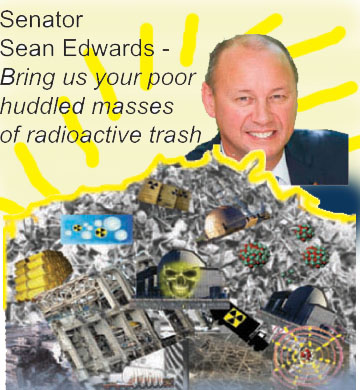 cycle in South Australia could provide low or even no cost electricity, create a generation of high-paying jobs and do so without any subsidies from government. His plan is to take spent fuel from older nuclear power plants from around the world, and reprocess them for use in fourth generation reactors here in Australia. We could be paid to take waste which we then turn into fuel, providing free electricity.
The facts
So called fourth generation reactors are not yet commercially available but are predicted to become available sometime in the 2030s. If these reactors become commercially available they will be able to take spent fuel rods(currently treated as nuclear waste) from older nuclear reactors and use them to generate electricity. This effectively turns a waste source into a valuable commodity.
The claim that low or no cost electricity can be produced comes from the idea that other countries would pay South Australia to take their nuclear waste. This would mean that not only will South Australia pay nothing for its fuel costs but it would generate an additional revenue source from taking other countries waste and turning it into a commodity.
We will address his argument as three linked claims:
- Other countries will pay Australia to take nuclear waste for storage.
- Australia can build fourth generation reactors to use this spent fuel to generate electricity.
- This will result in free electricity, and perhaps even earn sufficient profit for the state that it will allow a reduction in taxes.
Claim 1
The expert advice to the South Australian Royal Commission into expanding the nuclear fuel cycle gave a time-frame of 25 years to complete a long term waste storage facility. The Generation IV International Forum expects fourth generation reactors – capable of using existing waste stockpiles as fuel – to be commercially deployed in 2030-2040. This means that any waste storage facility that South Australia develops is likely to be completed at about the same time as fourth generation reactors become commercially available. It is likely that South Australia’s own waste storage business would need to compete with other countries’ fourth generation reactors. Spent fuel will cease to be waste, and will become a commodity. Why would anyone pay South Australia to take a commodity?
Claim 2
The circular reasoning is clear. If fourth generation reactors work as hoped, no-one will pay South Australia to take their spent fuel. Further, if fourth generation technology proves to be expensive and difficult to maintain, South Australia would have locked itself into expensive electricity generation, having set up a waste import industry. In either case, countries with existing stockpiles of spent fuel have a clear competitive advantage over South Australia. It makes more financial sense for them to build fourth generation reactors next to existing stockpiles than it does to transport it half-way around the world. There is no good outcome for South Australia.
Claim 3
According to the US Energy Information Administration, fuel represents less than 15% of the cost of generating electricity with advanced nuclear power plants. Most of the cost is in the initial capital expense and maintenance of the reactor. Even if Australia received “free” fuel – a wildly optimistic hope – the cost of building reactors is still great. Wind and solar have no fuel costs, but no one thinks renewable electricity is free. Furthermore, the cost of setting up an international waste storage component would be extreme large. The Pangea proposal which looked at setting up a nuclear waste disposal facility in the late 1990’s included port facilities and a fleet of specialised ships. It showed that any waste facility would be very expensive.
The first ton of waste that Australia received would require a gamble of many billions of dollars.The findings
Perhaps the cheapest way to take a gamble on nuclear power might be to create temporary storage facilities now, use this brief window before fourth generation reactors are deployed commercially to get paid to take waste, and be among the first in the world to build the reactors which can use our newly acquired waste for fuel.
However, the risks are obvious. If fourth generation reactors turn out to have high costs of operation, we would be locked into expensive electricity. If they can’t be made to work commercially at all, we would have given ourselves a high-level waste problem for tens of thousands of years, a problem that may not have a solution. And if they are cheap and effective, most countries could build their own and bid for the fuel we are so generously taking for a fee. If we can plan ahead for fourth generation technology, so can everyone else.
Even at best, if everything goes just as hoped, the payoff for our gamble is paltry. A 15% reduction in energy costs from nuclear reactors, which already have a higher cost per unit of energy than new wind and solar generators, is far from “free” electricity. A waste industry, costing billions to set up, which will see its revenues killed off – in as little as ten years – by the very technologies we hope to champion, can hardly be said to provide “generations” of high-paying jobs. And we will inherit a nuclear waste storage problem that must be solved for at least hundreds, and perhaps thousands, of years.
The most risk for the least reward is not a smart business plan. Free electricity is no more than a pleasant dream.
Christopher Pyne joins Australia’s pro nuclear dance troupe

In February Mr Pyne said he did not support either a nuclear enrichment industry or nuclear waste storage in South Australia. “I don’t support a nuclear waste dump in South Australia,” he told the ABC.
Now, he has softened his stance, saying he will have a look at proposals to start an industry.
“I’m looking forward to the royal commission’s findings and if Kevin Scarce can convince the Australian public through his Royal Commission that we should go down the track of investing in a nuclear industry, well I’m interested in having a look at it. I’m not convinced but I’m happy to look at it,” he said,……
Mr Pyne signalled he may be open to nuclear waste storage, a politically explosive issue in the state.
“There are countries around the world which have managed to solve the issue of the storage of nuclear waste, so I think that is a bit of an old-fashioned argument,” he said.
Prime Minister Malcolm Turnbull last month said Australia should consider getting involved in the nuclear fuel cycle of production, export and storage and Assistant Science Minister Karen Andrews said that developing a nuclear waste disposal industry was an option…….
Earlier this year Mr Pyne had cautioned of the political dangers of dredging up the issue. http://www.afr.com/news/christopher-pyne-signals-turnaround-on-nuclear-20151104-gkqgkc#ixzz3qeTZQrA1
Solar’s falling costs are making India’s nuclear programme unviable

 Quiet burial for the nuclear deal? 5 NOVEMBER 2015, Gateway House BY Amit Bhandari
 Solar power developers have offered to sell electricity in India at less than Rs 5/unit. This makes solar competitive with traditional forms of energy, and makes new nuclear power plants financially unviable. India must register the changed reality, and discard the idea of expensive Western reactors. Time to scrap the India-U.S. nuclear deal?
Hard on the heels of falling oil prices and affordable shale, comes another dramatic energy changes for the energy industry: The falling cost of solar energy. This has many implications, but the most immediate impact the nuclear power industry, large parts of which may have just become obsolete. This means that the new nuclear power plants being planned by India, especially those with foreign collaboration, must be reconsidered and scrapped if they are financially unviable.
Iluka Resources to subdivide West Victoria land with radioactive trash tomb
 Miner Iluka Resources gets Horsham Council approval to subdivide Douglas mine land http://www.abc.net.au/news/2015-11-04/miner-iluka-gets-nod-to-subdivide-douglas-mine-land/6910420 Horsham Council has approved an Iluka Resources’ application to subdivide land at its Douglas mine in western Victoria.
The approval is subject to a range of planning and environmental conditions.
“The mineral sands miner said it did not need some parts of the site, including Pit 19 where radioactive mining by-product was buried.
The council’s planning committee has been reviewing the application for the past month and it has now been approved with conditions. Future activities on the land deemed sensitive will trigger an environmental audit and previous use of the land would be disclosed to any future buyer.
The conditions require a plan which clearly outlines land previously used for mining purposes and the disposal of radioactive by-product.
London’s bankers the only UK beneficiaries of the China nuclear deal
 the decision to involve Chinese companies – initially with EDF at Hinkley Point and then on their own at Bradwell and Sizewell – only makes sense if it is seen as part of a quid pro quo for the previously announced financial services deal.
They put the Chinese Communist Party and military at the heart of strategic infrastructure. They interlink the British and Chinese financial systems at a time when the latter is structurally weak, poorly regulated, and struggling with corruption.

 Britain’s nuclear deal with China is a boon for bankers – and no one else, The Conversation, Jeffrey Henderson November 6, 2015 At first glance, it seems an almost inexplicable paradox. A right-wing British government has invited companies controlled by the Chinese Communist Party – and in one case, the Chinese military – into the heart of the UK’s strategically vital energy infrastructure. The nuclear deal between Britain and China goes against the advice of the security services, the military and the US government.
So to explain this paradox, we must look carefully at another major deal in the British government’s flirtation with President Xi Jinping: the inter-penetration of the two countries’ financial services.
There would seem to be no possible connection between Chinese companies building and operating nuclear power stations in 2020s Britain and a curious political role created in 1571. But the fact that the Remembrancer, a representative of the City of London Corporation, is allowed to attend and monitor debates in the House of Commons, says much about Britain’s priorities.
When considering economic and budgetary policy, the Remembrancer is at hand to ensure that our elected representatives remember that, whatever other interests they might serve, the needs of financial services must be paramount. And the near-invisible hand of the Remembrancer seems recently to have been at work ensuring that Britain’s infrastructure is made accessible to Chinese state-owned companies.
London capital Continue reading
Trans Pacific Partnership fails the environment, ignores climate change
Climate change missing from full Trans-Pacific Partnership text, The Age November 5, 2015 Gareth Hutchens “…….this is the first time Australians have had a chance to see what the federal government has been negotiating on their behalf for over five years.
Matthew Rimmer, Professor of Intellectual Property and Innovation Law at the Queensland University of Technology, told Fairfax Media it looks like US trade officials have been “green-washing” the agreement.
“The environment chapter confirms some of the worst nightmares of environmental groups and climate activists,” Dr Rimmer said.
“The agreement has poor coverage of environmental issues, and weak enforcement mechanisms. There is only limited coverage of biodiversity, conservation, marine capture fisheries, and trade in environmental services. The final text of the chapter does not even mention ‘climate change’ – the most pressing global environmental issue in the world.”
Controversially, the deal includes a clause giving foreign companies the right to sue Australian governments if they introduce laws they say have harmed their investments.

Dr Patricia Ranald from the Australian Fair Trade and Investment Network said the “safeguards” Mr Robb claimed he had won to prevent foreign tobacco companies suing Australian governments for pursuing anti-smoking policies do not appear strong enough.
“The general ‘safeguards’ in the text are similar to those in other recent agreements which have not prevented cases against health and environmental laws,” Dr Ranald said.
“Public health groups have influenced governments to include in the text the option of more clearly excluding future tobacco control laws from ISDS cases, which is important and has angered the tobacco lobby. But this also begs the question of how effective are the general ‘safeguards’ for other public health and environmental laws.”
Dr Rimmer also criticised the investment chapter, saying it was one of the most “labyrinthine” in the agreement……..http://www.theage.com.au/federal-politics/political-news/details-of-transpacific-partnership-finally-released-20151105-gkrivo.html
Even Westinghouse gives cost of nuclear reactor as $17.5billion
Global energy giant Westinghouse says an Australian nuclear power plant would cost $17.5bn November 5, 2015 ……..Ms Bowser, Westinghouse’s vice president of new plant project advancement, said construction of the company’s AP1000 model would take four years but deciding a site and various necessary approvals would take longer.
Big companies urge action on climate change (but beware of BHP’s nuclear lobbying

This sounds good, and it IS good. At the same time BEWARE of BHP Billiton. They are part of the nuclear lobbying to get nuclear accepted as the cure for climate change
Paris 2015: Australian corporate giants sign up for action on climate, SMH November 5, 2015 Peter Hannam Environment Editor, The Sydney Morning Herald More than a dozen of Australia’s largest companies including BHP Billiton, Westpac and Origin Energy, have signed up to take long-term action on climate change.
The firms have joined more than 250 global corporations, boasting more than $US5.6 trillion ($7.7 trillion) in annual turnover, that have agreed on steps such as putting a price on carbon and buying 100 per cent of their electricity from renewable sources.
The pledges by companies, which also include ANZ, Commonwealth Bank, AGL, Infigen and Brambles, come just weeks before delegates from almost 200 nations meet in Paris to negotiate a global climate treaty aimed at keeping temperature increases to within 2 degrees of pre-industrial levels…….http://www.smh.com.au/environment/un-climate-conference/paris-2015-australian-corporate-giants-sign-up-for-action-on-climate-20151104-gkqk2c.html
The nuclear lobby’s deceptive spin about climate change
“[E]xpanding nuclear power is uneconomic, is unnecessary, is not undergoing the claimed renaissance  in the global marketplace … and, most importantly, will reduce and retard climate protection. That’s because … new nuclear power is so costly and slow that … it will save about 2-20 times less carbon per dollar, and about 20-40 times less carbon per year, than investing instead in the market winners: efficient use of electricity and what The Economist calls ‘micro-power,’ comprising distributed renewables (renewables with mass-produced units, i.e., those other than big hydro dams), and cogenerating electricity together with useful heat in factories and buildings.”
Nuclear Power: Dead in the Water it Poisoned, CounterPunch, by JOHN LAFORGE NOVEMBER 5, 2015 On Feb. 11, 1985, the cover page of Forbes thundered, “The failure of the U.S. nuclear power program ranks as the largest managerial disaster in business history, a disaster on a monumental scale.…”
Fourteen months later, reactor No. 4 at Chernobyl exploded and burned for 40 days, spreading radioactive fallout across the entire Northern Hemisphere, depositing cesium-137 in Minnesota’s milk[1]and Japan’s topsoil.[2]
 So how is it that Congressional representatives, TV network pundits, FOX ditto heads and even CNN program directors still promote nuclear power?
Part of the answer comes from American University researcher Judy Pasternak and her students. According to Pasternak’s 2010 study, the nuclear industry spent $645 million over 10 years lobbying Capitol Hill, and another $63 million in campaign contributions over the same period.[3] Between 1999 and 2008, these millions manufactured the canard that nuclear power is “carbon free,” “clean” and can “help fend off climate change.” Prior to this spending blitz, the US nuclear power program was, because of the shock of accidents at Three Mile Island in 1979 and Chernobyl in 1986, “pretty well dead in the water” — in the words of economist and author Jeremy Rifkin.[4]
The lobbyists and check writers worked hard spinning the yarn that the richest and most pollution-intensive industrialists on earth were concerned about climate change and wanted to cut carbon emissions — but they didn’t convince everybody.
Independent scientists, free of corporate blinders and the market imperative of short term profit, scoff at “green nuke” propaganda. Continue reading
1 This month

of the week – Australians for War Powers Reform (AWPR)
To see nuclear-related stories in greater depth and intensity
 Antinuclear