This week today – in nuclear and climate news Australia
 Apologies, everyone, because the Australian section is so lo oong. Also because the International section is practically non existent.
I find the International scene gloomy, as:
- Japan’s Fukushima disaster is unending.
- Britain’s govt is happily promoting the Hinkley Point nuclear boondoggle, with China’s help.
- Obama govt buying into the nuclear lobby’s climate lie. (Well, Obama does owe the nuclear industry, for all the campaign funding they’ve given him.)
- Trans Pacific Partnership fails the environment, ignores climate change.
March on Paris The Don’t Nuke the Climate campaign will be present in Paris to organise and
coordinate actions, gatherings and lobby efforts. On December 12 we organise a strong and visible anti-nuclear contingent in the Global Climate March. We call upon everyone to come to Paris for December 12 to make your point clear.
- 28 & 29 Nov, 2015: Mass demonstrations in European Capitals.
- 30 Nov – 11 Dec, 2015: The 21st session of the Conference of the Parties to the UNFCCC – Paris, France.
- 12 Dec 2015: Mass demonstration in Paris.
AUSTRALIA – well, the nation at large sleeps on, thinking that the removal of half-witted PM Abbott has fixed things. Well, it hasn’t!
FEDERAL POLITICS
- Turnbull backs Sen Edwards plan to make South Australia the world’s radioactive trash toilet. Senator Sean Edwards wants the whole toxic nuclear chain here, as well as the radioactive trash dump. Fact-checking Senator Sean Edwards’s claim on future nuclear bonanza. Nuclear waste dump idea is a political stinker: Liberal powerbroker Michael Kroger is worried.
- MP Rowan Ramsey explains difference between Lucas Heights nuclear waste and the Sean Edwards import plan.
- Australia’s nuclear/uranium giants don’t want nuclear technology (just waste dumping).
- Why is Australia suddenly embracing both nuclear industry AND Green Climate Fund?
- Senator Scott Ludlam explains why nuclear power is ‘the dream that failed’.
- Australians would be ill-advised to accept Turnbull’s “green” credentials.
- Christopher Pyne joins Australia’s pro nuclear dance troupe. Matthias Cormann joins, too
On uranium sales to India, Malcolm Turnbull should heed Parliament’s Joint Standing Committee on Treaties.
Costs of new nuclear, high, higher, and astronomic – Australia, USA, South Africa, China.
CLIMATE CHANGE Australia has no environmental credibility, yet seeks to co-chair the Green Climate Fund. Banks NAB and CBA support climate action (but watch out for nuclear investment). Big companies urge action on climate change (but beware of BHP’s nuclear lobbying). Australian insurance companies must come clean about climate change.
Adelaide’s January heatwave attributed to climate change.
SOUTH AUSTRALIA. Forget climate change spin: Nuclear lobby’s aim is South Australia as radioactive trash dump – Helen Caldicott. South Australia’s Nuclear Royal Commission THE APPEARANCE OF BIAS – NOT A GOOD LOOK. Don’t let strident pro nuclear voices drown out alternative voices.
Karoonda Council, South Australia, considering floating solar plant.
WESTERN AUSTRALIA Cameco’s uranium plans in Western Australia stalled indefinitely by low prices. But Resources Minister Josh Frydenberg expresses nuclear lobby’s religious belief in future uranium boom. Australian media continues to confuse return of Lucas Heights wastes with plan to import world’s radioactive trash.
Western Australia’s wave power microgrid – a world first.
VICTORIA Iluka Resources to subdivide West Victoria land with radioactive trash tomb.
QUEENSLAND State aims to prevent green ‘lawfare’. McKinley Shire, Queensland, promotes local business with renewable energy initiative.
RENEWABLE ENERGY Too good to be true? Environment Minister Greg Hunt’s new found enthusiasm for renewable energy. AUSTRALIA CAN GO GREEN AND HAVE ECONOMIC GROWTH. WHY WE SHOULD GO IT ALONE ON CLIMATE CHANGE. The Balunu Foundation’s healing programme of green energy with Aboriginal people.
Australia’s chance for a new “mining” boom – mining the sun. Council approval for central Queensland solar farm near Baralaba. Sunshine in your beer in Sydney.
Costs of new nuclear, high, higher and astronomic
 You’ll never guess how much this Australian nuclear power plant will cost, http://www.bizjournals.com/pittsburgh/blog/energy/2015/11/youll-never-guess-how-much-this-australian-nuclear.html Matt Stroud, energy reporter for the Pittsburgh Business Times. Nov 6, 2015 A nuclear power plant has never been built in Australia before, but Westinghouse is putting a price tag on a new one they’re hoping to build there.
The price? About $12.3 billion.
 Australian state of South Australia should build the nation’s first nuclear power plant — Westinghouse executive Rita Bowser said that price was all inclusive, according to The Advertiser in Adelaide, South Australia. It would include land, environmental safeguards and construction.
Australia has zero nuclear power plants — and is known for being extremely averse to nuclear energy; it won’t even allow nuclear ships into its ports.
 The historical aversion won’t affect the price much, apparently; the company’s guesstimate is in line with its current Vogtle project in Georgia, which has been plagued by cost overruns. It’s less than a comparable Chinese project, set to cost $24 billion. And it’s cheap in comparison to a project proposed in Johannesburg that could cost $100 billion.
The South Australia project’s future is fluid at the moment: the Nuclear Royal Commission hasn’t even decided whether it wants to recommend a nuclear facility.
That decision is set to come in May 2016. Tokyo-based Toshiba Corp. (TYO: 6502) owns 87 percent of the Cranberry-based Westinghouse Electric Co.
USA finding that the economics of nuclear power don’t add up
 It is past time for utility executives and their regulators to take a step back and reassess. An honest look at the real costs of nuclear power will show that the economics don’t add up. It is time to stop believing in impossible things
 Nuclear Power Economics Requires Believing In ‘Impossible Things‘, Energy Collective, Dennis Wamsted, 6 Nov 15 It is increasingly clear that the economics of nuclear power don’t add up. Just in the past two and a half years, for example, seven plants at six sites have been shut down due to uneconomic performance or massive equipment repair costs—and other plants are on the chopping block.
Similarly, the two ballyhooed active construction projects, in Georgia and South Carolina, are seriously behind schedule and way over budget. Nonetheless, utility executives and regulators in a number of states still have not gotten the message, notably in Florida and Virginia where executives at Juno Beach-based Florida Power & Light and Richmond-based Dominion soldier on, pushing new reactor proposals whose economics, simply put, just don’t add up and could leave ratepayers holding the bag for billions of dollars in nuclear construction costs. Continue reading
Japan’s 20 year costly experiment with nuclear reprocessing still not working
NRA’s ‘new management’ call for Monju reactor proves divisive, Japan Times, BY ERIC JOHNSTON OSAKA, 6 Nov 15, – Two decades after a sodium leak and fire shut it down and nearly six decades after it was first conceived, the Monju prototype fast-breeder reactor in Tsuruga, Fukui Prefecture, suffered another blow Wednesday when the Nuclear Regulation Authority called for it to be turned over to another operator.
To date, over ¥1 trillion has been poured into Monju — a plant that has never produced commercial electricity. Despite remaining inactive, safety measures alone cost ¥50 million a day.

Anti-nuclear activists have hailed the NRA’s unusually critical language as an important step toward scrapping the reactor, which was supposed to burn plutonium mixed with uranium. Continue reading
Banks NAB and CBA support climate action (but watch out for nuclear investment)
 This is a good start. But use of the words “low carbon”always needs to be taken with a grain of salt, as it is often code for “nuclear”
Would these banks back nuclear power as a “low carbon” option?
Banking On Climate Action, NAB And Commonwealth Bank Move To Support Paris Talks,  New Matilda, By Thom Mitchell on November 6, 2015 The move has drawn praise from green groups, who are still warning both institutions need to back away from investments in coal. Thom Mitchell reports.
Two of Australia’s biggest banks stepped up their commitments to climate action, outlining how they will support the international push to limit the rise in average global temperatures to two degrees or less ahead of a major United Nations summit in Paris this December.
The Commonwealth and National Australia Banks confirmed they support the two degree target, with NAB even going as far as to committing to spending at least $18 billion by 2022 “to help address climate change and support the transition to a low carbon economy”. “NAB believes the financial sector has an important role to play in assisting the transition to a low carbon economy, through both the energy we purchase directly and through financing,” the institution said in a statement.
The $18 billion will be spent on “new lending, debt market activity, provision of risk management products, development of financing solutions and advisory activity”.
“Finance will be provided to our customers to undertake climate change mitigation such as renewable energy and energy efficiency including low carbon property, low emission transport, and climate change adaptation activities,” the statement reads. Continue reading
Trans Pacific Partnership final text confirms fears of critics
 TPP Environment Fears Confirmed By Final Text https://newmatilda.com/2015/11/06/tpp-environment-fears-confirmed-by-final-text/
By Thom Mitchell on November 6, 2015 The content of the TPP is finally known, and it appears to be as bad as critics feared. Thom Mitchell reports.
The Trans Pacific Partnership leaves the door open for corporations to inhibit the ability of governments to legislate for environmental protection, critics of the biggest free trade deal in history said after the release of the final text yesterday.
Like many trade deals, the TPP includes ‘Investor State Dispute Settlement’ clauses which allow multinational corporations to sue governments in trade tribunals outside of national judiciaries if laws are passed that risk their profits. According to Dr Mathew Rimmer, a Professor of Intellectual Property and Innovation law at the Queensland University of Technology, “They have given foreign investors very broad ranging powers to go into investment tribunals to make complaints about decisions by government that affect their foreign investments.”
“There are some clauses there dealing with protection of the environment…and the right to regulate, but they aren’t absolute defences,” Dr Rimmer said.
The Executive Director of America’s influential Sierra Club, Michael Brune, said the fact that “the words ‘climate change’ don’t even appear in the text [is] a dead giveaway that this isn’t a 21st-century trade deal”.
“It sets us back further, empowering fossil fuel corporations to challenge our public health and climate safeguards in unaccountable trade tribunals while increasing dirty fossil fuel exports and fracking,” Brune said.
Over more than half a decade, the deal was negotiated in secret between 12 ‘Pacific Rim’ countries, including Australia, the United States, Canada, Japan, Malaysia, Mexico, New Zealand, Peru, Chile, Singapore, Vietnam and Brunei.
Adelaide’s January heatwave attributed to climate change
The findings are reported in the fourth issue of the American Meteorological Society’s report into extreme weather. The report looked at 33 extreme weather events around the world and analysed which could be attributed to human activity and which were the result of natural variability in weather patterns.
As David Mark reports, detecting the human hand in climate change is a developing area of climate science.
Continue reading
Lawsuit alleges 2,700 cancer cases from secretly buried nuclear wastes
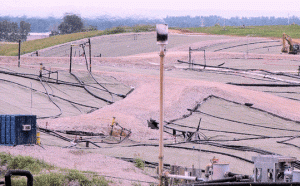 US Government Secretly Buried Nuclear Waste Near Playground — And Thousands Now Have Cancer http://www.offthegridnews.com/current-events/us-government-secretly-buried-nuclear-waste-near-playground-and-thousands-now-have-cancer/ by: Daniel Jennings November 4, 2015 A government contractor buried tens of thousands of barrels of nuclear waste in two sites around St. Louis that may have caused more than 2,700 cases of cancer, a lawsuit and CBS News are alleging. Continue reading
Burst dam in Brazil – another BHP mine disaster
BHP disaster unfolds in Brazilian village 7 Nov 2015 The Weekend Australian Business MATT CHAMBERS
BHP Billiton was last night facing one of the worst disasters in its 130-year history after sludge from two burst mining dams at the Samarco iron ore joint venture in Brazil destroyed much of a nearby town, killing at least two people and leaving scores unaccounted for.
Brazilian newspapers reported local unions as saying there were 15 or 16 people killed and 45 missing after the tailings dam burst at BHP’s 50 per cent-owned Samarco operations in the state of Minas Gerais, burying houses and streets in the town of Bento Rodrigues in muddy waste.
Late last night officials were reportedly confirming two deaths but said the toll could mount.
Yesterday afternoon, BHP managing Andrew Mackenzie could not confirm how many people were killed or injured, or whether employees of Samarco, which BHP owns with Brazilian giant Vale, were missing after the disaster.
“There has been a tragic incident at the Samarco iron ore operation,” Mr Mackenzie said in a hastily arranged media conference in Melbourne………
Local reports said another dam, Santarem, which recently had its crest raised with a rubber structure to increase its capacity, had also burst, while Samarco said “dams” had been breached.
A local official said more than 50 were injured in the disaster and that the death toll could pass 40.
“That is not official,” said local fire chief Adao Severino Junior. “The situation is grim. It is dark. There is a lot of mud.”
He said rescue operations would continue through the night.
Television footage showed a torrent of industrial muck several hundred metres long that swamped houses and ripped off roofs in Minas Gerais, which is in the southeast of the country and host to a large mining industry.
BHP shares slid 58c, or 2.5 per cent, to $22.70 yesterday after news of the disaster, which Morgan Stanley estimated could result in a year of lost iron ore production……
Reuters reported last night that flooding from the mine had reached another village called Paracatu de Baixo and that villagers were being evacuated.
If the number of reported deaths from the disaster are correct, the tragedy will eclipse the Appin coalmine explosion in 1979 in the Illawarra region, in which 14 workers died.
Another great mining disaster in BHP’s history was also caused by a tailings dam failure, but not one that caused any immediate deaths.
At the OK Tedi copper mine in Papua New Guinea, a tailings dam collapse in 1984 started more than 20 years of government approved tailings discharge into local rivers, causing huge environmental damage.
South Africa might have to abandon its nuclear power programme
The nuclear build is a very risky exercise with numerous potential pitfalls. And there are alternatives. The shortfall in the projected nuclear capacity can be covered by a 50% larger than planned renewable energy investment. Wind and solar energy plants have been operationalised on schedule, and solar panel prices continue falling. The intermittence of renewable energy availability is considered manageable. Finally, energy saving strategies have yet to be fully explored.
 Why SA must abandon nuclear ambitions, The nuclear build is a very risky exercise with numerous potential pitfalls. And there are alternatives. Tech Central, By Hartmut Winkler, 6 Nov 15 It has been an eventful year in South Africa, characterised by power cuts, parliamentary confrontations about wasteful expenditure and student fee protests. There has, however, been an elephant in the room that has impacted all these issues but enjoyed surprisingly scarce attention. The idea, vigorously driven by government, is for the country to build nuclear plants with an expected price tag of R1 trillion.
This equates to 4 000 times the controversial costs to upgrade President Jacob Zuma’s Nkandla residence and 400 times the shortfall the tertiary education sector will experience in 2016 because of the freeze in university fee increases. Continue reading
Nuclear Industry complaining that Obama is not helping them enough
 Obama’s Green Push Comes At Expense Of Nuclear Power, Daily Caller 6 Nov 15 The nuclear power industry supports President Barack Obama’s plan to force coal plants to close, but a pending Supreme Court case threatens to cause huge problems for nuclear plants.
Currently the Federal Energy Regulatory Commission (FERC) is embroiled in a Supreme Court battle over a program called demand response, which seeks to cut energy use by compensating retail customers who reduce consumption during peak power grid operation. FERC is forcing energy companies to participate, a move that opponents argue exceeds their legal mandate. According to Utility Dive, demand response keeps wholesale energy prices low, cutting into profits in the nuclear and coal industry……….
The court case puts the coal and nuclear power industries on the same side……..
In the wake of these closures, the industry has been lobbying the administration to increase government assistance to nuclear power, arguing the nuclear industry holds the key to cleaner air………http://dailycaller.com/2015/11/05/obamas-green-push-comes-at-expense-of-nuclear-power/
1 This month
7 April – WEBINAR – Australia and the Doomsday Clock – Preventing nuclear war through NoFirstUse and other policies
Online | Tuesday April 7, 4:00-5:30pm, Australian Eastern Time / 8:00-9:30am Central Europe Time
– Access the registration link
15 April – Zoom –Nuclear Power is Not the Solution
Apr 15, 2026 01:00 AM in Canberra, Melbourne, Sydney

Join the International Physicians for the Prevention of Nuclear War (IPPNW) on Tuesday, April 14th for a timely webinar exploring the risks associated with nuclear power and challenging the myth that it offers a simple, safe, carbon-free solution to the climate crisis

of the week – Australians for War Powers Reform (AWPR)
To see nuclear-related stories in greater depth and intensity
 Antinuclear