Australia’s role in bringing about a ban on nuclear weapons
Australia should be at the forefront of global efforts to outlaw and eliminate nuclear weapons – not clinging onto the misguided belief that we are protected by these weapons of mass destruction
 BAN NUCLEAR WEAPONS AUSTRALIA’S ROLE, ICAN 12 Nov 15 Nuclear weapons are not yet a relic of the past – far from it. But with your help, they can be. The next step is for nations to negotiate a global treaty banning these worst weapons of terror Continue reading
Australia’s obligations to Pacific climate migrants
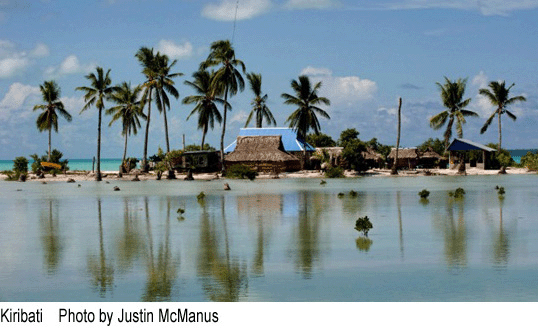 Australia must not be afraid of its obligations to Pacific climate migrants, Guardian,
Richard Marles, 12 Nov 15 Australia’s humanitarian intake is from distant countries; as climate change leads some islanders to migrate, that will change. So must our approach “……While land is a necessary precondition for life, people live on these atolls because of the sea. It is the source of food, culture and legend. These are marine people whose ancient understanding of the wind and the waves still often transcends what modern equipment has to offer.
Yet as the greenhouse effect starts to take hold these winds are beginning to change. Predictable weather patterns in equatorial environments which produced constant temperatures, regular rains and seasonal storms are no longer behaving. Life is being disturbed.
Of all the climate change threats to coral atolls the most pressing is water security. On Tarawa atoll in Kiribati, half the fresh ground water supply is now permanently salty.
On Funafuti in Tuvalu there is no groundwater, which leaves people dependent on water tanks next to their homes – many of which have been provided by Australian aid. But even with extra tanks the water supply of the atoll amounts to about six weeks worth of water.
In November 2011 reduced rainfall brought the atoll to a point where the water supply was down to just a few days. Drastic water restrictions were imposed which essentially allowed for little more than the bare minimum of drinking water. Australian and New Zealand mercy flights had to airlift an emergency supply of water on to the island.
This community had lived on the atoll for centuries relying on highly predicable rainfall in order to have a supply of fresh water. Just a small shift in weather patterns had suddenly overwhelmed even the enhanced infrastructure to a point where there was almost no water. When winds and rain change, the conditions of life are thrown into question.
This question raises another for Australia. Kiribati and Tuvalu are in a region where Australia has enormous influence and great obligations. We are for both countries the natural development partner and by far the largest aid donor. In large measure it is this work which sits atop our calling card as a good global citizen. And we derive much from that reputation.
If climate change is beginning to raise the existential question in the Pacific then this also has implications for our obligations.
To be sure, the desire for the peoples of the Pacific to migrate because of climate change will not happen tomorrow. The focus of all these communities right now is naturally on how they maintain their homes, lives and cultures. And currently they see the critical role for Australia as playing its part in reducing greenhouse emissions and in supporting them with adaptation efforts.
But if climate change is placing the viability of communities in question, then inevitably some people will move as a result. So Australia being a destination for climate change migrants surely has to be up for discussion……..http://www.theguardian.com/commentisfree/2015/nov/11/australia-must-not-be-afraid-of-its-obligations-to-pacific-climate-migrants
Christiana Figueres: the climate revolutionary
That market-driven shift to cleaner energy is making Figueres’ job easier. When she talks to business, she’s already pushing at an open door. Some investors — such as Norway’s $900 billion sovereign wealth fund generated by oil and gas exports — are getting out of coal, in the belief that its days are numbered.
The message that tackling climate change makes economic sense is one that Figueres has been taking around the world.
The climate revolutionary Christiana Figueres blends tact, emotion and a bit of bullying to get deep emissions cuts in Paris next month. Politico By JANOSCH DELCKER
11/10/15, “…….. blend of tact, emotion and a bit of bullying is what the rest of the world can expect from the executive secretary of the U.N. Framework Convention on Climate Change (UNFCCC) at next month’s COP21 climate talks in Paris.

The petite Costa Rican anthropologist-turned-diplomat with short brown-hair and striking eyes — one blue and one hazel — is the public face of the effort to strike a deal that seeks to address global warming. She travels the world, occasionally becoming so moved while giving speeches that she wells up, in her campaign to bring home the seriousness of the threat facing the world.
As the Norwegians discovered in Svalbard, the world shouldn’t expect only praise for steps taken so far to combat climate change. Figueres will be demanding it do still more because to her, what’s on offer isn’t enough.
“I am the daughter of a revolutionary and I feel very comfortable with revolutions,” Figueres said at a climate conference last month in Oslo……. Continue reading
Australia’s ’empty promises’ on phasing out fossil fuel subsidies
 Australia making ’empty promises’ on phasing out fossil fuel subsidies: report, SMH, Lucy Cormack November 12, 2015 Environment Reporter Australia and its fellow G20 nations are “paying fossil fuel producers to undermine their own policies on climate change”, a British think tank says.
In a report released on Thursday, the Overseas Development Institute questioned why the Australian government continued to provide more than $5 billion a year to support fossil fuel production, despite a G20 commitment to phase out subsidies six years ago.
The report, titled Empty Promises: G20 subsidies to oil, gas and coal production, comes ahead of the G20 summit in Turkey on November 15, and says that G20 governments collectively spend more than $640 billion a year to support the production of fossil fuels – almost four times the total of global subsidies for renewable energy.
“The G20 committed for the first time in 2009 to phase out fossil fuel subsidies. Six years later, very little has happened,” said Shelagh Whitley of the Overseas Development Institute, which jointly published the report with US-based Oil Change International.
According to the report, “production subsidies” are national subsidies delivered through direct spending and tax breaks, investments by majority state-owned enterprises and public finance from majority government-owned banks and institutions.
The report specifically excludes support to consumption of fossil fuels and consumption of fossil fuel-based electricity.
“We’ve done this work to focus on production subsidies, because [they] are what is driving the exploitation of reserves that we know we have to keep in the ground to avoid dangerous climate change,” Ms Whitley said.
“We’re putting this inventory together – which we shouldn’t really be doing, it should be governments doing it themselves … It’s potentially a precedent for what governments can do and it allows policy makers looking at this for reform.”
The report placed Russia at the top of the list for production subsidies, averaging around $23 billion each year, followed by the US providing more than $20 billion, Britain providing $9 billion, China giving just over $3 billion and Brazil about $5 billion.
“Without government support for production and wider fossil fuel subsidies, large swaths of today’s fossil fuel development would be even less profitable,” the report said, pointing to the Isaac Plains mine in the Bowen Basin of northern Queensland, which, valued at $628 million in 2012, sold for $1 in June this year.
Australian Conservation Foundation economist Matthew Rose said the report’s findings about Australia were shocking but unsurprising.
“It’s in the budget every year. The fuel tax credit scheme is a majority of that money, but it’s usually over $5 billion every year that we use to subsidise fuel of large corporations,” he said.
“Malcolm Turnbull, Greg Hunt and Julie Bishop can go to the Paris climate conference and say what they like, but looking ahead if they haven’t started phasing out subsidies in the budget in May and if they haven’t laid out a plan for what is happening to renewables past 2020, there is a problem.”
The Australian Conservation Foundation estimates that federal budget handouts that encourage pollution will amount to $47 billion in the four years between 2014-15 and 2017-18………. http://www.smh.com.au/environment/australia-making-empty-promises-on-phasing-out-fossil-fuel-subsidies-report-20151111-gkwbrb.html#ixzz3rKHM7RZj
1 This month

of the week – Australians for War Powers Reform (AWPR)
To see nuclear-related stories in greater depth and intensity
 Antinuclear