What are the radioactive risk of nuclear waste dump to a farming community?
Jim Green Friends of the Earth, 18 Nov 15 Responding to these questions: “So what are irradiation cans, ion exchange resins and aluminium ends of fuel rods and what dangers do they present to those living in a farming community? Is anyone able to inform me or direct me to where I can find such information please?”
They are harmless metals (irradiation cans + aluminium ends of fuel rods) and resins/polymers … but hazardous because of contamination with radioactive substances. For the contaminated metals they are likely contaminated with long-lived alpha-emitting radionuclides and would likely be classified as long-lived intermediate-level waste (LLILW) and would therefore be sitting in an above-ground shed at Kimba for an ‘interim’ period likely to last for many decades since absolutely no effort is being made to find a disposal site for LLILW (it is destined for deep underground disposal).
The risks …. pretty much anything you can imagine has happened at one or another radioactive waste repository around the world: fires, leaks, water infiltration and corrosion of waste drums, a chemical explosion, etc.
Fire would be a particular concern at Kimba, all the more so since the most hazardous waste (LLILW) would be stored above ground. Articles about recent fires at U.S. repositories are posted at: http://www.foe.org.au/fire
Water infiltration and corrosion is a difficult dilemma. Continue reading
South Australia’s radioactive threat: it’s not “medical” waste – it’s nuclear waste from used fuel rods
Freydenberg said the facility would ‘only’ house low and intermediate level waste. Perhaps he is unaware of the toxicity of this LLILW. Dr Green again: ‘When the spent fuel is removed from the reactor, it is high-level nuclear waste. After some months it cools down and falls below the heat criterion so is reclassified as LLILW.’
The farmer opponents of the Kimba sites are right to be concerned. The spent fuel reprocessing waste will be hazardous for thousands of years.
 South Australia’s nuclear threat continues http://www.eurekastreet.com.au/article.aspx?aeid=45708#.VkuCE9IrLGh Michele Madigan | 17 November 2015
Last Friday 13 November, the federal government released the shortlisted sites of the proposed national radioactive waste facility. No surprise that three are in South Australia, the ‘expendable state‘: Cortlinye and Pinkawillinie near Kimba on Eyre Peninsula, and Barndioota near Hawker, north of Port Augusta.
I wonder if South Australians aren’t beginning to feel like nuclear particles themselves, bombarded on all sides by the nuclear industry. This announcement from the federal government about its nuclear repository plans comes as the state government continues to consider, through its Royal Commission, whether, when and where South Australia will offer to host the world’s high-level nuclear waste.
The six names on the federal government shortlist (the remaining three being Sallys Flat in NSW, Hale in the Northern Territory and Oman Ama in Queensland) are taken from an original list of 28 properties that were offered by their landowners. It’s disturbing to find that the owner of the Cortilinye site, at least, has been misinformed,believing ‘It’s basically only a medical waste facility.’
In reality, only 10–20 per cent of the radioactive waste is medical in origin. And nuclear medicine is in no way affected by the lack of a national repository.
Resources and energy minister Josh Freydenberg’s Friday announcement included a masterly sentence of understatement: ‘Low level waste is those gloves or those goggles or the paper or the plastic that comes into contact with nuclear medicine, and intermediate waste could be, for example, those steel rods that are used in the reactor to actually create these particular products.’
It’s interesting to notice what’s different and what stays the same from the 1998–2004 ‘dump’ campaign in SA. Continue reading
Indigenous Australians fight Liberal bigwig Grant Chapman’s plan for radioactive trash dump
 Indigenous groups to fight plan for Flinders Ranges nuclear dump THE AUSTRALIAN NOVEMBER 18, 2015 Michael Owen Aborigines in the northern Flinders Ranges of South Australia are vowing to fight any move to make a site owned by a former senator the home of a national nuclear waste dump.
A group representing the Adnyamathanha people yesterday said it was fiercely opposed to any expansion of the nuclear industry. The group was shocked that Barndioota, along the Leigh Creek railway to Port Augusta, was one of six sites, including three in South Australia, being considered by the federal government to store low and intermediate-level nuclear waste.
Former senator and state Liberal Party president Grant Chapman jointly owns the long-term lease to
Wallerberdina, a station near Barndioota in the Flinders Ranges. If the site were chosen, it would house a storage facility over about 100ha in the northern section of the 25,000ha property.
Adnyamathanha Camp Law Mob spokeswoman Jillian Marsh yesterday said there was no support for the “imposition of a radioactive waste dump on Adnyamathanha country”.
“We are shocked that one of the three nominated sites in South Australia … is 377 Wallerberdina Road, Barndioota,” Ms Marsh said. “We understand that ex-Liberal senator Grant Chapman is the current owner of the nominated site that is a perpetual lease property and therefore no native title claim can be lodged.”
Public meeting in Oman Ama vents opposition to nuclear waste site proposal
 Southern Queensland community Oman Ama vents fears over potential nuclear waste site, ABC News, 18 Nov 15 Residents of a Queensland southern border community earmarked for a nuclear waste dump have gathered for a public meeting to voice concerns about the proposal.
Oman Ama, near Inglewood, is one of six sites shortlisted to host the country’s first permanent nuclear waste dump.
It comes with a $10 million sweetener but that is not enough to convince many local residents of the small rural community……The Federal Government wants one site in Australia and is due to make a decision by the end of 2016, with the site operating by 2018, or 2020 at the latest.
Government experts are trying to allay their fears with claims the dump will not be built anywhere if there is an environmental risk.
Oman Ama locals mainly asked about the risk if the waste escapes, how long it took to break down, what happens in a flood and how can they be sure it is safe.
Some yelled out their opposition, which drew claps from the audience.
Gavan Lahey said he was concerned the local catchment would be polluted……..http://www.abc.net.au/news/2015-11-18/oman-ama-vents-fears-over-potential-nuclear-waste-site/6952492
Subject: Open letter to nuclear waste site candidates
So you want a nuclear waste dump in your neighbourhood?
Despite warnings, Malcolm Turnbull, in Turkey, announces uranium deal with India
 Australia – India Civil Nuclear Deal Finalised Amidst Warnings, Australia Network News, 17 Nov 15 In 2014, India and Australia signed the civilian nuclear cooperation agreement during then Australian PM Tony Abbott’s visit to New Delhi. Now, his successor, Australian PM Malcolm Turnbull, told PM Narendra Modi on Sunday that procedure for the deal had been completed and could now be implemented…….The significant part of the civil nuclear cooperation agreement was that Australia agreed to become “a long-term reliable supplier of uranium to India.”…..
However, a Huffington Post piece suggests it was only around two months ago that the Joint Standing Committee on Treaties delivered a well-considered report into Australia’s controversial plan to sell uranium to India. The government-controlled Committee identified a number of practical steps & recommendations needed to address safety, security and legal uncertainty around the deal.
According to Dave Sweeney, earlier this week, the government chose to ignore these recommendations — emphatically stating that “the Government does not accept the Committee’s recommendation that exports of uranium to India should be deferred.” http://www.australianetworknews.com/australia-india-civil-nuclear-deal-finalised-amidst-warnings/
Finland Govt approves Deep Nuclear waste Burial Plans
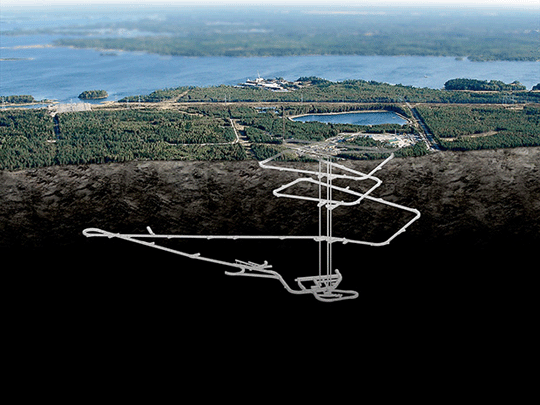
 Deep Storage Plans Approved. IEEE Spectrum By Lucas Laursen 17 Nov 2015 Finland’s government issued a construction license to nuclear disposal consortium Posiva last week, Reuters reported. The license gives the group approval to build a storage facility on Olkiluoto Island, Finland, designed to last 100,000 years.
Nuclear waste consists of metal rods composed mostly of uranium with a molecular weight of 238. Over time, the depleted uranium atoms release radioactive particles—a process called decay—that converts the uranium into lighter elements. Over billions of years, those atoms decay, too. By the end, all that is left is lead.
In the (long) meantime, however, the radioactive material can contaminate its surroundings, and therefore requires costly management. The United States and other nuclear-powered countries have thus far proven unable to agree on where to store their half-century’s worth of accumulated nuclear waste. An earthquake, volcanic activity, or even a slow leak of water could disrupt the temporary facilities in which the waste now sits.
To provide safer and more permanent storage, Posiva proposes to bury electrically-welded iron-and-copper capsules 400 meters underground. The capsules would be surrounded by clay barriers and capped with rubble and cement. The facility, which would have a 6,500 metric ton capacity, could likely hold Finland and Sweden’s projected future nuclear waste. But that capacity doesn’t come close to the volume required by larger nations such as the United States, which has over 70,000 metric tons of waste piled up, and produces an additional 2,200 tons a year.
Though tunneling has been going on for over a decade, Posiva had to wait for the Finnish government to approve its 2012 construction permit application before it could begin the trickier task of loading radioactive waste into its metal coffins. That task may begin as soon as 2023, continue for up to a century, and end when operators fill in the access tunnels with rubble and cap them off with cement. Posiva estimates that installation and operating costs for the first century will be around €3 billion (US $3.21 billion). http://spectrum.ieee.org/energywise/energy/nuclear/nuclear-waste-deep-storage-plans-approved
Finland’s Nuclear Waste Solution.
But maybe nobody will be here to care. In 1000, 10 000, or 100 000 years……
 Finland’s Nuclear Waste Solution. IEEE Spectrum, By Sandra Upson 30 Nov 2009 Here on Olkiluoto Island, the forest is king. Elk and deer graze near sun-dappled rivers and shimmering streams, and humans search out blueberries and chanterelle mushrooms. Weathered red farmhouses sit along sleepy dirt roads in fields abutting the woods. Far beneath the vivid green forest, deep in the bedrock, workers are digging the labyrinthine passages and chambers that they hope to someday pack with all of Finland’s spent nuclear fuel.
Posiva, the Finnish company building an underground repository here, says it knows how to imprison nuclear waste for 100 000 years. These multimillennial thinkers are confident that copper canisters of Scandinavian design, tucked into that bedrock, will isolate the waste in an underground cavern impervious to whatever the future brings: sinking permafrost, rising water, earthquakes, copper-eating microbes, or oblivious land developers in the year 25 000. If the Finnish government agrees—a decision is expected by 2012—this site will become the world’s first deep, permanent repository for spent nuclear fuel.
Of course, not everyone shares Posiva’s confidence. ”It’s deep hubris to think you can contain it,” says Charles McCombie, executive director of the Association for Regional and International Underground Storage, based in Switzerland.
There’s more at stake here than the interment of 5500 metric tons of spent Finnish fuel. More than 50 years after the first commercial nuclear power plants went operational in the United Kingdom and the United States, the world’s 270 000 metric tons of spent nuclear fuel remain in limbo. After it gets swapped out of a reactor, utilities put it in specially designed pools, where chilled, circulating water absorbs the initial heat and radioactivity. After about five or six years, the fuel has cooled considerably, enabling utilities with limited pool space to load it into huge, million-dollar steel casks that are left to sit on concrete pads within guarded compounds.
The arrangement is far from ideal. Continue reading
Investors urged to dump Toro Energy at company AGM
 Conservation Council of Western Australia, 18 Nov 15, Traditional Owners and environment groups will ask shareholders to withdraw support for Toro Energy highlighting community opposition to the company’s uranium mine plans and a flat lining uranium market at the Toro’s AGM today.
Vicki Abdullah, Traditional Owner of the Lake Maitland area where the company plans to mine uranium will be attending the AGM today.
Ms Abdullah said, “I’ve told Toro Energy time and time again that they are not allowed to mine at Lake Maitland, they have no right to destroy our homelands, our sacred places and the burial sites of our old people. You wouldn’t let them do that your home or your ancestors. Well I won’t let them do it to mine.”
CCWA Director Piers Verstegen, said “After ongoing weak performance we expect Toro Energy will be asking shareholders to ‘hang in there and be patient’, however the reality is that community opposition and weak market are serious impediments that are not going to go away.
“Uranium is unnecessary, unsafe and unwanted and we will be asking Toro shareholders to place their investments in more lucrative and responsible industries like renewable energy.
“Toro must also face reality and cease pressuring local communities and Traditional Owners causing anxiety and conflict over a mine that will never make economic sense” concluded Mr Verstegen.
Petition: No Uranium Waste for Australia
Australians do not want uranium wastes from other countries. This also means no wastes from uranium originating in Australia.
We believe this is a commercial effort by Australian corporations to sell more uranium to the world. Please help us stop this.
It is NOT safe – our friends in Japan and worldwide can verify this.
We must act now to protect future generations.
Please sign for the sake of your children and grandchildren.
Toro Energy Wiluna Uranium Project Public Consultation opens
 Public consultation opens for proposed Toro Energy Wiluna Uranium Project expansion http://www.abc.net.au/news/2015-11-17/public-consultation-opens-for-wiluna-uranium-mine-expansion-plan/6948066 Plans to extend a uranium project in the Shire of Wiluna are now open for public consultation.
Toro Energy is proposing to extend the Wiluna Uranium Project, which already has two deposits, known as Centipede and Lake Way, which were approved by the Environmental Protection Authority (EPA) in 2012.
The company is now looking to add two more deposits, which will be known as Millipede and Lake Maitland. The proposal also includes a haul road to be built at Centipede. Toro has not started mining at any of the deposits.
The EPA public consultation period for the two new sites runs until February.
Doubtful that Australia will become the world’s nuclear trash dump
So will Australia become the nuclear waste dump of the world? It looks very doubtful, with too much at stake if things go wrong.
Will Australia become the world’s nuclear waste dump?, Blouin News November 16, 2015 by Michael Lerner “…….. P.M. Malcolm Turnbull’s idea of possibly storing nuclear waste from elsewhere — permanently — has caused an outpouring of criticism. In a withering op-ed published last week, Dr. Jim Green, the national nuclear campaigner with Friends of the Earth, Australia, blasted the country’s previous nuclear safety record and economic viability of the storage scheme.
…the country needed to undertake three priority reforms in order to realize [the nuclear waste storage scheme]:
Removing exploration and mining bans in those states where the bans exist; excluding the federal government from the current dual state/federal environmental assessment process; and increasing the number of ports through which uranium can be exported.
All of these steps are controversial, as NIMBY (not-in-my-backyard) sentiment runs high when it comes to anything nuclear.
Additionally, the government’s desire to export uranium to India, as per an earlier civilian nuclear power agreement, is even outweighing the recommendations of the nonpartisan committee established to examine the matter. Continue reading
Bega climate activist Philippa Rowland to speak at UN summit in Paris
 Community projects lead to world stage: Bega climate change activist to speak at UN summit in Paris ABC South East NSW Ian Campbell, 17 Nov 15 Philippa Rowland, one of the founding members of a regionally-based climate action group, is Paris-bound, keen to play a role in shaping a safer climate future for the world.
The United Nations Conference on Climate Changeruns from November 30 to December 11, and Ms Rowland will be there as a voice from rural Australia.
Motivated by her connection with Clean Energy for Eternity (CEFE), based in the Bega Valley of New South Wales, Ms Rowland said she would bear witness at a pivotal time in the world’s response to a warming atmosphere.
“If we turn the corner now we still have time,” she said.
Since 2006 CEFE has championed a range of renewable energy projects that have resulted in solar panels being installed on community buildings, and culminating in the Tathra Solar Farm coming online earlier this year……..http://www.abc.net.au/news/2015-11-17/bega-activist-to-address-un-climate-change-paris/6947248
Bathurst residents rally to protect Sallys Flat from nuclear waste
 Residents rally to protect Sallys Flat from nuclear waste http://www.abc.net.au/news/2015-11-18/sallys-meeting/6950152 Residents in a Bathurst district village are rallying to fight Federal Government plans to store nuclear waste on a local property. Dozens of people have attended a public meeting at Hill End yesterday to discuss the proposal to house the material at nearby Sallys Flat.
Local resident Ross Brown says more than two-thirds of the community attended and all were opposed to the waste being dumped in the area. He said they were getting advice from environmental groups and federal MPs on how to stop Sallys Flat being selected by the government.
“It’s not a place where we want it to be, at Hill End or Sallys Flat,” Mr Brown said.”We want to know how best to object to it being at Sallys Flat or Hill End.
“Most people see that if the facility is here it will devalue their land. “They’re not really happy with the process of how it was selected.”
A committee is being set up as part of the community’s efforts to stop Sallys Flat being chosen.Mr Brown said locals would do everything they could to protect the area. “They’ve all offered methods in counteracting this proposal and show that the local community are (sic) entirely against it.”
Australia’s Prime Minister happy to have this nation be the world’s nuclear waste dump
A nuclear industry would be a dead end for Australia’s economy. At least, that is what the latest edition of the International Atomic Energy Agency’sNuclear Technology Review suggests.
Prime Minister Malcolm Turnbull wants to turn Australia into a nuclear wasteland for other countries http://www.fukushimawatch.com/2015-11-12-prime-minister-malcolm-turnbull-wants-to-turn-australia-into-a-nuclear-wasteland-for-other-countries.html by Greg White Prime Minister Malcolm Turnbull feels cautious, but is at the same time open to the idea of a nuclear fuel leasing industry in Australia. The industry would consist of leasing fuel rods to other countries, and then storing the waste afterwards. In other words, Australia would become a nuclear junkyard that other countries could use to dump toxic waste.
The Prime Minister said he was originally skeptical about whether or not Australia would build power stations in order to provide electricity for its citizens. The country already has a rich supply of gas, wind and solar power.
“We have got the uranium, we mine it, why don’t we process it, turn it into the fuel rods, lease it to people overseas, when they are done, we bring them back and we have got stable, very stable geology in remote locations and a stable political environment,” the Prime Minister said.[1]
NUCLEAR INDUSTRY COSTS MORE MONEY THAN IT’S WORTH Continue reading
1 This month

of the week – Australians for War Powers Reform (AWPR)
To see nuclear-related stories in greater depth and intensity
 Antinuclear