What are the radioactive risk of nuclear waste dump to a farming community?
Jim Green Friends of the Earth, 18 Nov 15 Responding to these questions: “So what are irradiation cans, ion exchange resins and aluminium ends of fuel rods and what dangers do they present to those living in a farming community? Is anyone able to inform me or direct me to where I can find such information please?”
They are harmless metals (irradiation cans + aluminium ends of fuel rods) and resins/polymers … but hazardous because of contamination with radioactive substances. For the contaminated metals they are likely contaminated with long-lived alpha-emitting radionuclides and would likely be classified as long-lived intermediate-level waste (LLILW) and would therefore be sitting in an above-ground shed at Kimba for an ‘interim’ period likely to last for many decades since absolutely no effort is being made to find a disposal site for LLILW (it is destined for deep underground disposal).
The risks …. pretty much anything you can imagine has happened at one or another radioactive waste repository around the world: fires, leaks, water infiltration and corrosion of waste drums, a chemical explosion, etc.
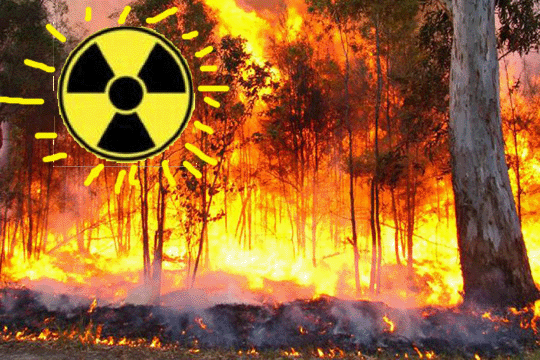
Fire would be a particular concern at Kimba, all the more so since the most hazardous waste (LLILW) would be stored above ground. Articles about recent fires at U.S. repositories are posted at: http://www.foe.org.au/fire
Water infiltration and corrosion is a difficult dilemma. The Howard government planned an unlined radioactive waste repository near Woomera. Later governments proposed a concrete-lined repository in the NT … but with water outlets so that water ingress didn’t lead to excessive corrosion, or waste barrels swimming in pools of water, etc. One of the problems they had at Lucas Heights was water infiltration into a ‘dry’ storage area for spent nuclear fuel, followed by ham-fisted efforts to retrieve the spent fuel elements (they dropped a spent fuel canister and it took them several months to build a mechanical device to fix the problem − four workers got low levels of radiation exposure). Another problem involved in the incorrect ‘cropping’ of spent fuel elements (chopping the ends off) resulting in contamination of the water pool the spent fuel was sitting in.
Most repositories around the world have experienced few if any problems BUT the federal government department responsible for the proposed Kimba repository + above-ground store is the same department that spectacularly mismanaged the ‘clean up’ of the Maralinga test site just 15 years ago. There is no logical, rational reason to believe that this project would be managed more responsibly. For details on the Maralinga fiasco see:
http://www.foe.org.au/anti-nuclear/issues/oz/britbombs/clean-up
Incredibly, the Maralinga project was managed by two government officials whose scientific and nuclear illiteracy was so profound that one didn’t understand the difference between acids and bases and the other didn’t understand the difference between alpha and gamma radiation. Neither had project management experience. They were hostage to savvy contractors who took the government on an expensive ride. At least four scientists publicly voiced their concerns and opposition:
* Nuclear engineer Alan Parkinson said of the ‘clean up’: “What was done at Maralinga was a cheap and nasty solution that wouldn’t be adopted on white-fellas land.”
* US scientist Dale Timmons said the government’s technical report was littered with “gross misinformation”.
* Geoff Williams, an officer with the Commonwealth nuclear regulator ARPANSA, said the ‘clean up’ was beset by a “host of indiscretions, short-cuts and cover-ups”.
* Nuclear physicist Prof. Peter Johnston said there were “very large expenditures and significant hazards resulting from the deficient management of the project”.
Nuclear engineer Alan Parkinson noted that the government changes its definitions and standards when it suits. Shallow burial of long-lived radioactive waste is a breach of Australian standards yet that is precisely what happened at Maralinga − shallow burial of long-lived waste in unlined trenches in totally unsuitable geology.
That’s precisely the sort of thing that could happen at Kimba. According to national and international standards LLILW is destined for deep underground disposal, but as mentioned no effort is being made to find a disposal site for LLILW. No-one who has been following these debates over the years would be the least bit surprised if the government decided on shallow burial of LLILW at Kimba (or ‘interim’ storage stretching on for decade after decade after decade). When government officials reassure you that ‘interim’ above-ground storage of LLILW at Kimba won’t last too long, just ask them why no effort is being made to find a disposal site for LLILW.
Shifting LLILW from an above-ground interim store at Lucas Heights to an above-ground interim store at Kimba is particularly idiotic. Lucas Heights has the storage facilities, the on-site expertise and the security personnel and systems.
Alan Parkinson’s submission to the Royal Commission focuses on regulatory failures. Since it is difficult to find particular submissions on the Royal Commission website, I have posted it at: http://www.foe.org.au/sites/default/files/Parkinson-Alan-12-06-2015.pdf
Parkinson summarises: “The disposal of radioactive waste in Australia is ill-considered and irresponsible. Whether it is short-lived waste from Commonwealth facilities, long-lived plutonium waste from an atomic bomb test site on Aboriginal land, or reactor waste from Lucas Heights. The government applies double standards to suit its own agenda; there is no consistency, and little evidence of logic.”
(Alan Parkinson, 2002, ‘Double standards with radioactive waste’, Australasian Science, www.foe.org.au/anti-nuclear/issues/oz/britbombs/clean-up)
If I lived in a country with a track record of responsibly managing radioactive waste, I wouldn’t be much fussed about what the government is proposing. If I lived in Kimba I would be fighting like hell because there is no logical, rational reason to believe the project will be managed carefully and responsibly, and every reason to believe that it won’t be.
More information is posted at http://www.foe.org.au/anti-nuclear/issues/oz/nontdump
And some of the information (and videos) posted at this website may be of interest: http://www.australianmap.net/
… children playing in contaminated sites because of slack security, contaminated sites closed down 50++ years ago and still not properly cleaned up, etc etc.
−
No comments yet.
1 This month

of the week – Australians for War Powers Reform (AWPR)
To see nuclear-related stories in greater depth and intensity
 Antinuclear
Leave a comment