National Party MP John Cobb happy to host radioactive trash – Merino farmers ARE NOT!
 On Friday, Member for Calare John Cobb said he was very relaxed about the
  proposal to consider Sallys Flat for the dump.
He said he felt the waste was so non-threatening that a person could put it in a bag and sleep on it without feeling any ill-effects.
Merino farmers at Sallys Flat fear nuclear dump next door, Western Advocate, 17 Nov 15 PRIME wool producers around Sallys Flat fear the potential establishment of a nuclear waste dump on a neighbouring property could put their livelihoods at risk.
Geoff and Robyn Rayner produce some of the best superfine fleece in the world at their Pomanara Merino Stud, close to a neighbouring property which has been shortlisted for a permanent radioactive waste dump.
The Rayners’ home is the closest residence to the site ……The Sallys Flat site has been offered to the Federal Government for use by the landowner.
The Rayners have just signed up to become a sustainable operation and said they had to meet stringent criteria. Now, with the prospect of nuclear waste on their doorstep, all that has been put at risk. “The stigma sticks,” Mr Rayner said. Three generations of the family have made their living from the land. Now they wonder if they will have a future. Continue reading
Inglewood residents tell govt – “No nuclear waste dump here”
 Residents tell officials they don’t want nuclear waste, ABC Radio PM Annie Guest reported this story on Wednesday, November 18, 2015 DAVID MARK: Residents of the southern Queensland town of Inglewood have told Government officials they don’t want Australia’s first permanent nuclear waste facility in their community.
Most residents say they were worried about safety risks and property values declining, but one woman said the waste from the nuclear medicine that saved her husband’s life must be stored somewhere.
Annie Guest reports from Inglewood…….http://www.abc.net.au/pm/content/2015/s4354831.htm
USA won’t start Hanford nuclear tank clean-up for another 17 years!
 U.S. government proposes 17-year delay in start of Hanford nuclear tank cleanup — until 2039 http://www.latimes.com/science/la-na-hanford-delay-20151118-story.html Ralph VartabedianContact Reporter, 19 Nov 15
The Energy Department has proposed a 17-year delay in building a complex waste treatment plant at its radioactively contaminated Hanford site in Washington state, pushing back the full start-up for processing nuclear bomb waste to 2039.
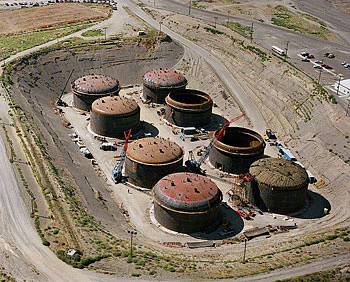
The department submitted the 29-page plan in federal court as part of a suit to amend an agreement with the state that requires the plant to start operating in 2022.
A series of serious technical questions about the plant’s design have caused one delay after another. Two of the major facilities at the cleanup site, which resembles a small industrial city, are under a construction halt ordered in 2013 by then-Energy Secretary Steven Chu.
The plant, located on a desert plateau above the Columbia River, is designed to transform 56 million gallons of radioactive sludge, currently stored in underground tanks, into solid glass that could theoretically be stored for thousands of years.
The waste was a byproduct of plutonium production, which started with the Manhattan Project during World War II.
The 586-square-mile Hanford site is widely considered the most contaminated place in the country, requiring 8,000 workers to remediate half a century of careless industrial practices that were done under strict federal secrecy. The Energy Department filing shows the extent of the problems. Continue reading
Burying dead reactors will cost nuclear companies 100s of $billions
Standard & Poor’s: Dismantling Europe’s old nuclear power plants will run up a €100bn bill for EDF, E.ON, RWE and others http://www.cityam.com/229161/standard-poors-dismantling-europes-old-nuclear-power-plants-will-run-up-a-eur100bn-bill-for-edf-eon-rwe-and-others 19 November 2015 by Jessica Morris Dismantling Europe’s old, uneconomic power plants will impose heavy costs on Europe’s biggest operators, something which could strain their balance sheets, and hit their credit rating.
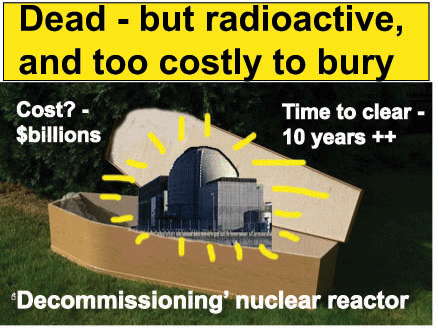
Nuclear liabilities of the largest eight nuclear plant operators in Europe totaled €100bn at the end of last year, representing around 22 per cent of their aggregate debt, according to credit rating agency Standard & Poor’s.
Operators are legally responsible for decommissioning nuclear power plants, a process which can take several decades to implement, meaning the associated costs are high. Europe’s main nuclear operators include France’s EDF, Germany’s E.ON and RWE. They are legally responsible for decommissioning nuclear power plants, a process which can take several decades to implement, meaning the associated costs are high.
While the analysis by S&P treats nuclear liabilities as debt-like obligations, it recognises that several features differentiate them from traditional debt. But given the size of the liabilities against a company’s debt, they can impact a company’s credit metrics, and their credit rating.
The report noted that a company’s nuclear provisions are difficult to quantify, as well as cross compare, because accounting methods vary between different countries. It also foresees many operational challenges ahead, including a reality check on costs and execution capabilities.
Malcolm Turnbull “browns down” OECD deal to limit coal subsidies
According to the Australian Greens, the Turnbull government’s deal could allow the development of up to 16,000MW of extra coal plants – already in the planning pipeline – to be financed.
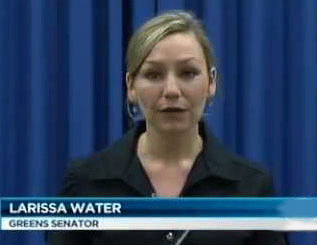 Greens Senator and climate spokesperson, Larissa Waters, said the Turnbull government’s “grubby gambit” had tipped the scales against clean energy in these developing countries, and towards coal – a situation that would benefit Australia’s resources sector.
Turnbull accused of “browning down” OECD coal subsidy 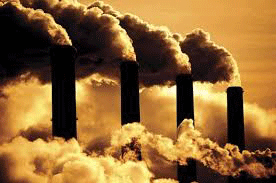
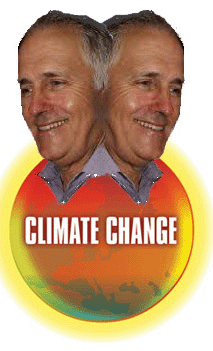 cuts, http://reneweconomy.com.au/2015/turnbull-accused-of-browning-down-oecd-coal-subsidy-cuts-44371 By Sophie Vorrath on 18 November 2015 The Turnbull government has been accused of “browning down” the deal to limit global coal plant subsidies, struck this week by the Organisation of Economic Cooperation and Development, after the compromise it proposed alongside South Korea was worked into the agreement. Continue reading
Obama backs community solar – a practical alternative to rooftop solar
 White House pushes community solar power as rooftop
  alternative Gregory Korte, USA TODAY, 19 Nov 15 WASHINGTON — About half of electric customers can’t install solar panels because they don’t own their building, don’t get enough sun or don’t have a large, south-facing roof to install solar panels, according to the U.S. Department of Energy.Those technical challenges are a particular hurdle for low- and middle-income customers — and that’s why the Obama administration is pushing a solution known as community solar.
The White House hosted a summit Tuesday to bring together major solar players to figure out ways to expand retail solar power from traditional rooftop arrays to a model in which households and businesses invest in shared solar systems. The administration announced that 68 cities, states, and businesses had signed on to a White House initiative to promote community solar, with an emphasis on low- and moderate-income households.
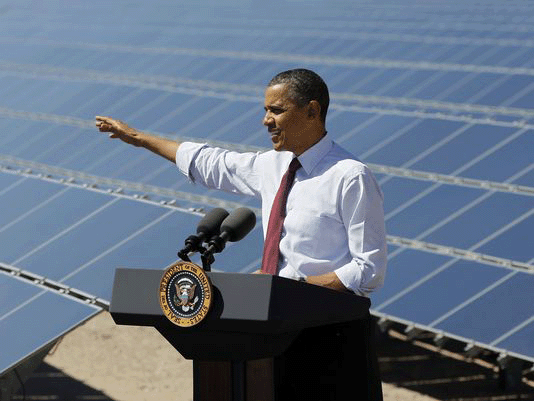
Those commitments are expected to bring solar power to to more than 20,000 households in 21 states, the White House said. And, just as importantly for President Obama, it will allow the United States to expand its use of clean energy as Obama prepares to travel to Paris for an international climate summit where he’ll press other companies to make similar strides to reduce carbon pollution from fossil fuels…….
Another participant, Michelle Moore of the nonprofit Groundswell, works as a community organizer to try to create markets for community solar power in places where it doesn’t yet exist. She said the White House summit was helpful in bringing for-profit utilities, cooperatives, local governments, non-profits and financiers together to make connections.
“Our role is organizing customers so that they’re able to have more of a say in what kind of energy they want and how they want to buy it,” said Moore, a former environment policymaker at Obama’s White House Council on Environmental Quality. “It’s a way to buy into a solar project without a home construction project.” http://www.usatoday.com/story/news/politics/2015/11/17/white-house-pushes-community-solar-power-rooftop-alternative/75950054/
Global toll of the nuclear industry and uranium exploitation
 Federation For a Sustainable Environment « Nuclearisation of Africa » Symposium 19. Nov 2015 There is a clear global downtrend in the civil use of nuclear power, as documented by the annual World Nuclear Industry Status Report and as discussed at the international Symposium on « Nuclearisation of Africa » concluded on the 19th of November in Johannesburg.
Testimonies by participants from Niger spoke about the heavy toll of the 40 years exploitation of Uranium in their country. An excursion by the participants of the W Rand gold mine region (Johannesburg) demonstrated the grave environmental effects of gold mining, as tailing storage facilities contain a significant amount of uranium and a host of radioactive materials.
Health problems affecting miners and their families, living near the tailings and acid mine drainage receptor dams are frequent and well understood.
The link between the mining of uranium and the spread of nuclear weapons was also discussed. In view of the globally expanding use of renewables, South Africa has the chance to become the African leader for a sustainable energy future and this at a fraction of the costs of less risks compared with a nuclear power system. Mariette Liefferink CEO FSE (Federation for a Sustainable Environment) Günter Wippel Uranium-network Germany Prof. Andreas Nidecker, MD IPPNW (Interntl Physicians for the Prevention of Nuclear War) Switzerland
We might need a Senate inquiry into ultrasound from trees etc

If the committee is sincere in its concerns about the health effects of infrasound, will we soon learn of a new inquiry about the pernicious and unappreciated dangers of living near the sea or trees, having air conditioners, stereos, ceiling fans, or travelling in motor vehicles?
What’s next, a Senate inquiry into infrasound from trees, waves or air conditioners?, The Conversation, Simon Chapman Professor of Public Health, University of Sydney November 18, 2015 At the centre of claims about wind farms allegedly causing health problems is the infrasound that wind turbines generate as they turn in the wind.
Infrasound is sound below 20Hz, which is generally inaudible. Wind turbines are just one source of artificial man-made infrasound. Others include power stations, industry generally, motor vehicle engines, compressors, aircraft, ventilation and air conditioning units, and loudspeaker systems. Everyone living in an urban environment is bathed in infrasound for most of their lives.
As I sit at my inner Sydney desk writing this I’m copping infrasound from the planes that pass some 200-300 metres over my house sometimes many times an hour, the sound of passing road traffic on a quite busy road 100 metres from our house, and the stereo system I listen to as I write. Don’t tell anyone, but I feel fine and I’ve lived here 25 years.
But infrasound is generated by natural phenomena too. These include rare occurrences such as volcanoes and earthquakes, but also sources like ocean waves and air turbulence (wind) that countless millions, if not billions, are exposed to on most days. Anyone living close to the sea is surrounded by constant infrasound from waves.
The inclusion of wind as a source of infrasound is of particular significance to claims made that wind turbine-generated infrasound is noxious. In a Polish research paper published in 2014, the authors set out to measure infrasound from wind turbines and to compare that with naturally occurring infrasound from wind in trees near houses and from the sound of the sea in and around a house near the seaside…….
Wind is, of course, a prerequisite for wind turbines to turn and generate their mechanical infrasound. Here, the Polish authors noted that:
natural noise sources … always accompany the work of wind turbines and in such cases they constitute an acoustic background, impossible to eliminate during noise measurement of wind turbines.
This is a fundamentally important insight: wherever there are wind turbines generating infrasound, there is also wind itself generating infrasound. And it is impossible to disentangle the two. Indeed, every time I’ve been near wind turbines, easily the most dominant sound has been that of the wind buffeting my ears. Continue reading
Moree solar farm operational by end of 2015
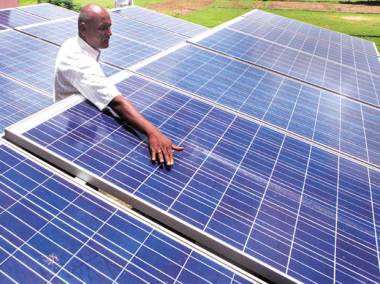 Energy generation expected at Moree Solar Farm by year’s end, ABC News, 17 Nov 15
Work is nearly complete on the Moree Solar Farm with an expectation energy will be generated at the site by the end of the year. A spokesman for the company behind the project, Fotowatio Renewable Ventures, said there’s just a few tasks left to do on site.
“The Moree Solar Farm is entering the final stages of construction,” Technical manager Tom Best said.
“We’ve finalised the installation of the PV modules and the tracking system and we’re currently undertaking commissioning of the PV plant with a view to start generating energy by the end of the year.”
The project is led by FRV and has been funded with assistance of a $102 million grant from Australian Renewable Energy Agency and $47 million in debt financing from the Clean Energy Finance Corporation…….
The solar farm is expected to supply 15,000 homes. http://www.abc.net.au/news/2015-11-17/production-expected-at-moree-solar-farm-by-year27s-end/6946716
Impact of El Nino on Peru and Australia
El Nino: Separated by the Pacific, Australia gripped by drought while Peru prepares for devastating rain, ABC News, By freelance contributor Krista Eleftheriou in Peru 19 Nov 15 The world’s largest ocean is hosting the yin and yang of El Nino.
On one side of the Pacific, large tracts of Australia are gripped by drought triggered by the phenomenon. On the opposite side, the desert coastline of Peru is preparing for devastating rain.
Scientists warn Peru faces one of the strongest El Ninos on record.
In the next few months it could deliver a multi-billion-dollar damages bill from landslides, floods, failed crops and the collapse of the world’s largest anchovy fishery.
“Peru, along with Australia, is one of the worst affected countries in the world from El Nino,” said Angel Cornejo, professor of climate studies at the National University Agraria in the Peruvian capital, Lima.
“Poverty is the problem here. People live in places that will flood. They are very poor and they have nowhere else to go.”….http://www.abc.net.au/news/2015-11-18/el-nino-peru-prepares-for-devastating-rain/6951042
Canberra researchers seek information from solar home-owners
Solar panels installed on homes across ACT needed by researchers for local power study 666 ABC Canberra By Hannah Walmsley with Philip Clark, 19 Nov 15 Researchers at the Australian National University (ANU) are calling for volunteers across the ACT who have solar panels on their house to take part in a new study. This project will allow us to predict what will be fed into the grid at a particular time. Dr Christfried Webers
ANU researchers are collaborating with Data61’s Machine Learning Research Group — formerly National ICT Australia (NICTA) — to develop methods of forecasting power output from rooftop solar energy systems.
Dr Christfried Webers from the ANU’s College of Engineering and Computer Science said that while total energy output could be measured over long periods, little was known about changing energy output across the day. “What we need is to be able to predict how much energy will be produced over five minutes to 60 minutes,” he said.
“That’s necessary information for the energy market operator — they need information on what’s coming from hour to hour. “It’s also important for the local utility providers because they have a spinning reserve running and if they can anticipate an energy drop, they can ramp that up when they need to.”
Close to 13 per cent of households in the ACT have solar panels generating power. “If that reaches 30 per cent, it will become vital to predict what energy will be produced to ensure the stability of the grid,” Dr Webers said. How the weather can impact
Dr Webers said he hoped the project would allow his team to develop software to forecast the solar output from each suburb using low-cost data-logging devices installed on individual homes…….Canberra residents interested in participating in the project can register their interest with NICTA. http://www.abc.net.au/news/2015-11-17/volunteers-wanted-for-canberra-solar-panel-study/6946904
Australia’s really big radioactive waste dump is at Roxby Downs
Dennis Matthews, 19 Nov 15, In the 1980’s we were repeatedly told not to worry about uranium mining at Roxby, that Roxby was a copper mine and that uranium was incidental. Now we are being told that Roxby has the world’s largest deposit of uranium.
Despite strong public opposition, mining at Roxby got the nod from politicians. Soon radioactive water started leaking through the un-sealed base of the tailings dam, and now BHP is building an ever-expanding man-made stockpile of radioactive waste.
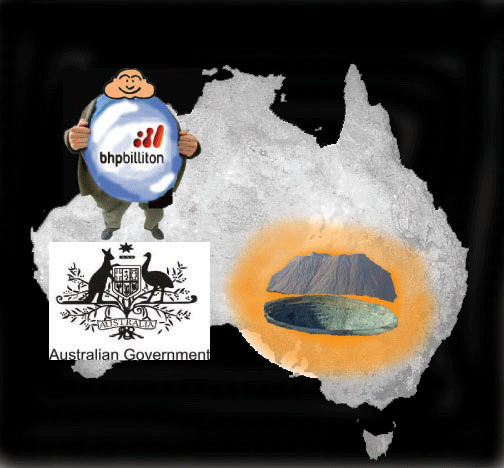
Paul Starick (The Advertiser, 13/11/15) downplays the fact that we have a nuclear reactor, stating that Australia has no nuclear power reactor, a distinction that has little to do with the issue. Using the “nuclear medicine” mantra, Starick downplays the main role of a nuclear waste dump, namely to deal with highly radioactive waste from Australia’s nuclear reactor, which will open the door to international waste.
The small amounts of relatively benign low-level waste being safely stored in institutions around Australia is trivial compared to BHP’s massive stockpiles of waste at Roxby and Australia’s nuclear reactor waste.
1 This month

of the week – Australians for War Powers Reform (AWPR)
To see nuclear-related stories in greater depth and intensity
 Antinuclear