Government and media are lying about the purpose of the hunt for nuclear waste dump ,site
 Australia’s mainstream media keep on repeating the same old lie about the “national
  nuclear waste dump being all about medical wastes.
It’s not. It’s about the highly radioactive wastes now being returned from France to the Lucas Heights nuclear site in Sydney. By contracts made long ago, Australia is obligated to take back spent nuclear spent fuel rods that were sent to France, UK and Argentina for processing. And this will continue to happen, as long as the Lucas Heights nuclear reactor is kept going.
Production of medical radioisotopes is not the major function of the reactor. And these medical isotopes are now being made much more safely in non nuclear cyclotrons – without all those problems of safety, of being a terrorism target, and of radioactive trash, and its dangerous transport.
Hospital medical wastes are overwhelmingly of short-lived radioactivity, and therefore well suited to disposal near the site of use. No need to cart them all the way to South Australia. That’s just an nexcuse fofr the real aim – the storage of lucas heights highly radioactive trash returning from overseas.
ANSTO, Geoscience, Dept of Science to visit Kimba, South Australian site on shortlist for nuclear trash dump
 Nuclear delegations to visit Kimba after release of toxic dump short list, ABC News 23 Nov 15 Two separate delegations are to visit Kimba on SA’s Eyre Peninsula, the tiny town shortlisted by the Federal Government to be the site of a nuclear waste dump.
Earlier this month the Government released a shortlist of six sites nominated to store low and intermediate level nuclear waste…….One delegation, including Geoscience Australia, the Australian Nuclear Science and Technology Organisation, and the Department of Science, will visit councillors and landowners who have nominated their properties.
Greens MP Mark Parnell will also tour the community which has been divided by the issue.
He said there was no need for a new dump because waste could be stored at existing sites.
“When it comes to nuclear waste we have a responsibility to manage it properly, and safely,” Mr Parnell said.
“The waste has been stored at Lucas Heights for many years and can be safely continue to be stored there. There’s waste that’s in hospital basements that’s got people worried, but they’re still going to have to operate.”
He said local residents had good reason to be alarmed, especially in light of an accident last year at a New Mexico waste facility.
“The operators put organic kitty litter into the drums of nuclear waste rather than inorganic kitty litter. As a result, the chemical reaction burst the drum open and radiation spread throughout the facility,” he said.
“There were 22 workers who were contaminated, and the facility is likely to be closed for four years.” http://www.abc.net.au/news/2015-11-23/nuclear-delegations-to-visit-kimba-after-dump-shortlisting/6962598
3 South Australian sites picked for nuclear trash toilet, but locals resist
The indigenous group Adnyamathanha Camp Law Mob says while the property is governed by a perpetual lease, meaning no native title claim can be lodged over the area, Aboriginal heritage legislation does apply.
“We demand that the Federal Resources Minister Josh Frydenberg publicly declare who he has consulted regarding these nominations, and who has the authority to nominate these sites,” spokeswoman Jillian Marsh said in a statement.
Cortlinye and Pinkawillinie KIMBA is known as “the Gateway to the Gawler Ranges”. But some residents fear the township would become known as “the Gateway to the National Nuclear Waste Facility” should it be selected as the future site to store radioactive waste. Local farmers Toni Scott, Sue Woolford, Helen Harris and their families have vowed to fight any move to build the facility in their district.
“They’re saying this is a voluntary process but how is this voluntary?,” Mrs Scott said.
“We’re not volunteering, we don’t want any money and we don’t want to live next to it.’’
The group vowed to be vocal during the Federal Government’s consultation in Kimba next week
Nuclear waste repository in SA: What do the locals think? The Advertiser, 22 Nov 2015 BRYAN LITTLELY, PAUL STARICK and MEAGAN DILLON PICKING a site for a nuclear dump is as contentious a decision as you will find. Whichever of the six Australia-wide candidates that is chosen to be the nation’s nuclear repository will acquire a degree of notoriety.

South Australia is home to three potential dump locations. Continue reading
Calare MP John Cobb blames local media for ‘sensationalism’ about nuclear waste dumping
 Member for Calare John Cobb’s words to offer hope for Sallys Flat, Western Advocate, 22 Nov 15 Calare MP John Cobb has guaranteed no nuclear waste dump would be built in Sallys Flat if local residents remain “generally opposed” to it.
More than 100 residents turned out at a community meeting last Tuesday to voice their anger about Sallys Flat being shortlisted as one of six sites to potentially host the new permanent waste dump.
Mr Cobb also came under fire at that meeting for saying he was not concerned about the prospect of a nuclear waste dump being established at Sallys Flat and claiming the waste that would be dumped in the region was so benign “you could sleep on it”.
But in a written statement issued on Friday, Mr Cobb blamed the local media for “sensationalising” the issue and failing to tell the people of Sallys Flat there would be no nuclear waste dump in their backyard without their support……. http://www.westernadvocate.com.au/story/3509083/nuclear-reaction/
Aboriginal leaders meet Kiribati president in support of climate action, stopping coal mines
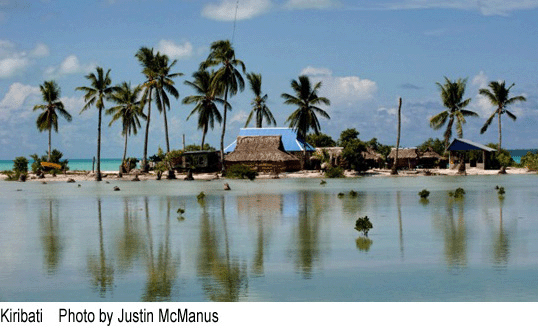 Wangan & Jagalingou leader in historic meeting with Kiribati president http://wanganjagalingou.com.au/category/latest-news/ November 19, 2015 Joins president’s call for no new coal mines; seeks support to defend W&J’s rights and country
Wangan and Jagalingou (W&J) Traditional Owner, and senior spokesperson Adrian Burragubba, will this morning meet with President Anote Tong of Kiribati and offer support to his call for a global moratorium on new coal mines. The meeting will bring together for the first time two leaders of traditional peoples in the region vulnerable to the devastating impacts of coal mining and burning. Continue reading
AUSTRALIA/INDIA U-DEAL SELLS URANIUM DIRECTLY INTO SUBCONTINENTAL NUCLEAR ARMS RACE
 India-Australia nuclear agreement: supplying uranium to a nuclear flashpoint http://www.dianuke.org/john-hallam-india-australia-nuclear-agreement-supplying-uranium-to-nuclear-flashpoint/ AUSTRALIA/INDIA U-DEAL SELLS URANIUM DIRECTLY INTO SUBCONTINENTAL NUCLEAR ARMS RACE, John Hallam Nuclear Weapons Campaigner PND-NSW
The India-Australia uranium deal, whereby Australia agrees to sell uranium to India in spite of India’s not being a signatory of the nuclear nonproliferation treaty, and in spite of the fact that a vigorous nuclear arms race is in progress on the subcontinent, beggars belief for anyone who has been involved for decades as I have, in questions of nuclear nonproliferation, disarmament, and nuclear safety.
A vigorous nuclear arms race is taking place right now on the Indian subcontinent between India and Pakistan, with Pakistan now having some 130 nuclear warheads, and India not far behind with between 110 and 120.
Pakistan has deployed short-range, war-fighting ‘mini nukes’ to repel Indian tank attacks. India has said that their use will lead to full-scale nuclear war.
India and Pakistan are poised on a nuclear knife-edge. While we can say all we like that Australian uranium will only ever be used to ‘civil’ uses, the fact is that because India has limited uranium supplies of its own (mined under appalling conditions at Jharsguda in Bihar with catastrophic effects on the health of local people) – the fact is that use of Australian uranium will ‘free up’ un-safeguarded Indian uranium for weapons use. It can be no other way, there is simply no avoiding the brute facts of arithmetic. Uranium that has been replaced by imported (Australian) uranium for nuclear power use is now available for use in nuclear weapons.
Australia has chosen to sell its uranium into the worlds most dangerous nuclear flashpoint. It has done so against the recommendations of a parliamentary joint committee.
This is a mindbogglingly foolish decision.
1.5 degrees C is the necessary global warming limit
Jumeau of the Seychelles pointed out that a 1.5°C goal would be achievable, and that adopting and meeting it would benefit rich coastal nations as well as those whose existences may be threatened by rising seas.
“It’s not just about the islands, it’s about New York, it’s about New Orleans, it’s about London, it’s about Venice,” Jumeau said. “There is no way we can compromise on 1.5.”
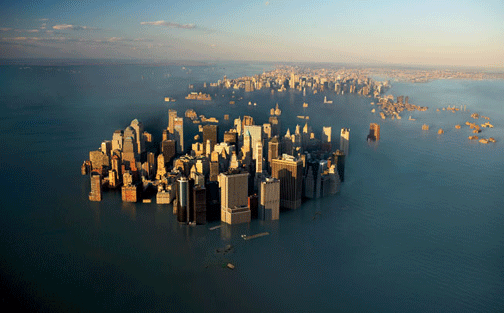
Delegates representing island states and others whose homelands are most threatened by rising seas will be pushing for the formal adoption of a long-overlooked goal, one that limits warming to less than 1.5°C, or 2.7°F.
Opposition grows in China against authoritarian government’s nuclear project
China’s authoritarian government, adept at corralling public opinion to get its way, can ram through its plans over the objections of people like Ms. Liu. But opponents say its closed, secretive political system is ill equipped to manage a rapid expansion of nuclear power, pointing to its struggle to prevent industrial disasters such as the chemical explosions in Tianjin in August that killed 173 people.

“The Chinese are beginning to wrestle with the same issues that Western countries were dealing with, concerning fear of the technology, transparency in decision making and trust of the authorities,”
Opponents of nuclear power in China maintain that the country can achieve its clean energy goals without a nuclear building spree, by investing heavily in improving solar and wind power and by upgrading the power grid so it can send electricity more efficiently across vast distances.
They point to the deadly explosions in Tianjin, where hazardous chemicals appear to have been stored improperly at a facility close to residential areas, as an example of how of lax regulation, graft and official obfuscation can undo the Chinese government’s promises to put safety first.
China’s Nuclear Vision Collides With Villagers’ Fears, NYT By CHRIS BUCKLEYNOV. 21, 2015“………..Hubin is one of dozens of sites across the country where officials have plans ready, awaiting further approval, to build atomic reactors over the next decade — an ambitious program to expand the use of nuclear energy that Beijing considers essential to weaning the Chinese economy from its reliance on coal-fired plants, which churn out air pollution and carbon dioxide.
Ask villagers here what they think of the proposed plant, though, and talk quickly turns to the Communist government’s dismal record of industrial accidents, as well as the 2011 nuclear disaster in Fukushima, Japan. Residents in Hubin will be resettled to new homes a few miles away, but many said that they would still feel threatened living so close to a nuclear station.
“It’s just not safe,” said Liu Shimin, a farmer in her 20s, nursing a baby outside her home near the banks of the Yahe River. “We’ll always be wondering, ‘What if there’s a big accident, like that one in Japan?’ ”
Such fears are on the rise in China as the nation embarks on a new phase of nuclear power construction that could make it the world’s biggest producer of nuclear energy by 2030. Continue reading
A warning to “pro nuclear” environmentalists
warned that when you sup with these nuclear devils you can never be sure what you’re going to end up with. It’s no surprise to me, therefore, that our pro-nuke greenies have been keeping very quiet about the now inevitable prospect of a huge part of our energy system in the UK being handed over to the Chinese.

Once captured by the nuclear industry, you don’t get to choose what you think might be the best (ie least problematic) option: you get what you’re given. And as pro-nuclear environmentalists, you get stitched up by an industry that gobbles up people like you for breakfast, that has lied, inveigled and bribed its way into the heart of umpteen governments over decades, often off the back of its still undeniable links to the nuclear weapons establishment. So just how naïve can you be?
for God’s sake, think again before you shift your allegiance to the latest ‘just over the horizon’ dreams now being peddled so enthusiastically by the nuclear industry.

 Meltdown for Pro-Nuclear Environmentalists http://www.jonathonporritt.com/blog/meltdown-pro-nuclear-environmentalists#comment-1778, Jonathon Porritt, 19 Nov 15
I wonder what our pro-nuclear greenies will be thinking this week as they listen to President Xi Jinping and George Osborne bombastically declaring ‘a new nuclear dawn for the UK’. I hope they’ll be feeling as ashamed as they should be.
It may be just a little harsh to blame the meltdown in UK energy policy on a handful of well-meaning but monumentally misguided environmentalists, who chose some time ago to lend their voices to the nuclear establishment here in the UK. They were warned that it would probably end in tears, and so it has turned out. Here’s the indictment against them:
1. They were warned that their high-profile support would prove to be massively confusing for many people, including a large number of environmentalists who were persuaded (often against their better judgement) that if the likes of George Osborne and his pro-nuclear buddies had decided that nuclear is ‘a necessary evil’, then that was good enough for them. Continue reading
Nuclear industry worried as reactors close in USA
Makhijani recommends a a two-prong remedy to this problem.
“Rather than keep old, clunky nuclear power plants going, we should have a community and worker protection fund — a small charge on nuclear electricity that can be used to protect workers from unemployment and transition them into new employment,” he suggests. “We give companies incentives to come, but then they can be a kind of pension fund for communities when they die or leave.”
The second part of the solution is to replace the plant with efficient and renewable energy that can create a lot of tax revenues and jobs, Makhijani says……….
Why should we be spending $60, $70, $80 a megawatt hour for old power plants that are generating nuclear waste that we don’t know what to do with instead of simply going to renewable energy?”
And then there’s the problem of nuclear waste. Opponents of nuclear power contend we should not even be talking about nuclear power if we can’t solve the waste problem. Makhijani agrees.
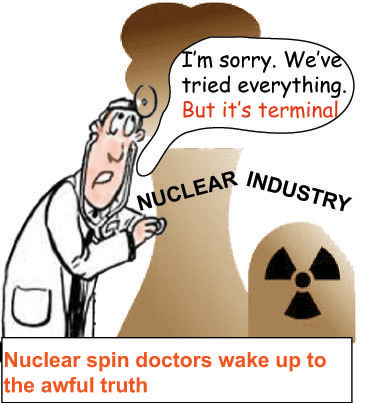
 Nuclear reactor closings in the US continue to roil the energy industry Living on Earth November 22, 2015 Adam Wernick In the face of growing safety problems, cheap natural gas and the rising use of renewable energy sources, aging nuclear power plants are closing down across the US, raising questions about the future viability of nuclear energy production. The Entergy Corporation is the most recent company to announce closings. Entergy plans to shut down the Fitzpatrick nuclear power plant on Lake Ontario near Syracuse, New York, and the Pilgrim Nuclear Power station near Boston, Massachusetts, before the end of this decade.
The two plants typify some of the problems facing the US nuclear energy industry, says Arjun Makhijani, president of the Institute for Energy and Environmental Research in Takoma Park, Maryland, and a former nuclear engineer. Continue reading
Climate change brings worse heat waves to New South Wales
Think this is hot? Warming climate points to heatwaves worsening in NSW, SMH, November 20, 2015 Peter Hannam Environment Editor, The Sydney Morning Herald NSW will experience more frequent and longer heatwaves in the future as the climate warms with the worsening extremes dependent on whether carbon emissions continue to climb, according to research from the government and the University of NSW.
The heatwave projections, released on Friday during what was expected to be Sydney’s hottest three-day spell in November in almost eight decades, cover the period to 2030 and then out to 2070.

The shift towards hotter weather is already evident, with south-eastern NSW experiencing about 18 more heatwave days a year compared with the start of the 20th century, the Office of Environment and Heritage says.
For most other parts of the state, the increase was about four-11 days.
The research, based on 12 climate models as part of the NSW and ACT Climate Modelling Project (NARCliM), estimates that most of the state will experience 1-1½ more heatwave events a year by 2030.
The number of heatwave days – defined to be excessive heat compared with historical records and the preceding 30 days – will increase by as much as 10 days a year by 2030 in the state’s north, with smaller increases near the coast. (See chart below showing the rising percentage of heatwave days each year.)
This provides a clear indication that, out to 2030, we can expect the heatwaves to happen more often, and for them to be longer,” Matthew Riley, director of OEH’s Climate and Atmospheric Science, said.
“[The models show] even more heatwaves out to 2070, that last longer still, and are becoming hotter,” Mr Riley said……http://www.smh.com.au/environment/climate-change/think-this-is-hot-warming-climate-points-to-heatwaves-worsening-in-nsw-20151120-gl3nwt.html
Greens spell out their policy for 90% renewable energy target
 Greens unveil push for 90% target for renewable energy by 2030 Daniel Hurst http://www.theguardian.com/australia-news/2015/nov/22/greens-unveil-push-for-90-target-for-renewable-energy-by-2030?CMP=share_btn_tw
Policy proposes new authority to oversee $5bn of construction in clean energy generation and a 15-year pipeline of projects through direct investment. The Greens will seek to build momentum for more ambitious action on climate change by calling for the creation of a new government authority to help Australia reach a 90% target for renewable energy by 2030.
The leader of the Greens, Richard Di Natale, said the policy to be released on Sunday showed the type of “real leadership” the country should display as world leaders prepared for climate negotiations in Paris next month.
The party has previously adopted a goal of ensuring Australia obtains 90% of its energy from renewable sources by 2030, but the new policy document spells out how this could be achieved. Continue reading
Aboriginal legal challenge to Carmichael coal project in Queensland
 Traditional owners challenge Qld mine http://www.heraldsun.com.au/news/breaking-news/traditional-owners-challenge-qld-mine/news-story/f243c7c4f8af7436202f40bd0e60b1d1
Indian energy giant Adani’s controversial $16.5 billion Carmichael coal mine is facing even more legal action, with traditional owners to become the latest to challenge its approval.
Wangan and Jagalingou cultural leader Adrian Burragubba will appear in the Federal Court in Brisbane on Monday to challenge a National Native Title Tribunal decision that allowed the government to issue a mining licence for the Carmichael project in Queensland’s Galilee Basin without traditional owners’ consent.
The environmental group is arguing Mr Hunt didn’t properly consider the impact emissions from burning coal will have on climate pollution and Australia’s international obligations to protect the World Heritage-listed Great Barrier Reef.
Pregnant Silence #Auspol #EarthToParis #COP21

It’s about time we discussed the real population crisis.
By George Monbiot, published in the Guardian 18th November 2015
This column is about the population crisis. About the breeding that’s laying waste to the world’s living systems. But it’s probably not the population crisis you’re thinking of. This is about another one, that we seem to find almost impossible to discuss.
You’ll hear a lot about population in the next three weeks, as the Paris climate summit approaches. Across the airwaves and on the comment threads it will invariably be described as “the elephant in the room”. When people are not using their own words, it means they are not thinking their own thoughts. Ten thousand voices each ask why no one is talking about it. The growth in human numbers, they say, is our foremost environmental threat.
At their best, population campaigners seek to extend women’s reproductive choices. Some…
View original post 1,031 more words
Paris Climate Talks – Corporations and Climate Change
 http://www.abc.net.au/radionational/programs/ockhamsrazor/corporations-and-climate-change/6947120ABC Radio National, Ockhams Razor 22 Nov 15 In the lead-up to the Paris Climate Talks, Christopher Wright, examines how environmental destruction became a business opportunity. He explores the complex relationship between the corporate world and climate change, and the central role of corporations in shaping political and social responses to the climate crisis………
These proclamations need to be viewed in the broader context of business opposition to the fundamental economic change necessary to avoid dangerous climate change. A good example of the duality of this corporate engagement has been the recent revelation that oil-giant Exxon, for decades a leading opponent of carbon regulation and funder of climate change denial, has since the mid-1980s been well aware of the disastrous implications of fossil fuel use for the Earth’s climate. This self-serving logic parallels other well-known examples of business obfuscation such as BP’s infamous ‘Beyond Petroleum’ greenwashing in the early 2000s, and more recently Peabody Energy’s marketing of coal as a response to “energy poverty” in the developing world.
How then to make sense of the mixed messages from corporations on climate change?

In our new book, Climate Change, Capitalism and Corporations: Processes of Creative Self-Destruction, Daniel Nyberg and I explore the role of corporations and corporate capitalism within the climate crisis. We argue that while many global businesses promote a message of “action” and “leadership”, this ignores the deeper problem 0f how corporate capitalism is locked into a cycle of promoting ever more creative ways of exploiting nature and destroying a habitable climate……..
In our book we argue that global capitalism is now locked into a process of what we term “creative self-destruction”…….
sparkling image of corporate environmentalism and business sustainability falsely promises no conflicts and no trade-offs. Here, it is seen as possible to address climate change while continuing the current global expansion of consumption. In contrast to the blinding evidence of ever-escalating greenhouse gas emissions, this comforting political myth promises no contradiction between material affluence and environmental well-being. We can have it all and, according to the myth of corporate environmentalism, avoid climate catastrophe!……..
Ultimately the “success” or otherwise of the Paris climate talks are unlikely to threaten the fundamental dynamics underlying the climate crisis. Dramatic decarbonisation based around mandatory limits upon consumption, economic growth, and corporate influence are not on the agenda nor open for discussion. Rather, global elites have framed the response to climate change around an accentuation of the very causes of the crisis.
In essence, the prevailing corporate view is that capitalism should be seen not as a cause of climate change but as an answer to it. Thus a problem brought about by overconsumption, the logic goes, should be addressed through more consumption………http://www.abc.net.au/radionational/programs/ockhamsrazor/corporations-and-climate-change/6947120#transcript
1 This month

of the week – Australians for War Powers Reform (AWPR)
To see nuclear-related stories in greater depth and intensity
 Antinuclear