1.5 degrees C is the necessary global warming limit
Jumeau of the Seychelles pointed out that a 1.5°C goal would be achievable, and that adopting and meeting it would benefit rich coastal nations as well as those whose existences may be threatened by rising seas.
“It’s not just about the islands, it’s about New York, it’s about New Orleans, it’s about London, it’s about Venice,” Jumeau said. “There is no way we can compromise on 1.5.”
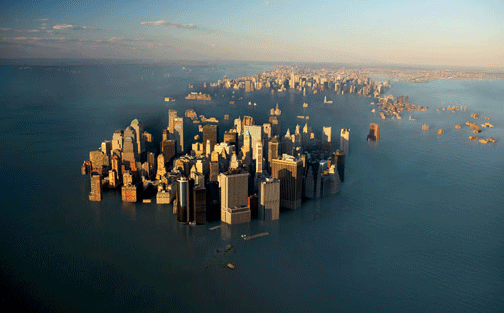
Delegates representing island states and others whose homelands are most threatened by rising seas will be pushing for the formal adoption of a long-overlooked goal, one that limits warming to less than 1.5°C, or 2.7°F.
The longing by low-lying nations to limit warming to 1.5°C has been overshadowed since 2010 by a preoccupation by many with the less ambitious goal. On Wednesday, the U.N. released the latest report to confirm that goal — to limit warming to 2°C, compared with preindustrial times — could be reached through massive globally cooperative efforts that overhaul energy supply chains and reform farming and forest management.
“We definitely think that staying below 2 degrees is still very possible,” Christiana Figueres, executive secretary of the U.N. Framework Convention on Climate Change, told reporters as the report was released. “Getting down to the range of 1.5 should not be taken off the table either.”
When climate delegates agreed during meetings in Copenhagen in 2009 that “the increase in global temperature should be below 2 degrees Celsius,” they also agreed that a study would be completed by 2015 comparing the effects of that goal with an alternative one of curbing temperature rises to 1.5°C. During talks a year later, negotiators agreed to consider tightening the 2°C goal to 1.5°C in the “near future.”
Ahead of what could be history’s most highly anticipated round of climate negotiations, the governments of the countries that are most vulnerable to sea level rise believe that future time has arrived.
The study called for in Copenhagen was published by the U.N. in May, based on interviews with some 70 experts. It concluded that adopting the 1.5°C alternative would be technically feasible, and that meeting it would come with a “high likelihood of meaningful differences” compared with allowing earth to warm by 2°C……..
“The scientific finding is that 2 degrees is not enough,” said Ronny Jumeau, a U.N. ambassador from the Seychelles who will negotiate on behalf of small island states during the two-week round of Paris talks, which begin in two weeks. “1.5 is what the low-lying, small island developing states need for their survival.”
The May report warned of the “high” risks that would accompany 2°C of warming, including crop failures, floods, extreme weather events that jeopardize health, and “mass coral bleaching.” But it also pointed out that “there would be significant residual impacts even with 1.5°C of warming.”
It concluded that “most” species would be able to keep up with climate change if warming is kept below 1.5°C. It found, bleakly optimistically, that “up to half of coral reefs may remain” if the planet warms 1.5°C, that sea level rise “may remain below” 3.3 feet, ocean acidification impacts “would stay at moderate levels,” and that it would be easier for communities to adapt to climate change — especially farmers.
Strategies for limiting warming to 1.5°C by century’s end “are similar to those limiting warming to 2°C,” the report noted. It concluded that such strategies would involve “more immediate” actions and “an additional scaling-up” of clean energy and of any technology that captures and stores carbon dioxide pollution, such as at coal power plants.
The conclusions from the May report were consistent with the views of leading scientists……..Mark Jacobson, a Stanford University professor whose research focuses on clean energy, said that a radical enough global switch from fossil fuels to clean energy alternatives could be enough to limit warming to less than 1.5°C — even without the need for carbon capture or nuclear power technologies…….. Jumeau of the Seychelles pointed out that a 1.5°C goal would be achievable, and that adopting and meeting it would benefit rich coastal nations as well as those whose existences may be threatened by rising seas.
“It’s not just about the islands, it’s about New York, it’s about New Orleans, it’s about London, it’s about Venice,” Jumeau said. “There is no way we can compromise on 1.5.” http://www.climatecentral.org/news/the-forgotten-un-climate-goal-19701
No comments yet.
1 This month

of the week – Australians for War Powers Reform (AWPR)
To see nuclear-related stories in greater depth and intensity
 Antinuclear
Leave a comment