Australia at Paris Climate Summit
 Australia rejects call for 1.5-degree global warming target
Australia won’t support a 108-country-strong call in Paris to limit global warming to 1.5 degrees, but backs a United Nations review of the science.
The call for a special report by the UN climate science body is understood to have come from a group of vulnerable nations, who believe the two-degree goal would severely damage their countries.
Those nations, like the Pacific Islands, want the 1.5-degree goal included in a global agreement to curb emissions, which is being negotiated an major climate talks in Paris.http://www.sbs.com.au/news/article/2015/12/05/australia-rejects-call-15-degree-global-warming-target
Julie Bishop chided for ‘joke’ about rising seas flooding Marshall Islands
Australia still has not learned not to make jokes about the impacts of climate change on its low-lying neighbours, Marshall Islands minister says at Paris talks
http://www.theguardian.com/australia-news/2015/dec/05/julie-bishop-chided-for-joke-about-rising-seas-flooding-marshall-islands
UN climate summit Paris 2015: Australia trying to push open rich-poor divide
Australia is at the centre of a stoush that is enraging developing countries, as some industrialised nations fight for the decades-long demarcation between the wealthy and poor to be broken down as part of a global pact to fight climate change.
The move at the Paris climate summit prompted angry representatives of developing nation to warn that a deal would be at risk unless agreement was reached on the financial help offered to poor nations.http://www.smh.com.au/environment/un-climate-conference/un-climate-summit-paris-2015-australia-trying-to-push-open-richpoor-divide-20151203-glf58j.html
Is ‘Breakthrough Energy Coalition’ a cover for more money for nuclear?
The Breakthrough Energy Coalition must tear itself away from the fascination of tinkering in a laboratory and instead do something real, practical and hands-on with their money. However, the group’s assertion that “the foundation of this program must be large funding commitments for basic and applied research”, does not provide much reason for optimism.
A tennis coach I used to know would tell his team after a loss that “breakdowns come before breakthroughs.” We’ve caused the climate breakdown and we’ve made the energy breakthroughs. Now we just need to start winning.
The Breakthrough Energy Coalition could and should be on that team.

The first question that crossed my mind when reading about the latest Bill Gates investment venture was “is this a cover to divert yet more money into nuclear energy?” Continue reading
72% of Australians oppose this nation becoming the world’s radioactive trash dump
 Nuclear waste returned to Australia, raising concerns about future dump site, Guardian, 5 Dec 15 “………Environmentalists have raised concerns about the safety of the ship, which left the northern French port of Cherbourg in October. One French lawmaker described it as a “dustbin ship”.“This is not the kind of ship you would want to see transporting nuclear waste,” said Greenpeace campaigner Emma Gibson, who was on board a boat following the BBC Shanghai on Saturday……
The waste will initially be housed at the Lucas Heights reactor in southern Sydney until a nuclear waste dump site is selected and built. It is expected to be trucked to the reactor from Port Kembla overnight.
The government has said the nuclear waste dump site would only be used to store Australia’s radioactive waste but Greenpeace has warned that creating a new waste facility is an invitation to other countries to use Australia as a dumping ground.
The group said a poll of 3,144 people last month that it had commissioned from ReachTel suggested that most Australians opposed plans to store nuclear waste for other countries.
Asked about Australia accepting nuclear waste from overseas, 18.3% supported it, 72.1% opposed it and 9.6% were undecided…….
Most Australians rightly don’t want their country to become a nuclear waste dump for the rest of the world,” Gibson said.
“Nobody has yet worked out a safe way to manage long-term nuclear waste, which can remain dangerous for hundreds of thousands of years.”…..http://www.theguardian.com/environment/2015/dec/05/nuclear-waste-returned-to-australia-raising-concerns-about-future-dump-site
Lucas Height’s nuclear reactor’s returning wastes arrive by ship at Port Kembla
 Controversial nuclear waste shipment arrives in Port Kembla http://www.smh.com.au/nsw/controversial-nuclear-waste-shipment-arrives-in-port-kembla-20151205-glged7.html Twenty five tonnes of nuclear waste will be transported to Sydney’s Lucas Heights after it arrived in NSW on Saturday.
The bulk carrier BBC Shanghai was greeted at Port Kembla, near Wollongong, by a heavy police presence including the riot squad, mounted officers and divers.
Police boats and jet skis accompanied it into the harbour as Greenpeace protesters followed behind. On shore about a dozen protesters unfurled a banner that read “don’t waste Australia”. “We are very concerned our place, our region, is being used to do other people’s dirty work,” South Coast Labour Council secretary Arthur Rorris said.
Arriving from France, the ship entered the harbour just before 1pm. The waste was expected to take around eight hours to unload before it was to be transported in in a six-metre-long and three-metre-wide steel cell along the Princes Highway under police guard to Lucas Heights in Sydney’s south.
Police in Port Kembla worked with the Australian Nuclear Science and Technology Organisation (ANTSO) to coordinate the arrival. ANTSO in a statement said the waste would be held in Sydney while the Federal government searches for a permanent site to dump nuclear waste.
A shortlist of six sites was released in November, including Sallys Flat near Bathurst in New South Wales and three sites in South Australia.
The waste is what remains of shipments sent to France for reprocessing in the 1990s when eight shipments in total were sent there, as well as to the United Kingdom and the United States.
The waste sent to the US will remain there, but shipments sent to the UK will return within five years. In its statement ANTSO said the nuclear waste had “enabled generations of potentially life-saving nuclear medicine production”.
Anti nuclear activists arrested in Paris
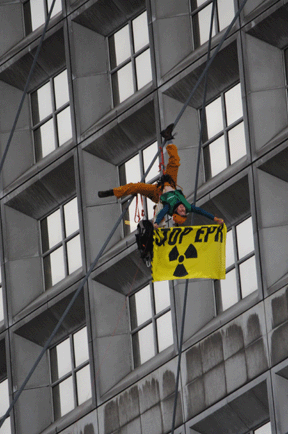 Anti-nuclear climbers defy Paris protest ban, four arrested http://www.nukeresister.org/2015/12/04/anti-nuclear-climbers-defy-paris-protest-ban-four-arrested/ Four anti-nuclear activists defied the state of emergency ban on public protest in Paris on Wednesday, December 2, climbing up the steel cables beneath the modern Arche de la Defense to hang banners. French environmentalists joined German climbers from the action group in the ascent as the COP 21 climate talks were underway. They first deployed small banners reading “Don’t Nuke the Climate – Stop EPR” (referring to the latest French reactor design). Police were quickly on the scene, including 20 from a specially equipped mountain brigade in town for the event. They pursued the climbers up the cables and prevented a larger banner from unrolling which would have proclaimed “System Change, Not Climate Change!”
The four were taken into custody and charged with disrupting public order and violating the state of emergency before their release some hours later. The action was part of international “Climate Games”, a call to direct action against institutions responsible for climate change. Continue reading
The double whammy threat: The Climate-Nuclear Nexus

increased reliance on nuclear energy to reduce carbon emissions will contribute to the risks of nuclear proliferation
a series of incidents in recent years, extreme weather events, environmental degradation and major seismic events can directly impact the safety and security of nuclear installations.
The Climate-Nuclear Nexus: Two Key Threats Endangering Future Generations, Huffington Post Jakob von Uexkull 5 Dec 15 Over the next two weeks, Heads of States are meeting in Paris to finally agree on a plan to curb climate change. Considering that climate change can exacerbate a range of interconnected transnational threats and crises that our generation faces today, such as extreme poverty, hunger, violent conflicts and pandemic disease, meaningful action is urgently needed.
Despite this, the proposed measures are again nowhere near proportional to the problem. In fact, the climate negotiations have so far been subjected to lack of information and misguidance on so-called solutions that should enable us to limit the rise in temperatures to 2°C. One particular problem is that too many of the intended nationally determined contributions (INDCs) still build on nuclear energy as a way for low-carbon development. Continue reading
Pacific islanders will be climate refugees, whatever the outcome in Paris
Even If Paris Climate Talks Succeed, Pacific Islanders Will Be Looking For New Homes, New Matilda, By Thom Mitchell on December 4, 2015 Australia’s Pacific Island neighbours already face poverty, and soon they’ll be facing even worse. Thom Mitchell reports from Paris.
More than 70 per cent of households in the Pacific Islands of Tuvalu and Kiribati to Australia’s north east say they’re likely to migrate if the impacts of climate change become any worse than they already are, according to research presented in Paris at a global summit on climate change yesterday.
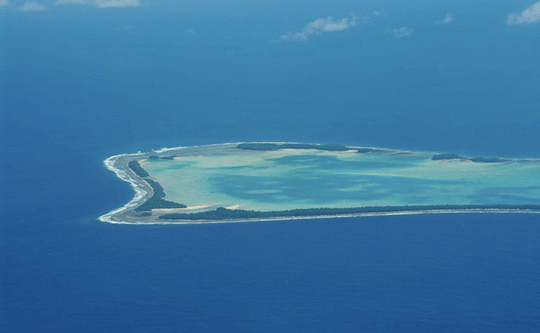
Climate change already exists as a key driver of migration in the region, according to the study presented by the United Nations University’s Dr Koko Warner, which found it motivating 23 per cent of Kiribati’s migration and eight per cent of Tuvalu’s.
In Nauru – an island nation Australia uses to arbitrarily and indefinitely detain many of its asylum seekers – more than 40 per cent of households said they feel migration would be their likely response if sea level rise or flooding worsened.
All three islands are extremely vulnerable to the climate change impacts like sea level rise, saltwater intrusion, and storm surges, and the survey of more than 7,000 people across the three countries found that climate change was already affecting agriculture and fish stocks, and reclaiming or spoiling land. Continue reading
China’s nuclear plans – the great hope for the industry, but are they safe?
 the idea of nuclear power in China makes many people, including many in the country, quite nervous.
One of the most compelling critics is He Zuoxiu, a physicist who worked on China’s nuclear program and is a member of the prestigious Chinese Academy of Sciences
 China has an awful safety record — and wants to run 110 nuclear reactors by 2030 WP, By Emily Rauhala December 4 It had been about a month since chemical explosions blasted and burned through the port of Tianjin, killing 173. Pictures of rescue workers in hazmat suits became some of the signature images of the disaster. And despiteincredible censorship, it was clear to most that unsafe chemical storage — thanks to bribery by local big shots — was to blame.
Still, on Sept. 15, China’s Ministry of Environmental Protection announced post-Tianjin nuclear safety checks to “make sure nuclear facilities and equipment are safe and under control.” Given the timing, it felt less like an assurance than an afterthought: “We definitely did not forget to check those nukes.”
Now, almost four months after the Tianjin blasts, with world leaders gathered in Paris for climate talks, a top Chinese energy firm reminded us, again, of China’s nuclear future—a future that a prominent Chinese physicist recently called “insane.” Continue reading
Big solar investment on hold because of Australian govt’s policy uncertainty
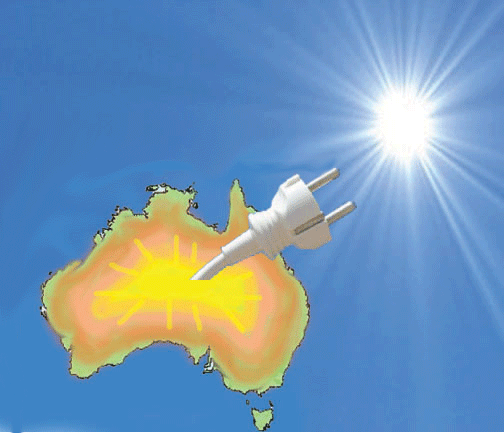 Chinese solar firm says policy instability holding back Australian investment, Guardian, Lenore Taylor in Paris, 5 Dec 15 Hareon Solar executive says firm is considering a billion dollar investment in large scale solar within a year but policy stability, not subsidies, is needed. Chinese firm Hareon Solar is “actively” considering a billion dollar investment in large scale solar projects in Australia, but the stability of government climate policy is its major concern, a senior company executive has told Guardian Australia.
Jie Zhang, Hareon’s vice president of global business development said government subsidies were not necessary for the investment decision, to be taken within a year, but policy stability was required.
“Our only wish for government is a stable policy, don’t flip back and forth, of course we are concerned what has happened in the past in Australia with the renewable energy target,” he said in an interview at the Paris climate summit……
Solar is a 25 year investment. If a government can’t keep its policy stable for five years how can we inves,” he said.
Hareon solar is a major Chinese solar cell manufacturer and global investor in large scale solar projects, founded by Australian citizen Samuel Yang.
It has invested in solar projects delivering 700 megawatts of power inChina as well as big projects in Bulgaria, Romania and the United Kingdom and smaller projects in the US and Japan.
Zhang said investment decisions were driven by government subsidies, but now required strong demand and policy stability…..
The Australian Renewable Energy Agency has announced a large-scale solar competitive round, seeking bids from major solar PV project proponents for grants of up to $30 million from a $100mn program. The Clean Energy Finance Corporation has announced a complementary $250 million large-scale solar financing program.
Renewable energy investment in Australia froze in the early years of the Abbott government when the renewable energy target was under review. In the end in was wound back, but not abolished. http://www.theguardian.com/environment/2015/dec/05/chinese-solar-firm-says-policy-instability-holding-back-australian-investment
Nuclear power: unsafe too costly says Indian energu expert
 Nuclear power is unsafe and too costly for India, ex-Power Secretary EAS Sarma tells Modi, Japan’s Abe, Scroll In, EAS Sarma 5 Dec 15 Ahead of the Japanese leader’s visit to India, former top bureaucrat urges New Delhi and Tokyo to be cautious about striking a deal. With Japan and India expected to sign an agreement on nuclear supply when the East Asian country’s prime minister, Shinzo Abe, visits India later this month, former power secretary EAS Sarma has written an open letter to the leaders of the two countries laying out his concerns about nuclear energy.
To begin with, he contended that there were intense anxieties about the safety of nuclear energy. “While the protogonists of nuclear technology persistently try to justify proliferation of nuclear power on the ground that the probability of occurrence of a Fukushima-like accident in a nuclear power plant is low, none of them can ever deny that such accidents can take place one time or the other, either as a result of a natural disaster on which we have no control or as a result of a human failure that we cannot wish away,” he wrote.
He also claimed that nuclear power is unaffordable for a country like India. “When the global climate negotiations have their focus on replacing new megawatts with “negawatts” (saved megawatts) and green megawatts, it is anachronistic for the world to cling to expensive energy sources like nuclear power,” he said.
Here is the full text of his letter……. http://scroll.in/article/773920/nuclear-power-is-unsafe-and-too-costly-for-india-ex-power-secretary-eas-sarma-tells-modi-japans-abe
Nuclear suppliers in difficulties trying to sell to India
Abe visit unlikely to lead to nuclear deal with India’s Modi, Japan Times, BY RAJESH KUMAR SINGH BLOOMBERG, 5 Dec 15 “……Modi will use Abe’s visit next week to lobby Japan to join the list of countries India can rely on for nuclear technology or fuel to help bring reliable and clean power to its 1.3 billion people. Japan, the only country to suffer nuclear attacks, has refrained from sealing a deal because India has not yet joined the global Nuclear Non-Proliferation Treaty.
“Prime Minister Abe’s visit will speed up the talks and I hope the deal can be signed when the two heads of state meet the next time,” Sekhar Basu, secretary at the Department of Atomic Energy, said in an interview in New Delhi. “We’re making very good progress, but I don’t think we are in a position to sign a deal during this meeting,” which starts Dec. 11……
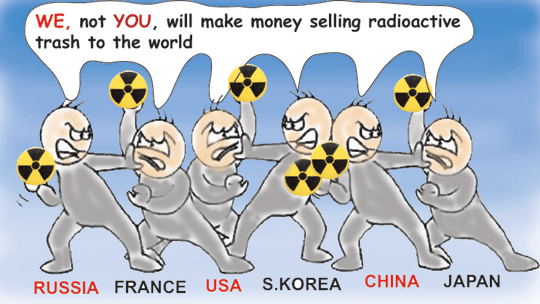 A deal with Japan would strengthen ties to U.S. reactor suppliers Westinghouse Electric Co., controlled by Toshiba Corp., and General Electric Co., which has a venture with Hitachi Ltd. It’ll also help India access cheaper financing and specialized steel from Japan used for nuclear projects, Basu said.
“The two governments are currently negotiating a nuclear treaty,” Chief Cabinet Secretary Yoshihide Suga told reporters in Tokyo on Tuesday. “India has not signed the NPT and the government is aware of various arguments concerning nuclear cooperation with India.”
Even if it signs a deal with Japan, India’s efforts to raise nuclear capacity are challenged by laws that leave equipment makers, in addition to the plant operators, liable for accidents. Foreign and local suppliers including General Electric Co. have opposed the rules……http://www.japantimes.co.jp/news/2015/12/04/business/abe-visit-unlikely-lead-nuclear-deal-indias-modi/#.VmNKF9J97Gj
1 This month

of the week – Australians for War Powers Reform (AWPR)
To see nuclear-related stories in greater depth and intensity
 Antinuclear