Deliberate downplaying of the seriousness of Oman Ama nuclear waste proposal
 Oman Ama nuclear waste proposal being ‘downplayed’, Warwick Daily News, Annette Clement, Oman Ama | 8th Dec 2015 The role of the proposed waste facility was played down at the first information meeting in Inglewood.
We are not children to be lulled into compliance by a ‘glossy’ film and soothing narrative.
The facts are that this facility, as well as containing the medical waste mostly mentioned, is being built to house all nuclear waste including intermediate level waste produced by Australia in the past and for the next 100 years (not just ANSTO’s medical waste), the containers of processed spent fuel rods and other waste (en route from France and United Kingdom) will be ‘temporarily’ stored in a secure shed for an indeterminate period.
This waste should be buried 400-1000 metres deep.
It appears that the significance of this is being deliberately downplayed and my trust has been shaken in the intentions to be completely open with the plans for, the facts about and the future use of the proposed facility, Mr Wilson said during question time ‘the eventual use of the facility is as yet unknown’.
Some points for you to consider.
Tourists …
Land devaluation … this area is known for its lack of harmful or potentially harmful industry that’s why a lot of people live and work or farm here. It’s their life.
Income loss … this area is rich in production from the land, some producers would be adversely affected by lowered consumer confidence in their products, possible devaluation of their land which could mean their banks will be less likely to back them when they most need it….
Security hazard ... regardless of the ‘little reward for a lot of effort’ reassurance we get concerning the waste facility ever becoming a target the possibility should not be brushed aside, our once relatively isolated and trouble free country has seen incidents recently which clearly demonstrate we are not immune to radical behaviour.
Ecologic concerns … although I am satisfied that the waste facility will endeavour to keep all nuclear waste in proper containment the risks for this area are still too great.
We are subject to major flooding, and large fluctuations in the water table.
In the great scheme of all things our lives are just a fleeting moment, therefore it’s not so much what we do now but what we leave for all future generations. That is our true legacy. http://www.warwickdailynews.com.au/news/nuclear-being-downplayed/2865565/
Western Australia systematically eroding Aboriginal heritage rights
 Separate but unequal: the sad fate of Aboriginal heritage in Western
  Australia The Conversation, Tod Jones Senior Lecturer, Human Geography, Curtin University December 7, 2015 There is systemic discrimination against Aboriginal heritage in Western Australia. This does not come from a racist administrator somewhere who hates Aboriginal heritage, but from the evolution of the institutions, rules and conventions that make up cultural heritage management.
Let me explain why.
Western Australia manages the heritage sites of Aboriginal and non-Aboriginal sites through different institutional channels, under different laws. This system is now providing much higher levels of protection for non-Aboriginal heritage.
There are several obvious imbalances. Should the Aboriginal Heritage Amendment bill that’s currently before parliament be passed, the maximum penalty for an individual illegally disturbing a non-Aboriginal heritage site will be A$1 million and two-years imprisonment, but for an Aboriginal site it will be A$100,000 and 12 months imprisonment, doubled on a second offence (it is currently A$20,000 and imprisonment for nine months, increasing to A$40,000 and two years for a second offense).
Less obviously, since Colin Barnett’s government took office in 2008 it has gradually reduced protection by reinterpreting definitions within theAboriginal Heritage Act 1972 to severely curtail the number of new sites. To date, some 1,262 sites have been blocked from gaining protection.
In 2012 the definition of “sacred” was reinterpreted to only include sites “devoted to a religious use rather than a place subject to mythological story, song or belief” – leading to the deregistration of 35 sites. This was found earlier this year to be a “misconstruction” by Justice John Chaney in the Supreme Court of Western Australia. Dreamtime stories have long been and continue to be considered sacred to Aboriginal people.
Furthermore, a recent report by UWA archaeologists indicates that more than 3,000 Aboriginal heritage sites have lost registration status as part of sweeping changes in classifications in the Aboriginal Heritage Register.
At no stage have Aboriginal custodians been notified about the changing status of their heritage……….
Proposed amendments to the Aboriginal Heritage Act
Sydney’s Lord Mayor Clover Moor in Paris: upbeat about city’s climate change action
 Paris UN climate conference 2015: Clover Moore tells government to get out of the way http://www.canberratimes.com.au/environment/un-climate-conference/paris-un-climate-conference–clover-moore-says-government-hindering-her-carbon-neutral-efforts-20151203-glf653.html December 8, 2015 Peter Hannam Environment Editor, The Sydney Morning Herald In Paris, the local city government is presenting a grim view of the possible impacts of global warming. It is offering visitors to the climate conference apocalyptic visions of a Venice or New York largely under water, and Stonehenge surrounded by an English desert.
Sydney lord mayor Clover Moore adopts a more optimistic view. In the French capital for a number of events held on alongside the climate summit, she has a positive story to tell, noting her city’s operations are already carbon neutral and deep emissions cuts are under way as business and green groups get on with it.

The city’s top commercial landlords have cut 45 per cent of their carbon dioxide emissions since 2006, saving $30 million a year, she said on the sidelines of the Paris . A surge in developments – almost $4 billion in 2014 rising to $7 billion this year – means a focus on efficiency in new buildings will also avoid future costs for energy, water and waste.
“The actions cities are taking across the world are making an incredible difference,” Cr Moore told Fairfax Media, noting 75 per cent of Australians and more than half the world’s people live in cities.
The performance and potential of the world’s major cities has been a theme of the Paris climate summit through a series of urban events – Ms Moore attended or spoke at five – highlighting the contribution that cities can make to meeting the conference’s wider goal of keeping global warming to less than 2 degrees of pre-industrial levels.
A report released at the conference found that cities – already home to more than 50 per cent of the world’s population – alone had the potential to cut global greenhouse gases by about 6 per cent by 2030 – or 3.7 gigatonnes of carbon dioxide – and more than double that by 2050.
For Sydney, the goal is to cut emissions 70 per cent on 2006 levels by 2030. Although well on the way to that goal, the city’s progress is being hampered by Canberra on the planning front, Cr Moore said. Continue reading
Breakthrough Energy Coalition no solution to Climate Change – quite the reverse
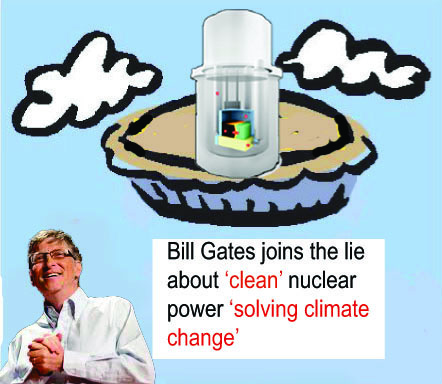 Breakthrough Boondoggle, DEC 7, 2015 While corrupt world leaders fawn over the Breakthrough Energy Coalition as world saviors promoting so-called ‘climate solutions’, the reality is that these con artists are setting us up for a global heist that we’ll be paying for long into the future.
Global opposition to sea transport of radioactive trash
 Nuclear waste transport risks, Tor Justad http://www.shetlandtimes.co.uk/2015/12/08/nuclear-waste-transport-risks-tor-
justad “…..I would wish to draw attention to the proposal from the Nuclear Decommissioning Authority to transport nuclear waste by sea from Scrabster to Barrow – a distance of over 400 miles.
This high level nuclear waste/spent fuel emanates from the Dounreay nuclear site and is intended for Sellafield – described as “the most toxic nuclear site in Europe”.
The campaigning group Highlands Against Nuclear Transport (Hant) has been campaigning since 2013 to stop this plan on the grounds that the risk to the environment, fishing, aquaculture and tourism is unacceptable.
 Transporting nuclear waste by sea is opposed by environmental groups throughout the world and Hant is of the view that all nuclear waste should remain on the sites where it is produced which is in line with Scottish government policy. Hant provided an input at a Nuclear Free Local Authorities (NFLA) seminar in Lerwick in August 2015 on “Transportation of Dounreay’s nuclear materials by rail or by sea to Sellafield – is it a safe solution for reducing the nuclear legacy in Scotland?” and was pleased to hear from SIC and Kimo representatives at that seminar that they supported Hant’s position.
The need for emergency response vessels stationed around the Northern Isles and Western Isles is important to safeguard these coasts against marine accidents and emergencies of any kind but the need is increased by the proposal to transport nuclear waste.
As is well known, nuclear radiation knows no land or sea boundaries so this issue is of concern to all coastal communities in the Highlands and Islands.
Hant will continue to campaign on this issue and would urge individuals and interested organisations to support this campaign.
Far West NSW Federal MP says no plans for nuclear waste dump there
No plans for nuclear waste storage in far west: federal MP, ABC News, Declan Gooch 7 Dec 15 The far west’s federal MP says the region is not part of any plans to built a nuclear waste storage facility, despite a suggestion from her state government counterpart…….
Farrer MP Sussan Ley said no private landholders volunteered their properties which means the region can’t be considered in the federal government’s process.
“There were no volunteers, if I can put it that way, in the far west to house the facility,” she said…..http://www.abc.net.au/news/2015-12-07/no-plans-for-nuclear-waste-storage-in-far-west3a-federal-mp/7006482
Upper Hunter Aboriginal Cultural Heritage Trust under scrutiny over funds to mining industry
 Mining funds reserved for Indigenous groups allegedly funnelled back to industry, ABC News 7 Dec 15 By state political reporter Brigid Glanville
A New South Wales Government body is under scrutiny amid claims it failed to distribute trust money to local Indigenous projects in the Upper Hunter and instead gave it to a mining industry body.
Key points:
- Trust set up so that mining companies pay $50k for each new development
- Funds to go to Aboriginal groups with connection to Upper Hunter
- $300k given to ARG, a company endorsed by chief mining lobby group
- Aboriginal Land Council chief says ARG has little affiliation with Indigenous communities Continue reading
Aboriginal landowners in King’s Canyon area want protection against mining

“The CLC and traditional owners of the park will accept nothing less than a [government] decision to protect the park for future generations by prohibiting exploration or mining within its boundaries.”
Kings Canyon landowners want protection from mining: ‘What happens if the water gets messed up?’ Guardian, Helen Davidson , 8 Dec 15 Watarrka national park’s Indigenous owners will petition environment minister over an existing fracking exploration licence and future mining ‘of all kinds’
Traditional owners of the land encompassing Kings Canyon in Australia’s central desert are petitioning the federal environment minister, Greg Hunt, to guarantee their protection against mining operations.
Under Northern Territory legislation, the Watarrka national park has no real protection from oil and gas exploration or mining operations, according to David Morris, the principal lawyer of the NT Environmental Defenders Office (EDO). Continue reading
Increasing popularity of community solar energy projects in Australia
 Small is beautiful: the community solar projects taking on big energy, Guardian, Annie Kane, 8 Dec 15 A brewery, a bowling club and a library join forces with a new type of energy supplier to save money and become more sustainable
What do Sydney’s Young Henrys brewery, Shoalhaven Heads’ Bowling and Recreation Club, and Bendigo library have in common? They’re all hosts to some of Australia’s first solar power projects funded and run by local people in community energy groups.
Projects like these are becoming increasingly popular in Australia. The Coalition for Community Energy (C4CE) 2015 national community energy strategy states that there were 19 community energy groups operating in early 2015, with a further 59 projects in development. Continue reading
Big loss for uranium company
Uranium Energy posts loss of $5.1 million in first quarter BY THE ASSOCIATED PRESS DECEMBER 8, 2015 VANCOUVER – VANCOUVER, British Columbia (AP) _ Uranium Energy Corp. (UEC) on Tuesday reported a loss of $5.1 million in its fiscal first quarter.http://www.theprovince.com/business/uranium+energy+posts+loss+million+first+quarter/11574576/story.html?utm_source=twitterfeed&utm_medium=twitter
South Australia headed for 100% renewable energy, and away from nuclear
It is also supporting its capital city, Adelaide, in its push to become the first large carbon neutral city in the world – a target it hopes to achieve within a decade. Both the state government and the city council have pushed new incentives to encourage battery storage in homes and businesses. Weatherill has also called for tenders to ensure that his government’s own electricity demand is met entirely by renewable energy.
South Australia is also hosting a royal commission into the nuclear fuel cycle, but since the release of a new report late last month predicting that nuclear technology will cost more than twice as much as wind and solar in the next decades, the chance of nuclear power being built in South Australia, or even Australia, appears negligible.
 South Australia to set path towards 100% renewable energy, REneweconomy By Giles Parkinson on 8 December 2015 South Australia is expected to pass its 50 per cent renewable energy target next year – nearly a decade ahead of schedule – and the Labor government will now aim to get the state as close to 100 per cent renewable energy as possible.
Premier Jay Weatherill said in Paris on Monday that the state was leading the world in the incorporation of variable renewable energy sources such as wind and solar, and hoped the knowledge gained would create a massive economic opportunity for a state struggling with the decline of long-term industries such as car manufacturing.
“We are running a big international experiment right now,” Weatherill said at the launch in Paris of the Compact of States and Regions, an initiative that will see 44 states and regions reduce their emissions by 12.4 tonnes by 2030.
“We have got a long, skinny transmission system and we will soon have 50 per cent renewable energy, including a lot of wind and some solar.
“We need technology breakthroughs for large-scale storage, such as pumped hydro or batteries, but these are massive technological challenges that are exciting opportunities for the state.”
South Australia does find itself at the cutting edge of the transition from a fossil-fuel based economy to an energy system dominated by technologies such as wind, solar and storage. Its last coal fired power generator is due to close in March next year.
The 50 per cent renewable energy target was formally announced last year, but was always going to be met well ahead of time – the addition of the Snowton 2 wind farm, the construction of the Hornsdale wind farm, and the growth in rooftop solar PV will take the state over that threshold in 2016.
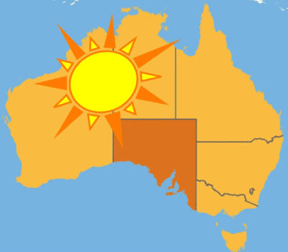
Indeed, the Australian Energy Market Operator has forecast that all of the state’s daytime demand may on occasions be met by rooftop solar alone within the next decade. Continue reading
Don’t undervalue the contribution of Australia’s indigenous people at Paris Climate Summit
West Australian Indigenous association, the Kimberley Land Council has sent a group of representatives to the conference.
The Council’s CEO, Nolan Hunter, warns that Indigenous communities shouldn’t be undervalued.
What do the Indigenous voices say on climate change? SBS, 8 Dec 15 Climate change continues to dominate the agenda, with Prime Minister Malcolm Turnbull holding firm to his target of a 26 to 28 per cent reduction on 2005 levels of carbon emissions at the Paris talks, but some are wondering where the Indigenous voices are in the debate?It’s a truly international topic of discussion: what can and should the world do about climate change?Like many nations, Australia faces hotter summers, more droughts, rising tides and a significant impact on its ecology.
Larissa Baldwin, national coordinator of youth climate group Seed, says the country’s Indigenous communities will bear the brunt.
And she believes their voices aren’t being given enough attention.
“I don’t think we have been given enough of a say, when you look at Indigenous communities around the world we’re already being impacted by climate change right now. We’re also on the forefront of fossil fuel extraction in Australia, and I think for a lot of us – we’ve had to send people over to Paris to actually get in front of our world leaders and say ‘hey you need to listen to us’.” Continue reading
Problematic road ahead for China’s nuclear power programme

 Mixed Fortunes for Nuclear Power NYT, DEC. 7, 2015 In July 2013, hundreds of people took to the streets in the southern Chinese city of Jiangmen to protest the proposed construction of a uranium processing plant in the region.
The $6 billion plant would have supplied fuel for the country’s rapidly expanding nuclear power industry. But the plan was dropped in the face of public opposition, the first case of its kind in China, said Keith Florig, a risk-management researcher at the University of Florida’s Warrington College of Business.
The protest, and its fallout, are important events in a country that has 22 nuclear power reactors under construction and more planned, as well as a growing international business selling nuclear energy technology to countries including Argentina, Britain and Pakistan. Mr. Florig said that this “rate of development hasn’t happened since the late 1960s and early 1970s in the U.S. and Soviet Union.”
At the same time, Mr. Florig characterized China as being underprepared for dealing with the public opinion issues that have plagued nuclear energy in developed countries.
He said that about 15 years ago he had interviewed Chinese energy officials to find out what they knew about nuclear energy development in the West. He found that they were uniformly focused on the technical challenges of controlling nuclear fission and using the heat it produced to boil water, create steam and power electric turbines. No one seemed to be aware of the social, political and economic challenges….
False claims made for nuclear power, at the Paris COP21 Summit
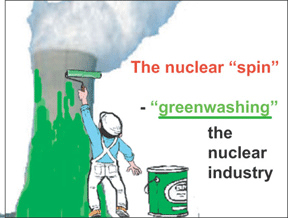 Nuclear energy struggles to find its voice at COP21 conference, France 24, 8 Dec 15 “………Jan Haverkamp, who authored the Greenpeace briefing, said the claim that nuclear energy was essential for reaching global warming targets was utterly false.
“There are now piles of scenarios that include different options for reaching decarbonisation targets that do not include nuclear energy,” he told FRANCE 24 by telephone from Poland. “To say that it cannot be done is a total PR strategy”.
In regard to the absence of debate about nuclear energy at the COP 21, Haverkamp said only a handful of delegations still believed nuclear had any long-term future in their countries.
He said that even countries that will continue to use nuclear power, like France and China, are broadly shifting resources away from this sector.
“The nuclear energy sector is facing very hard economic times,” the energy consultant said. “They will increasingly struggle to update their fleet, and do not know how to finance new projects”.
Cost curves
While the physicist David disagreed with Haverkamp about the ability to phase out nuclear energy and fossil fuels simultanously, both agreed that the fate of nuclear energy may be determined by market forces in the end.
In the wake of Fukushima disaster and a new global focus on terrorism, nuclear power plants will have to be both safer and more secure. This will likely increase the cost of nuclear energy in the short term, according to David. At the same time, a massive ramp-up of green technology is expected to bring down renewable energy costs.
David said that current economic trends demanded a quick return on investment, and that the energy sector was not excempt from such expectations.
Nuclear reactors, which he reminded required very high initial investments and only delivered profits a few decades later, were dangerously out of sync with the economic times.
Failings of Japan’s New Safety Standards

 Time to Stop Nursing the Nuclear Power Industry, nippon.com Yoshioka Hitoshi “…….Despite the reforms instituted in the wake of the 2011 meltdown, the fundamental safety issues surrounding nuclear power in Japan remain unresolved.
The final report of the government’s Investigation Committee on the Accident at the Fukushima Nuclear Power Stations, along with a slew of outside reports, points to the culture of complacency that undermined Japan’s pre-2011 nuclear safety regime and left the country—with its high population density and high risk of natural disasters—vulnerable to a catastrophic accident. It was clear that the government needed to institute a far stronger regulatory regime if it wanted to resurrect Japan’s nuclear power program. In September 2012, it launched the Nuclear Regulation Authority, and in July 2013, the NRA adopted new safety standards for reactors in use at nuclear power stations.
Unfortunately, the new regulatory regime is also inadequate to ensure the safety of Japan’s nuclear power facilities.
The first problem is that the new safety standards on which the screening and inspection of facilities are to be based are simply too lax. While it is true that the new rules are based on international standards, the international standards themselves are predicated on the status quo. They have been set so as to be attainable by most of the reactors already in operation.
In essence, the NRA made sure that all Japan’s existing reactors would be able to meet the new standards with the help of affordable piecemeal modifications—back-fitting, in other words. In practice, they need only to add a new layer of emergency management and some back-up equipment to meet the new standards for emergency preparedness. The estimates for earthquake intensity and tsunami height in each locale have been revised upward, but not to the point where they would necessitate fundamental design changes.
The second basic problem is that the new standards do not cover all the levels of “defense in depth” advocated by the International Atomic Energy Agency in its seven-stage International Nuclear Events Scale. They extend only as far as Level 4 (“control of severe conditions including prevention of accident progression and mitigation of the consequences of a severe accident”), stopping short of Level 5 requirements for responding to accidents that threaten the surrounding area through significant release of radioactive materials.
Under the Act on Special Measures Concerning Nuclear Emergency Preparedness, the prefectural and municipal governments within a 30-kilometer radius of a nuclear power facility are given full responsibility for emergency preparedness and evacuation planning geared to nuclear accidents with wider consequences, whose impact extends beyond the confines of the plant compound. Under the law, the plans must incorporate all items on a mandated checklist, but they are not subject to any outside review. The NRA does not view local preparedness or evacuation plans for a nuclear disaster as part of its regulatory regime…….http://www.nippon.com/en/currents/d00200/
1 This month
Chernobyl: The Lost Tapes – A good documentary on Chernobyl on SBS available On Demand for the next 3 weeks– https://www.sbs.com.au/ondemand/tv-program/chernobyl-the-lost-tapes/2352741955560
15 April – Zoom –Nuclear Power is Not the Solution
Apr 15, 2026 01:00 AM in Canberra, Melbourne, Sydney

Join the International Physicians for the Prevention of Nuclear War (IPPNW) on Tuesday, April 14th for a timely webinar exploring the risks associated with nuclear power and challenging the myth that it offers a simple, safe, carbon-free solution to the climate crisis

21 April Webinar: No Nuclear Weapons in Australia
Start: 2026-04-21 18:00:00 UTC Canberra, Melbourne, Sydney (GMT+10:00)
End: 2026-04-21 19:30:00 UTC Canberra, Melbourne, Sydney (GMT+10:00)
Event Type: Virtual
A virtual link will be communicated before the event.
Host Contact Info: australia@icanw.org

of the week – Australians for War Powers Reform (AWPR)
To see nuclear-related stories in greater depth and intensity
 Antinuclear