Pressure now on Turnbull to improve Australia’s climate policies
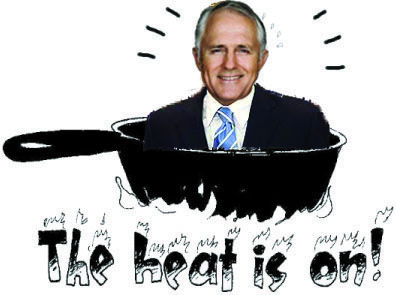 Heat turned up on Malcolm Turnbull’s domestic climate policies as world pledges to act, SMH, December 14, 2015 Nicole Hasham Environment and immigration correspondent A watershed climate pact in Paris has stepped up pressure on Prime Minister Malcolm Turnbull to act at home to curb emissions and phase out fossil fuels, as the federal government warns it will not risk the economy to meet the new global commitment.
Labor says the Paris agreement struck over the weekend, under which all nations will aim to keep global warming below 2 degrees or lower compared with pre-industrial levels, shows Australia’s domestic policies are “out of step with the rest of the world” and inconsistent with the new global accord.
The Greens and environment groups say the agreement shows the coal era is over and renewable power – set for an investment boost following the Paris talks – is now undeniably central to the world’s energy future.
The Paris agreement, which will take effect in 2020, will require all countries, including poorer ones, to tackle climate change.
Countries will seek to reach net zero greenhouse gas emissions in the second half of the century and review their targets every five years. They will also be required to adopt a consistent approach to reporting on both national emissions and progress towards meeting their targets.
Developed nations will allocate at least $US100 billion ($1.39 billion) a year in public and private funding to help poorer nations cope with climate change and this commitment will be reviewed in 2025.
Foreign Affairs Minister Julie Bishop said the agreement was “an historic step in the global response to climate change” and Australia worked constructively with other nations to secure a bold, enduring outcome that, for the first time, requires all countries to reduce emissions.
However she reportedly said it would be difficult for Australia to ramp up its climate efforts and “we have to get that balance right between environmental and economic outcomes”.
Mr Turnbull’s own personal views on the need for strong climate action have been curtailed by his party’s conservative wing, upon whose support he relied to take the leadership.
Minerals Council of Australia chief executive Brendan Pearson, whose organisation represents the mining industry, said the Paris agreement would support low-emissions coal technologies.
The deal would aid the development of carbon capture and storage and support the “rapid growth of new generation nuclear power in East and South Asia, providing strong demand for Australian uranium exports”, he said……..
Greens environment spokeswoman Larissa Waters said Australia refused to sign up to an agreement in Paris to phase-out fossil fuel subsidies, despite being the world’s largest per capita polluter.
Australia had great potential in wind, tidal, geothermal and other clean energy options and “the age of coal is over”.
“We need to get off fossil fuels and support those workers to transition into clean energy production and into other high-tech sustainable employment,” Senator Waters said.
Climate Institute chief executive John Connor said the Paris deal left Australia “conflicted”. The nation’s target emissions cuts for 2030 – 26-28 per cent, based on 2005 levels – are inadequate and would still leave it the highest per capita polluter in the G20, alongside Saudi Arabia, he said.
Bloomberg New Energy Finance’s Australian chief Kobad Bhavnagri said the Paris deal meant Australia would likely have to significantly strengthen its 2030 emissions reduction commitment every five years.
Global coal use would have to be curbed if the ambitions were to be met, reducing demand for Australia’s exports, he said.
“Deeper cuts in emissions imply that Australia will also need to hasten the deployment of renewable energy, make more concrete steps to reduce usage of fossil fuels, especially coal, and develop more robust, scalable and non-government funded carbon policy if the emissions reductions are to be achieved domestically.”
Mr Bhavnagri said this could be achieved through the renewable energy target, policy aimed at retiring coal-fired generators, more carbon regulations or a carbon price……..http://www.smh.com.au/federal-politics/political-news/heat-turned-up-on-malcolm-turnbulls-domestic-climate-policies-as-world-pledges-to-act-20151213-glmbv1.html
No comments yet.
1 This month

of the week – Australians for War Powers Reform (AWPR)
To see nuclear-related stories in greater depth and intensity
 Antinuclear
Leave a comment