Biased South Australia Nuclear Royal Commission
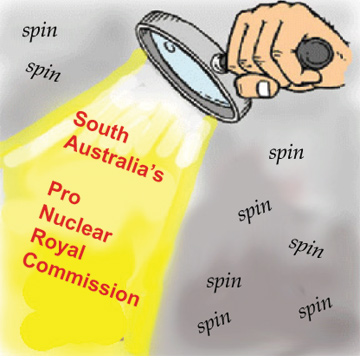 Royal Commission vs Community Permission: Environment groups assess performance of SA nuclear Royal Commission
National and state environment groups have today released an assessment of the state Royal Commission into the nuclear industry in SA. The report – commissioned by Conservation SA, the Australian Conservation Foundation and Friends of the Earth Australia – looks at the Commission’s progress since its surprise unveiling by Premier Jay Weatherill ten months ago.
The report raises serious concerns about the Royal Commission, from the unrepresentative and unbalanced composition of the Expert Advisory Committee, conflicts of interest, the Royal Commission’s unwillingness to correct factual errors, to a repeated pattern of pro-nuclear claims being uncritically accepted and promoted.
“The nuclear industry embodies unique, complex and long lasting safety, security, environmental and public health challenges,” said Conservation SA Chief Executive Craig Wilkins. “The sector lacks a secure social license and it is imperative that any consideration of an expansion of the industry is predicated on the highest standards of evidence, rigour, transparency and inclusion. Sadly this report shows these standards are not being reflected in the current Royal Commission.”
The Royal Commission has been criticised by civil society groups including environmental, public health and Aboriginal organisations for its restricted processes and limited information flows.
“Unlike most Royal Commissions this one was not a response to a pressing public issue, but rather it is a calculated political initiative with a pro-nuclear agenda,” said ACF nuclear campaigner Dave Sweeney. “As a result the Commission looks less like an objective risk-benefit analysis and more an industry feasibility study. Environment groups and others will continue to closely track this deficient process.”
The Royal Commission is set to make an interim report in February 2016 with a final report due no later than 6 May 2016.
“We are concerned about skewed and inaccurate information and assumptions, especially in relation to nuclear growth and reactor longevity and so-called small modular reactors,” said Friends of the Earth Australia’s Dr Jim Green, a co-author of the report. “The Royal Commission praises the United Arab Emirates for the speed of its nuclear power program without making any mention of the elephant in the room: undemocratic countries can build reactors more quickly than democratic countries. Statements by the Royal Commission regarding the impact of the Chernobyl and Fukushima nuclear disasters are incorrect – and the list goes on.”
The groups have called for an expanded Advisory Committee, increased Aboriginal access to information and decision points and dedicated studies into the potential for growth in SA’s renewable energy sector as important steps to bring some much needed balance into the Commission’s deliberations.
The report is posted at: http://www.foe.org.au/rc-critique
Direct download: http://www.foe.org.au/sites/default/files/RC-critique-16Dec2015-final.pdf
__._,_.___
Aboriginals fight nuclear dump plan, but they’re up against complete stupidity!
 Tim Mickel – “the effects on the environment of any dump at the site would be negligible.”
“The pharaohs managed to bury their dead for 3,000 years and they come up intact, so why can’t we do it with nuclear waste and have the same or nil effect to the environment?
Nuclear waste dump: Aboriginal traditional owners vow to oppose proposed radioactive facility near Alice Springs, ABC News, By Tom Maddocks, 17 Dec 15 The Federal Government has rejected claims that consultation for a proposed nuclear waste facility near Alice Springs has been a rushed process.
Key points about proposed dump:
- Dump estimated to cost $110 million to build, would employ 30 people
- Area to be used would be 100ha, waste contained in concrete blocks with steel and cement seals
- Storage capacity of 4250 cubic metres of low-level waste, 650 cubic metres of intermediate waste
- Low- level waste has to be stored for 300 years, intermediate waste stored on an interim basis (30-50 years) pending permanent solution
The owner of the date farm shortlisted for the dump has said if the Egyptian pharaohs were buried for thousands of years with no ill-effects on the environment, the same should be possible with nuclear waste.
Around 50 people turned out at a public meeting in the community of Santa Teresa, near the proposed dump, where opponents of the plan directed their anger at officials from the Commonwealth’s Department of Industry……
Tim Mickel, owner of the AridGold date farm shortlisted as a location for the nuclear waste facility, said he wanted to stay involved in the process.
He said he believed the effects on the environment of any dump at the site would be negligible.
“I really don’t think there’s going to be any effect to the water table, the aquifer, even the environment, and during the process there’s going to be monitoring,” he said.
“The pharaohs managed to bury their dead for 3,000 years and they come up intact, so why can’t we do it with nuclear waste and have the same or nil effect to the environment?
Santa Teresa local Christopher Wallace said he had hoped more people would turn up and show their opposition to the plans.
“We just don’t want that rubbish on our land, it would damage our land, our bush tucker, our story lines for our kids and their generation,” Mr Wallace said.
“This is our home. We want to live here. We just don’t want that contamination going into our water.”
Aboriginal traditional owners said they were sad and in shock following the meeting.
“[The meeting] made us really upset. We’re thinking about the land and our ancestors, they are still floating around the land and [the Government] is trying to destroy it,” traditional owner Sharon Alice said.
“It’s going to destroy the land forever. We’re thinking about our future. Dump it somewhere else, not in our backyard.”
Barbara Shaw from the Australian Nuclear Free Alliance said it was bad timing for consultations.
“A lot of our mob have cultural obligations and activities coming up soon, we have a lot of people going into town for health reasons and because it’s Christmas, a lot of people go away for holidays,” she said.
Jimmy Cocking from the Alice Springs-based Arid Lands Environment Centre said it was clear traditional owners, the people of Santa Teresa, Oak Valley and Titjikala do not want the nuclear waste site in their backyard.
“They’ve got concerns about the nuclear industry, there’s a lot of mistrust of government as well, I think there’s been a lot of broken promises in the past,” Mr Cocking said.
“People have seen the impact that these proposals have on communities, look at Muckaty, and I think while people appreciate the opportunity to be consulted I think they would much prefer not to be having to turn up to this thing at all.”
Mr Cocking said those nominating their land for proposed sites were doing so for financial gain.
“It’s not that they’re making some sort of altruistic attempt for a nuclear future.”
Mr Cocking said if the date farm is shortlisted he will stand by traditional owners in continuing to fight against it.
“If that means demonstrations and protests, we’ll be there. But in the meantime, we’ll engage in this process and hope that sense comes to the Federal Minister and they realise the error of their ways.”
The Federal Government has said it will return to the region for more consultations early next year.
A meeting was scheduled at the nearby community of Titjikala this week but it was postponed due to sorry business (Aboriginal mourning).
Public submissions on the plans close on March 11, 2016. “A lot of our mob have cultural obligations and activities coming up soon, we have a lot of people going into town for health reasons and because it’s Christmas, a lot of people go away for holidays,” she said.
Jimmy Cocking from the Alice Springs-based Arid Lands Environment Centre said it was clear traditional owners, the people of Santa Teresa, Oak Valley and Titjikala do not want the nuclear waste site in their backyard.
“They’ve got concerns about the nuclear industry, there’s a lot of mistrust of government as well, I think there’s been a lot of broken promises in the past,” Mr Cocking said.
“People have seen the impact that these proposals have on communities, look at Muckaty, and I think while people appreciate the opportunity to be consulted I think they would much prefer not to be having to turn up to this thing at all.”
Mr Cocking said those nominating their land for proposed sites were doing so for financial gain.
“It’s not that they’re making some sort of altruistic attempt for a nuclear future.”
Mr Cocking said if the date farm is shortlisted he will stand by traditional owners in continuing to fight against it.
“If that means demonstrations and protests, we’ll be there. But in the meantime, we’ll engage in this process and hope that sense comes to the Federal Minister and they realise the error of their ways.”
The Federal Government has said it will return to the region for more consultations early next year.
A meeting was scheduled at the nearby community of Titjikala this week but it was postponed due to sorry business (Aboriginal mourning).
Public submissions on the plans close on March 11, 2016. “A lot of our mob have cultural obligations and activities coming up soon, we have a lot of people going into town for health reasons and because it’s Christmas, a lot of people go away for holidays,” she said.
Jimmy Cocking from the Alice Springs-based Arid Lands Environment Centre said it was clear traditional owners, the people of Santa Teresa, Oak Valley and Titjikala do not want the nuclear waste site in their backyard.
“They’ve got concerns about the nuclear industry, there’s a lot of mistrust of government as well, I think there’s been a lot of broken promises in the past,” Mr Cocking said.
“People have seen the impact that these proposals have on communities, look at Muckaty, and I think while people appreciate the opportunity to be consulted I think they would much prefer not to be having to turn up to this thing at all.”
Mr Cocking said those nominating their land for proposed sites were doing so for financial gain.
“It’s not that they’re making some sort of altruistic attempt for a nuclear future.”
Mr Cocking said if the date farm is shortlisted he will stand by traditional owners in continuing to fight against it.
“If that means demonstrations and protests, we’ll be there. But in the meantime, we’ll engage in this process and hope that sense comes to the Federal Minister and they realise the error of their ways.”
The Federal Government has said it will return to the region for more consultations early next year.
A meeting was scheduled at the nearby community of Titjikala this week but it was postponed due to sorry business (Aboriginal mourning).
Public submissions on the plans close on March 11, 2016.http://www.abc.net.au/news/2015-12-16/alice-springs-nuke-dump-not-welcomed-at-public-meeting/7035070
Nuclear lobby failed at Paris summit, but still seeking climate funds
Is the nuclear industry having any success winning over environmentalists? Around the margins, perhaps, but the ranks of ‘pro-nuclear environmentalists’ (PNEs – an acronym previous used to describe ‘peaceful nuclear explosions’) are very thin.Nuclear lobbyists’ epic COP21 fail. Our next job? Keep their hands off climate funds.

Nuclear lobbyists’ epic COP21 fail. Our next job? Keep their hands off climate funds, Ecologist Jim Green 16th December 2015
nuclear industry has had a disappointing COP21, writes Jim Green. Lobbyists were there en masse desperately trying to get pro-nuclear wording into the Paris Agreement, and they failed. The word does not occur even once in the entire document. But we must prepare for the next battle: keeping nuclear power out of the $100 billion a year Green Climate Fund.
The nuclear industry and its supporters were busily promoting nuclear power – and attacking environmentalists – before and during the COP21 UN climate conference in Paris.
All the usual suspects were promoting nuclear power as a climate-friendly energy source: the World Nuclear Association, the International Atomic Energy Agency, the International Energy Agency, the OECD’s Nuclear Energy Agency, the US Nuclear Energy Institute, and so on.
The Breakthrough Institute has been promoting its pro-nuclear “paradigm-shifting advocacy for an ecomodernist future” and arguing against the “reactionary apocalyptic pastoralism” of anyone who disagrees with them. Continue reading
For Australia, nuclear power makes no sense, and no answer to climate change
 Nuclear Power In Australia: Too Slow, Too Expensive, Too Dirty And Too Dangerous https://newmatilda.com/2015/12/17/nuclear-power-in-australia-too-slow-too-expensive-too-dirty-and-too-dangerous/ By Margaret Beavis
Australia does not have a nuclear future, writes Margaret Beavis. Geoff Russell’s article this week spruiking new nuclear power as a solution for Australia’s woeful carbon emissions mentions Greens policy and then spends a lot of time personally attacking Greens leader Richard DiNatale. It is often a sign of a weak argument when people spend most of their time “playing the man and not the ball”.
The Paris agreement demonstrates widespread international support for limiting emissions. But Australia’s pledges fall a long way short. Nuclear enthusiasts promote new nuclear power as the answer to Australia’s emission reduction. This ignores the lived reality of building nuclear power plants. Continue reading
Shire of Leonora, Western Australia, enthusiastic for nuclear waste dump
 WA shire wants nuclear waste facility despite Federal Government knockback, ABC News 17 Dec 15 By Rhiannon Shine A shire in Western Australia’s Goldfields is determined to host a radioactive waste facility, despite being knocked back by the Federal Government last month.
The shire of Leonora was disappointed it did not make the Government’s shortlist for a proposed low-level radioactive waste facility.
The town, about 260 kilometres north of Kalgoorlie, east of Perth, was one of two local governments from the Goldfields region to express interest in hosting the facility.
But this week the council voted to engage a geological consultant to search for suitable nuclear waste sites in the area.
Chief executive Jim Epis said it was a long-term investment.
“I’m talking about maybe five, 10, or even 20 years away,” Mr Epis said.
“We are going to have quite a few uranium mines around our neck of the woods and we think it’s fair that someone in the area should be responsible for taking the waste back.
“We’re going to head off now and look into the future, and see if we can identify these sites where we can take nuclear waste from anywhere in Australia.”
Councillors voted unanimously to spend about $13,000 on the services of Al Maynard and Associates geological consultants.
Mr Epis said the geologists would likely focus on areas in the northern part of the shire.
“A lot of that land up there is in granite, which is ideal for nuclear waste deposits,” he said.
Council braces for opposition from locals
Mr Epis said he expected the decision would be met with some opposition.
“Over the last 10 years the Leonora community has had plenty of opportunity to discuss nuclear mining with a number of different companies,” he said.
“There [are] those out there that are totally against the idea.
“It just creates healthy debate.”……..http://www.abc.net.au/news/2015-12-17/wa-town-determined-to-secure-radioactive-waste-despite-knockback/7037398
McClatchy report reveals staggering death toll in USA nuclear workers
 More US fatalities from radiation exposure than in the wars in Afghanistan and Iraq, McClatchy report reveals, Fukushima Watch, December 15th, 2015, by Greg White The reverberations of nuclear power are most often reported on during the occasional nuclear meltdown, like the 1986 Chernobyl disaster and the 2011 Fukushima disaster. But, the consequences of nuclear power are far more persistent and prevalent than the mainstream media has often led the public to believe, even in the US. According to a yearlong investigation, a staggering 33,480 US nuclear workers have died from radiation exposure in the last seven decades.(1,2)
The death count was published and disclosed for the first time by American publishing company McClatchy. The report revealed that the number of US workers who died from nuclear radiation exposure was four times greater than the number of American casualties in the wars in Afghanistan and Iraq. The count involves all workers who died after they or their survivors were compensated by a special fund established in 2001, which aided workers who helped build the US nuclear stockpile.
Approximately 107,394 workers were diagnosed with cancer or other maladies after building the country’s nuclear stockpile over the last seven decades. The researchers extrapolated information using a database obtained from the US Department of Labor under the Freedom of Information Act. In addition, the investigation involved over 100 interviews with nuclear workers, scholars, government authorities and environmental activists.
US GOVERNMENT VASTLY UNDERESTIMATES HEALTH RISKS OF NUCLEAR PRODUCTION Continue reading
Deep concerns about India’s growing nuclear weapons arsenal
The strange love for nuclear energy http://www.thehindu.com/opinion/lead/on-the-indiajapan-civil-nuclear-deal/article7996972.ece M.V. RAMANA SUVRAT RAJU
The prospect of a nuclear deal with Japan is worrying because it ignores voices on the ground and takes India a step closer to the construction of untested and expensive reactors
During Japanese Prime Minister Shinzô Abe’s visit to India last week, Japan and India reportedly made progress on a nuclear deal that they have been discussing for more than seven years. The governments did not actually conclude the deal: the Joint Statement released by the Prime Ministers only includes a droll phrase welcoming the “agreement reached… on the Agreement… for Cooperation in the Peaceful Uses of Nuclear Energy” and expresses the hope that “this Agreement will be signed after the technical details are finalised”.
- These “details” include deep concerns about India’s growing weapons arsenal within Japan’s polity that even Mr. Abe’s militaristic government has found difficult to ignore. Nevertheless, even the prospect of an India-Japan nuclear deal is worrying because it takes the country a step closer to the construction of untested and expensive reactors. Moreover, despite the Narendra Modi government’s “Make in India” rhetoric, the agreement will primarily benefit multinational corporations based in Japan. Continue reading
Yandruwandha Yawarrawarrka people granted Native Title
Native title granted by Federal Court for Yandruwandha Yawarrawarrka people, ABC News, 17 Dec 15 By Nicola Gage Descendants of Aboriginal families who helped Burke and Wills on their ill-fated expedition through central Australia have won native title over their outback land.
Hundreds of Yandruwandha Yawarrawarrka people have gathered near Innamincka in South Australia for a bush hearing of the Federal Court.
It determined the group to be the rightful native title holders of 40,000 square kilometres of the outback. The area stretches across seven pastoral leases and includes Coongie Lakes National Park, Innamincka Regional Reserve and Strzelecki Regional Reserve.
Lawyer Michael Pagsanjan said the Yandruwandha Yawarrawarrka people fought for decades for recognition, after filing their original claim in 1998.
“The Yandruwandha Yawarrawarrka people will have the right to hunt, the right to camp, the right to fish and the right to look after special places,” he said.
“Today is a really momentous occasion where they can sit back, take a deep breath, a sigh of relief.
“This day isn’t just important for them, it’s important for their ancestors who have passed away.”……..
Historical past where two cultures met
The remote region includes places of significance to the Burke and Wills expedition, including the old “dig tree” under which food was buried.
The Yandruwandha Yawarrawarrka people helped the explorers, giving them food and shelter, and sharing knowledge about the land.
“For those explorers who were willing to accept their help, they luckily survived,” Mr Pagsanjan said.
“But unfortunately for those explorers who denied or rejected that help, they perished.”
Mr Pagsanjan said the native title determination marked a new chapter in South Australia.
“This is the last of the larger, far northern claims that’s been resolved,” he said.
“Now we’ve got close to about 60 per cent of the state which is capable of being determined.
“We’ve got a goal that soon we’ll hopefully have resolved the vast majority of claims in the state.” http://www.abc.net.au/news/2015-12-16/native-title-claim-acknowledged-at-sa-bush-hearing/7033858
Battery storage for renewable energy: boom expected in 2016
2016 boom in uptake of electricity battery-storage systems predicted by Clean Energy Council, ABC Radio 17 Dec 15 The year ahead will see a booming take-up of battery-storage energy systems, the Clean Energy Council predicts.
Key points:
- Battery storage costs ‘becoming affordable’
- Clean Energy Council says best power deals require aggressive ‘shopping around’
- Fewer power lines in bushfire risk zones could have benefits
“The main barrier has been that batteries have been fairly high cost but that cost is really coming down,” solar policy manager Darren Gladman told 891 ABC Adelaide.
“People are expecting in the next year or two batteries will become quite affordable and it’ll become a real option for households and businesses.”
He said South Australia and Queensland led the world in uptake of solar panel rooftop systems and battery storage of that energy was the next logical step.
“We don’t have a lot of big solar farms in Australia but we do have a lot of rooftop solar,” he said……..http://www.abc.net.au/news/2015-12-17/battery-electricity-storage-systems-2016-clean-energy-council/7037416
1 This month

of the week – Australians for War Powers Reform (AWPR)
To see nuclear-related stories in greater depth and intensity
 Antinuclear