Climate change – the last refuge of the nuclear charlatans
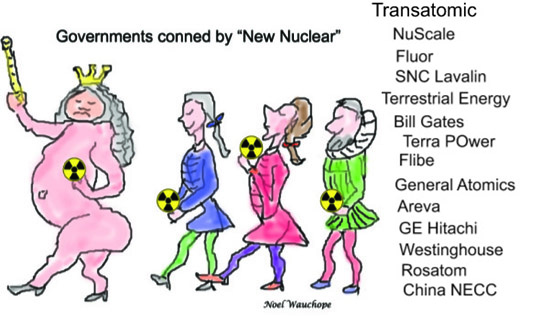
Praise the Lord and pass the ammunition: Nuclear power and climate progress in the 21st century http://thebulletin.org/commentary/praise-lord-and-pass-ammunition-nuclear-power-and-climate-progress-21st-century 17 DECEMBER 2015 Peter A. Bradford adjunct professor, Vermont Law School and former Nuclear Regulatory Commission member
In the 15th year of the era formerly known as “the nuclear renaissance,” not a single molecule of carbon dioxide emission has been avoided by a renaissance reactor built in the United States or in Europe. Unless the 40-year-old Watts Bar 2 reactor scheduled to operate in Tennessee early in 2016 is called “renaissance,” this situation will not change for several more years.
Climate change, so urgent and so seemingly intractable, has become the last refuge of nuclear charlatans throughout the Western world. From well-meaning ideologues and editorial writers claiming that the unknowable is theirs to state with certainty, to paid advocates more skilled in pleasing and persuading government officials than furthering consumer and environmental well-being, prophetic arguments have swollen from a stream to a river and now merge with the Seine in Paris, threatening to submerge the world under a layer of nonsense rising as inexorably as the seas themselves.
We are told that: Continue reading
Solar farm for Parkes, could double as sheep farm
French company plans 240ha solar farm for Parkes http://www.abc.net.au/news/2015-12-18/240ha-solar-farm-planned-for-parkes/7035218 Landholders adjoining a proposed solar farm near Parkes in central west New South Wales are being assured they will not be adversely affected by the development. The proponent Neoen is planning a 240-hectare plant west of the town that will include about 245,000 solar panels.
Cattle producer John Smeaton plans to lease his land to the company and says planting trees around the site will address any concerns about glare.
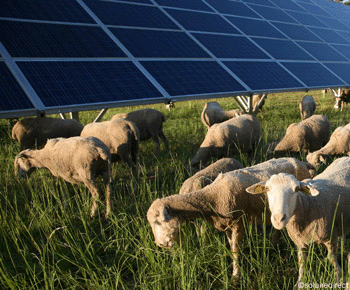 He said he was confident the area would remain productive and become ideal for grazing sheep.”These panels, cattle would wreck them, the only thing they could run there could be sheep,” Mr Smeaton said.
“Some of the other neighbours might be interested in running sheep there.
“From a fire prevention point of view I think it’s necessary for something to take the grass down, because it’s fertile farm land and the grass can grow a metre or more high and it grows hot when it burns.”
The company plans to create 120 jobs during construction if it is successful in getting grant funding and planning approvals next year. Mr Smeaton said it would also have tourism potential.
Like snake oil salesmen, nuclear lobby touts “new nuclear” as ‘Green

The Sierra Club says it has all the makings of a snake-oil sale. The organization would prefer the Obama administration abandon the extremely costly pursuit of advanced nuclear power in favor of greater investment in renewable energy such as solar and wind power.
Small-scale nuclear plants being pitched as new green, Albuquerque Journal, December 20th, 2015 “……….State leaders aren’t necessarily rushing to embrace the vision in a place where all but one nuclear plant have been mothballed and where old-guard nuclear safety advocates warn that so-called advanced nuclear technologies are an attempt to put shiny earrings on the same old pig.
But the investors and nuclear scientists opening startup labs in the office parks of California’s technology hubs and within the research centers of universities see a more influential ally in the White House.
‘All of the above’ strategy Nuclear power is at the nub of the Obama administration’s “all of the above” strategy for reinventing the energy industry in an era of climate change, and its faith in the fraught power source has captured the imagination of some notable and deep-pocketed West Coast thinkers.
Investors, including Microsoft founder Bill Gates and PayPal co-founder Peter Thiel, have poured about $2 billion into a few dozen small outfits, many of which are concentrated in the West. …….
Nuclear déjà vu That may all be possible someday, say the nuclear experts at the Union of Concerned Scientists, but that day is probably several decades and many tens of billions of dollars away. The sudden excitement around nuclear makes them nervous. They say they have seen this before. Continue reading
US nuclear workers are still being made sick by radiation
U.S. shrugs on nuclear worker safety http://www.kentucky.com/opinion/editorials/article50563650.html
Taxpayers have spent $12 billion in compensation
Contractors cut health benefits in push to reduce costs
Their story is sad.
This is outrageous: Workers in U.S. nuclear facilities are still being exposed to radiation on the job and will suffer the consequences to their health and longevity.
More than 186,000 workers have been exposed to radiation since 2001, when the federal government finally established a fund to compensate sick nuclear workers and their survivors.
The government has already paid $11 million to 118 workers who began working at nuclear weapons facilities after 2001, according to an exhaustive examination of federal data by the McClatchy Washington bureau.
Stronger safety standards and greater awareness are failing to protect today’s workers, even as the U.S. embarks on a $1 trillion, 30-year modernization of its nuclear arsenal. Continue reading
United Nations climate agreement delivered hope to the world
 In Paris, the United Nations showed its ability to deliver hope and
  healing to the world, The Age, December 20, 2015 Ban Ki-moon
Governments have ushered in a new era of global co-operation on climate change – one of the most complex issues ever to confront humanity. In doing so, they have significantly advanced efforts to uphold our charter mandate to “save succeeding generations”.
The Paris agreement is a triumph for people, the environment, and for multilateralism. It is a health insurance policy for the planet. For the first time, every country in the world has pledged to curb their emissions, strengthen resilience and act internationally and domestically to tackle climate change.
Together, countries have agreed that, in minimising risks of climate change, the national interest is best served by pursuing the common good. It is an example we could gainfully follow across the political agenda……
The Paris agreement delivered on all the key points I called for. Markets now have the clear signal they need to scale up investments that will generate low-emissions, climate-resilient development.
All countries have agreed to work to limit global temperature rise to well below 2 degrees and, given the grave risks, to strive for 1.5 degrees. This is especially important for the nations of Africa, small island developing states and least developed countries.
In Paris, countries agreed on a long-term goal to cap global greenhouse gas emissions as soon as possible in the second half of the century. One hundred and eighty-eight countries have now submitted their intended nationally determined contributions, which show what they are prepared to do to reduce emissions and build climate resilience.
These national targets have already significantly bent the emissions curve downwards. But, collectively, they still leave us with an unacceptably dangerous 3 degrees temperature rise. That is why countries in Paris pledged that they will review their national climate plans every five years, beginning in 2018. This will allow them to increase ambition in line with what science demands.
The Paris agreement also ensures sufficient, balanced adaptation and mitigation support for developing countries, especially the poorest and most vulnerable. And it will help to scale up global efforts to minimise loss and damage from climate change.
Governments have agreed to binding, robust, transparent rules of the road to ensure that all countries do what they have said they would do. Developed countries have agreed to lead in mobilising finance and to scale up technology support and capacity building. And developing countries have assumed increasing responsibility to address climate change in line with their capabilities……
Now, with the Paris agreement in place, our thoughts must immediately turn to implementation. By addressing climate change we are advancing the 2030 Agenda for Sustainable Development. The Paris agreement has positive implications for all the sustainable development goals. We are poised to enter a new era of opportunity.
As governments, business and civil society begin the mammoth project of tackling climate change and realising the sustainable development goals, the UN will assist member states and society at large at every stage. As a first step in implementing the Paris agreement, I will convene a high-level signing ceremony in New York, on April 22 next year.
I will invite world leaders to come to help keep and increase momentum. By working together, we can achieve our shared objective to end poverty, strengthen peace, and ensure a life of dignity and opportunity for all.
Ban Ki-moon is Secretary-General of the United Nations. http://www.theage.com.au/comment/united-nations-has-proven-its-ability-to-deliver-hope-and-healing-to-the-world-20151220-glrslx.html#ixzz3uvsOVMH3
International Energy Agency doubts the viability of Adani’s Galilee Basin mine
Adani’s Galilee Basin mine unlikely to go ahead, says International Energy Agency http://www.abc.net.au/news/2015-12-18/galilee-basin-projects-unlikely-to-go-ahead/7042526 national environment reporter Sara Phillips, ABC News: 18/19 Dec 15:
“The latest Global Coal Outlook from the world’s peak energy agency says mining projects worth nearly $40 billion in Queensland’s Galilee Basin are unlikely to go ahead. The International Energy Agency’s (IEA) forecast for the coal industry predicts demand for the fossil fuel will grow by less than 1 per cent a year for the next five years.
The fall-off in demand is largely a result of a declining Chinese market, with air pollution and climate change regulations reducing development of coal-fired electricity. …
However the coal quality in the Galilee Basin is not premium. And IEA says it has doubts about the viability of the huge development planned for Queensland. … “
Australian govt has legal power to act against massive Carmichael coal mine, but will it?
Australia’s moment in history: will it ban the Carmichael coal mine?
http://www.theecologist.org/News/news_analysis/2986707/after_cop21_australias_moment_in_history_will_it_ban_the_carmichael_coal_mine.html 18 Dec 15:
“The Paris Agreement is facing its first big test in Queensland, Australia, writes Justine Bell. After a long process beset by legal challenges, the massive Carmichael coal mine is inching closer to approval – which would open up the entire 250,000 sq.km Galilee basin and its 28
billion tonnes of coal to exploitation. …
Saying ‘no’ to the Carmichael mine would undeniably be controversial, and a significant departure from Australia’s historical reluctance to reject mining proposals.
Regardless, the legal power does exist for Australian governments to act, both at the federal and state levels, to prevent a project that could be at odds with the renewed global commitment to tackle climate change.”
Two waves sink Malcolm Turnbull’s rhetoric on Adani coal mine
Two waves sink Malcolm Turnbull’s rhetoric http://www.canberratimes.com.au/comment/two-waves-sink-turnbulls-rhetoric-20151217-glqja7.html Richard Denniss The Australia Institute chief economist, The Canberra Times: 18 Dec 15:
“… thanks to the Queensland Land Court decision to recommend the approval of the enormous Adani coal mine, we know that suggestions that Australia is planning to be competitive in a low-carbon world amount to nothing more than a cruel hoax. …
Ironically, one of the reasons the court recommended approval of the Carmichael mine was its
view that “it is apparent that [Adani] must pay tax on income earned or deemed to be earned in Australia”. The judge accepted the “prima facie evidence of the corporate tax payable” and rejected opponents’ claims that Adani would pay far less.
The ATO data shows Adani paid zero tax
on revenues of $268 million in 2013-14. Whoops. … “
Research into wind turbines and their role in reducing carbon emissions
The effect of increasing the number of wind turbine generators on carbon dioxide emissions in the Australian National Electricity Market from 2014 to 2025, Australian policy Online
18 December 2015……
India’s nuclear materials are not really secure

 India’s nuclear explosive materials are vulnerable to theft, U.S. officials and experts say. But Washington has chosen not to press for tougher security while its trade with India is booming, Center For Public Integrity, By Adrian Levy
 R. Jeffrey Smith 17 Dec 15 “…….. officials here and outside India depict as serious shortcomings in the country’s nuclear guard force, tasked with defending one of the world’s largest stockpiles of fissile material and nuclear explosives. Continue reading
Sick and dying workers due to radiation at Savannah River Nuclear Station
Ailing nuclear workers: Relying on Jesus and morphine, Charlotte Observer, 13 Dec 15
‘Smitty’ dies at 62 from cancer after working as a reactor operator
No compensation for him, or for thousands of other workers
Frustration with government from workers across the country
BY ROB HOTAKAINEN, SAMANTHA EHLINGER AND MIKE FITZGERALDMcClatchy Washington Bureau AUGUSTA, GA. 19 Dec 15

On an oven-hot Sunday in late August, Smitty wore white dress shorts and a cool lilac shirt that contrasted nicely with his salt-and-pepper hair, dozing in the front pew of the Southside Baptist Church.
Holding a black zippered Bible on his lap, he had his left leg stretched out all the way, resting it on two pillows on the seat of a wheelchair positioned just in front of him. He did it that way to protect a raw wound from a blood clot that ran from his knee to his hip. Doctors told him it was one of the biggest clots they’d ever seen.
[Irradiated: Read the full four-part report]
After working 17 years at the Savannah River nuclear weapons plant, just across the Georgia state line in South Carolina, Smitty found out on Sept. 11, 2008, 10 years after he retired, that he had multiple myeloma, a cancer.
Just like 54,005 other workers who have tried to get help from the federal government after getting sick at a nuclear weapons plant, Smitty never got a penny.
At 62, he relied instead on Jesus and morphine.
That meant up to two 30 milligram tablets of morphine sulfate every four to six hours, as needed, and prayers all day long, including the reading of at least one chapter in the Bible each day…….
Until the end, Smitty said he could not understand how the feds could say there was insufficient evidence to approve his claim for compensation. He said it was particularly perplexing because federal officials first led him to believe that his claim would be accepted, then suddenly ruled against him.
“I thought I was approved and shared it with my wife, and within no time at all, it was disapproved,” Smitty said……..
Survivors such as Priscilla Maez Clovis of Albuquerque, N.M., say the people who run the Energy Employees Occupational Illness Compensation Program are doing what they’ve always done: “Delay, deny, until you die.”
Over the past year, McClatchy journalists found that, on average, it takes 21.6 months for a claimant to get approved, while 20,496 workers spent five or more years navigating the bureaucracy. The government’s data shows that one production worker at a defunct facility in Portsmouth, Ohio, had to wait 14 years for compensation. The unidentified employee had bladder and brain cancers.
Across the nation, stories of frustration abound:………
The Investigative Fund of The Nation Institute, a nonprofit media center based in New York City, helped support this project. http://www.charlotteobserver.com/news/nation-world/article49568870.html
1 This month

of the week – Australians for War Powers Reform (AWPR)
To see nuclear-related stories in greater depth and intensity
 Antinuclear
