Queensland’s Oman Ama residents reject nuclear waste dump
 Oman Ama residents reject proposal for nuclear waste disposal site http://www.brisbanetimes.com.au/queensland/oman-ama-residents-reject-proposal-for-nuclear-waste-disposal-site-20160103-glyji8.html January 4, 2016 – Drew Creighton A group of residents of the tiny Darling Downs hamlet of Oman Ama has banded together in a bid to prevent Australia’s first permanent nuclear waste disposal facility from being built near their town.
Oman Ama was one of six sites shortlisted by the Federal Government and announced in November as a possible location for the facility.
The group has written to federal Resources Minister Josh Frydenberg ’emphatically’ rejecting the proposed nuclear waste dump.
The proposed site is roughly 90 kilometres from Warwick on Bennets Gully.
Friends of Oman Ama member and local doctor Dr Colin Owen said in a statement he was not convinced the proposal was risk free.”Mishaps have occurred in such facilities around the world, including at Lucas Heights in Sydney,” Dr Owen said.
The facility he referred to is the Lucas Heights reactor that produces nuclear medicine. Dr Owen is convinced there have been mishaps in the past 10 years at the reactor.
In 2010 a whistleblower alleged there had been a series of safety breaches at Lucas Heights.
Dr Owen said the proposed site was just a few kilometres north of Murray-Darling tributaries such as the Condamine. “The big concern is that if it leaks into there, the whole murray darling water way will be compromised,” he said.
Safety is not the only concern the residents have. Mental health nurse Susan Campbell had a list of worries including devaluation of land, risk to tourism initiatives and anxiety levels in locals.
Not all locals are against the proposal and one resident has offered their property as a potential site for the facility.
Another medical practitioner from Oman Ama, Dr Bob Morrish, is concerned with what has been called ‘obfuscation’ by the government. “The Government people have not been clear about the difference between storage and disposal, particularly in relation to the so called ‘interim’ storage of intermediate level radioactive waste,” Dr Morrish said. “They have refused to define ‘interim’ but suggested it could be as long as 30 years.”
The group is also pressuring the landholder to withdraw his application for the proposed site of the nuclear facility.
The other five sites on the shortlist are Sallys Flat in NSW, Hale in the Northern Territory and Cortlinye, Pinkawillinie and Barndioota in South Australia.
The government’s consultation process is expected to take until March, with a final shortlist of three sites announced later this year. A final determination of the site will not be announced until after this year’s federal election.
New Directive to Clean Energy Finance Corporation (CEFC) supports renewable energy investment
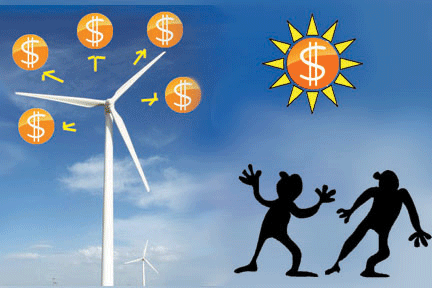 New clean energy investment mandate a shift from policy proposed by Abbott
Directive to CEFC to focus on innovative and emerging technologies will enhance support for windfarms and small-scale solar projects, Guardian, Shalailah Medhora, 24 Dec 15. The Clean Energy Finance Corporation (CEFC) has been directed to focus on innovative and emerging technologies, reversing a mandate by the former prime minister Tony Abbott that would have specifically blocked funding for windfarms and small-scale solar projects.
The mandate came into effect on Thursday, with a new clause outlining the shift in focus.
“As part of its investment activities in clean energy technologies, the corporation must include a focus on supporting emerging and innovative renewable technologies and energy efficiency, such as large-scale solar, storage associated with large- and small-scale solar, offshore wind technologies, and energy efficiency technologies for cities and the built environment,” the clause said. “ This will in turn increase the uptake of emerging technologies such as large-scale solar and energy efficiency.”
The investment mandate is not exclusive, meaning that established technologies can still be funded, and not retrospective, so projects that have already been funded will not be affected.
“The CEFC will therefore continue to pursue a diverse range of investment activities that are within the scope of the CEFC Act and this new investment mandate,” a statement by the body said.
“Together, the new investment mandate and the accompanying explanatory statement provide guidance on how the CEFC should approach investment in mature and established technologies, such as conventional onshore wind and conventional hydro,” it said. “It is the government’s expectation that, in many circumstances, projects involving mature technologies should be able to secure finance from commercial financing sources.”
The mandate is a shift from what Abbott proposed in July, when he said the body should no longer fund small-scale solar projects such as rooftop panels and wind technology…….
The CEFC chairwoman, Jillian Broadbent, wrote to the environment minister, Greg Hunt, and the finance minister, Mathias Cormann, welcoming the new mandate. She said it was an “appropriate approach that allows the CEFC to support the Australian government policy priorities while still allowing a measure of investment flexibility”. …….http://www.theguardian.com/environment/2015/dec/24/new-clean-energy-investment-mandate-a-shift-from-policy-proposed-by-abbott
Does Secret Nuclear Medical Experimentation Continue?
For over twenty years the law allowed the US Department of Defense (DoD) to use Americans as “guinea pigs.” This law (the US code annotated Title 50, Chapter 32, Section 1520, dated 30 July, 1977) remained on the books until it was repealed under public pressure in 1998. The new and revised bill prohibits the DoD from conducting tests and experiments on humans, but allows “exceptions.”
Unethical and dangerous experimentation undoubtedly continues in secret up to the present time, ostensibly under the guise of “national security.”
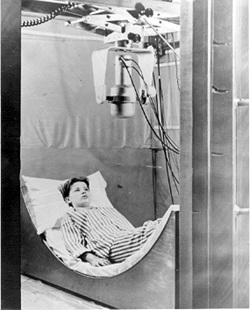 The Human Radiation Experiments By ALAN R. CANTWELL Jr., M.D.October 8, 2001 By davidjones “……. Does Secret Medical Experimentation Continue? To this day there are no adequate safeguards to protect people from secret government experimentation. ……. What is clear from studying the Committee’s Final Report is that the medical and scientific professions collaborated with the government and the military to abuse and harm US citizens. In the process, the nuclear establishment literally got away with murder. And there is simply no end to the secrets that still emerge from the Cold War years that began 58 years ago with the Manhattan Project.
In January 2000, the government presented the results of a statistical study showing that atomic workers employed in the nuclear weapons industry during the Cold War were more likely to suffer a higher rate of cancer, due to their exposure to cancer-causing radiation and chemicals. Continue reading
The Plutonium Files – a cautionary tale about nuclear medical experiments
Then there is the horrifying reality that these experiments were taking place in the shadow of Nazi Germany; some of the scientists involved in the radiation experiments were the very men whose earlier experimental designs had tormented prisoners of concentration camps. Welsome describes Operation Paperclip, conducted under the auspices of the U.S. government. Paperclip imported Nazi scientists and supported their work, helping to confer, in the words of scientist Joseph G. Hamilton, “a little of the Buchenwald touch” on American medicine.
This valuable work represents an elegy to lost ideals, lost health, and lost trust. One can only hope it will serve as a cautionary tale.
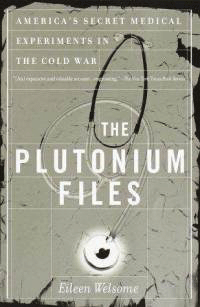 The Plutonium Files: America’s secret medical experiments in the Cold War N Engl J Med 1999; 341:1941-1942 December 16, 1999 Harriet A. Washington
The Plutonium Files: America’s secret medical experiments in the Cold WarBy Eileen Welsome. 580 pp. New York, Dial Press, 1999. $26.95. ISBN: 0-385-31402-7
Amid the embarrassments of Monicamania and of multiple public mea culpas, the past few years have not been exemplary ones for American journalism. This fact makes the triumph of The Plutonium Files all the sweeter, because this superlative book is a reminder of the purpose of investigative journalism.
This richly detailed, subtly nuanced history of government-engineered radiation experiments on unwitting Americans is based on the Pulitzer-prize–winning series Eileen Welsome wrote for the Albuquerque Tribune. Welsome’s tenacious and resourceful detective work has unveiled the saga of a sordid, tragic, yet fascinating chapter in the history of American medical science. The book succeeds on many levels. It is a gripping exposé of governmental exploitation and of medicine’s moral failures in an era in which blind trust defined the normal relationship between physicians and patients.
Between April 1945, scant months before the bombing of Hiroshima, and July 1947, the scientists of the Manhattan Project followed the construction of the atomic bomb with a chilling second act: medical experimentation on hundreds of unsuspecting Americans. Continue reading
1 This month

of the week – Australians for War Powers Reform (AWPR)
To see nuclear-related stories in greater depth and intensity
 Antinuclear