Australia’s hypocrisy about nuclear weapons
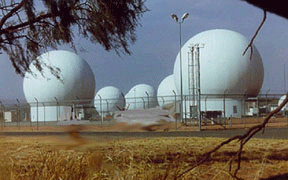 North Korea hydrogen bomb: Australia has a dangerous double standard when it comes to nuclear weapons The Age, January 7, 2016 Richard Lennane
Our reliance on nuclear deterrence for security only encourages other countries to acquire them. Foreign Minister Julie Bishop wasted no time in joining the chorus of international condemnation of North Korea’s latest nuclear weapon test.
“North Korea’s actions fly in the face of international non-proliferation norms, and challenge the Nuclear Non-Proliferation Treaty,” Bishop said. Certainly, whether or not the weapon really was a hydrogen bomb, the test is a disturbing development that threatens international peace and security. Despite the comically strident claims of the North Korean regime, nobody is made safer by North Korea’s acquisition of a nuclear arsenal.
But behind Bishop’s ready condemnation lies an awkward contradiction. Like North Korea, Australia believes that nuclear weapons really do make it safer. Of course, Australia claims that it supports nuclear disarmament and is working for a world free of nuclear weapons. But our actions say something different: Australia relies on extended nuclear deterrence for its security, has no plans to change that, and has been actively opposing and resisting international steps to stigmatise and prohibit nuclear weapons on humanitarian grounds. Continue reading
Popularity of Western Australia’s rooftop solar makes privatisation of electricity assets unlikley
 WA’s rooftop solar so popular power privatisation not an option, says expert, Guardian, Calla Wahlquist, 6 Jan 16 Prof Philip Jennings, a renewable energy expert, says investors would be unlikely to be interested in unprofitable power networks Western Australia would not be able to privatise its electricity assets “even if they gave it to them for nothing” because the popularity of rooftop solar panels has made state-owned power stations unprofitable, a renewable energy expert has said. Continue reading
James Hansen is in error in saying that nuclear power can solve climate change

The nuclear power industry has essentially priced itself out of the market for new power plants because of its 1) negative learning curve and 2) inability to avoid massive delays and cost overruns in market economies. This is doubly problematic because the competition — renewable power, electricity storage, and energy efficiency — have seen steady, stunning price drops for a long time.
the IEA and many others have concluded that new renewable energy will play a far bigger role in the transition.
Why James Hansen Is Wrong About Nuclear Power, Climate Progress BY JOE ROMM JAN 7, 2016 CLIMATOLOGIST JAMES HANSEN ARGUED LAST MONTH, “NUCLEAR POWER PAVES THE ONLY VIABLE PATH FORWARD ON CLIMATE CHANGE.” HE IS WRONG.
As the Nuclear Energy Agency (NEA) and International Energy Agency (IEA) explained in a major report last year, in the best-case scenario, nuclear power can play a modest, but important, role in avoiding catastrophic global warming if it can solve its various nagging problems — particularly high construction cost — without sacrificing safety.
Hansen and a handful of other climate scientists I also greatly respect — Ken Caldeira, Tom Wigley, and Kerry Emanuel — present a mostly handwaving argument in which new nuclear power achieves and sustains an unprecedented growth rate for decades. The one quantitative “illustrative scenario” they propose — “a total requirement of 115 reactors per year to 2050 to entirely decarbonise the global electricity system” — is far beyond what the world ever sustained during the nuclear heyday of the 1970s, and far beyond what the overwhelming majority of energy experts, including those sympathetic to the industry, think is plausible.
They ignore the core issues: Continue reading
Leeton, New South Wales: plan for multimillion dollar solar farm
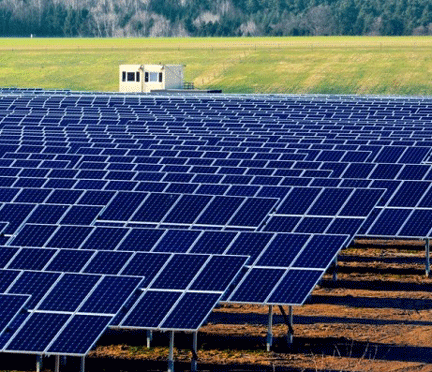 proposed for Wumbulgul http://www.abc.net.au/news/2016-01-07/wumbulgul-solar/7072604 A $90m solar farm is proposed near Leeton in the New South Wales Riverina, to help power a new rail freight hub in the region. Photon Energy has been in discussions with Leeton Shire Council since 2012 about a solar development.
It’s now asked the state government to consider a proposal for a 100 megawatt plant, with the ability to double that output, next to the recently opened Western Riverina Intermodal Freight Terminal at Wumbulgul.
Documentation lodged with the Planning Department states the solar farm would be on a 140 hectare site on the Griffith Road and would take around a year to build.
Photon estimates the farm would have a life of around 30 years, after which infrastructure could be updated or the site rehabilitated.
The application says feedback from initial discussions in August is positive and a community consultation plan will be developed.
The Department is now preparing its requirements for the solar project.
Nuclear winter, global famine from just one “small” nuclear war
One small atomic war could trigger cruel nuclear winters and global famine http://www.techinsider.io/nuclear-explosions-earth-atmosphere-temperature-2016-1 Kevin Loria 7 Jan 16
North Korea’s fourth test of a nuclear weapon — whether it was a hydrogen bomb or not — calls attention to a well-known but sobering fact: There are a terrifying number of nuclear weapons in the arsenals of major powers around the world.
But worse, unprecedented and widespread devastation doesn’t require the unlikely scenario of all those powers unleashing all the firepower at once, according to a recent study published in an American Geophysical Union journal.
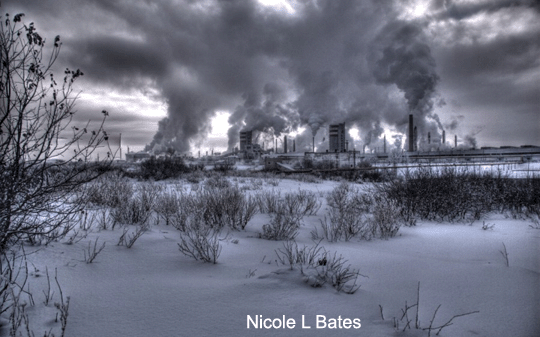
In fact, that study found that a “limited, regional nuclear war” using 100 “small nuclear weapons” — the size of the bomb dropped at Hiroshima — could cause a nuclear winter that would last decades. Continue reading
Radioactive Baby Teeth: The Cancer Link
 Radioactive Baby Teeth: The Cancer Link Paperback by Joseph J Mangan In 2001, college administrators entered a remote, musty storage room near St. Louis. Not knowing what was in the room, the group was puzzled to find a large wall with hundreds of long boxes stacked against it. They pulled out one of the boxes, took off the cover, and found —- baby teeth. Quite by accident, the group had unearthed 85,000 baby teeth left over from a study done decades before. The study had found how much radiation from atomic bomb tests had entered human bodies, by testing teeth. News of the discovery spread like wildfire in newspapers across the country. Coverage focused on the fact that the teeth could answer a critical question – how much cancer was caused by radiation exposure? In this book, read about the mystery faced by scientists of how much radiation from nuclear weapons and reactors actually infiltrated people’s bodies – and how much cancer it really caused. Learn about the furious opposition researchers faced from government and industry. Discover how the research helped end above-ground nuclear testing, how it challenged the claim that nuclear reactors are safe, and how it exposed an undeniable link with cancer. Joseph Mangano draws on his direct experience and his involvement with scientists and citizens to create a lively, intriguing story – a story that continues today. Mangano is a health researcher, and is Executive Director of the Radiation and Public Health Project, based in New York. http://www.amazon.com/Radioactive-Baby-Teeth-Cancer-Link/dp/0615168752/ref=sr_1_3?s=books&ie=UTF8&qid=1452117447&sr=1-3&keywords=joseph+mangano
Consumerism – our personal and global mess
Decluttering can’t save us from the consumerist mess we’ve made, Guardian, 7 Jan 16
Suzanne Moore Marie Kondo’s bestselling books sell tidying as a spiritual experience. But liberating ourselves from stuff is about more than just a neat sock drawer
“……What fascinates me is how decluttering has become yet another way of virtue signalling. The rise of mega-selling advice about decluttering is an extension of the detox, an add-on to the binge/purge cycle. For those who live on TED talks and superfood alone, then maybe tidying up really is that liberating.
For decluttering elevates the domestic sphere. This is not just cleaning. Would any woman buy a book on how to do housework?
……we hold on. We are constantly told to get more stuff and we are confused by the value of what we possess. This is acted out perversely by hoarders……
the decluttering industry can’t deal with the broader aspect of why we feel so out of control in our own homes. After all, we have merely done as we were told: consumed. Now, it has become excessive, and we are swimming in our own tat. Is this elevation of tidying enough to stop the circle of shopping, of built-in obsolescence, of fashion, of our complete lack of connection to where any of our products come from?
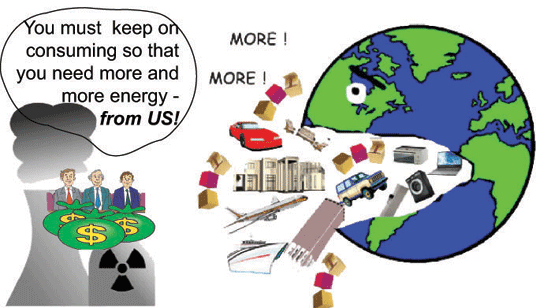
To be free from this cycle may indeed be magical. The illusion that it is up to each of us individually to sort this out may be comforting. But liberation from the mess we have made is about more than a neat sock drawer. http://www.theguardian.com/commentisfree/2016/jan/06/decluttering-cant-save-us-from-the-consumerist-mess-weve-made#comment-66332353
Australia’s renewable energy future – theme for January 2017
Australia has a bright renewable energy future. Indeed a pretty bright renewable energy present, too. Australian households have taken up solar energy in a big way – per head of population, the best in the world.
Wind energy is already a success story, with South Australia leading the way. Initiatives are happening, in utility scale renewable energy, particularly in the Australian Capital Territory.
Along with the ACT, Australia’s cities are choosing renewable energy – Sydney, Melbourne, Perth, , and many other cities are making the solar city change.
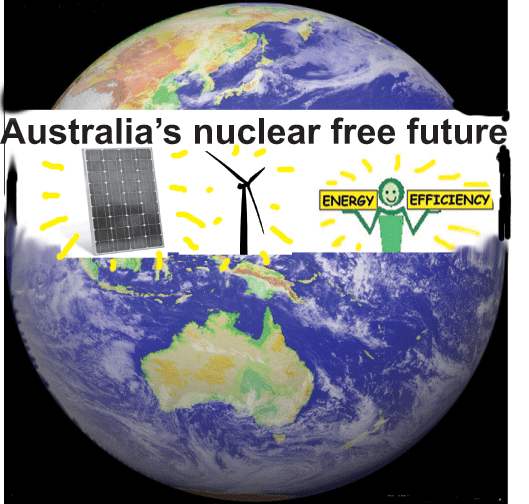
For large scale renewable energy, Australia has lagged behind. The climate policies of Liberal Coalition governments, under PM Tony Abbott, and now PM Malcolm Turnbull have been, and still are, dictated by the fossilfuel/nuclear lobbies.
Yet we still have the Australian Renewable Energy Agency, and the Clean Energy Finance Corporation, supporting initiatives in clean energy. The Turnbull government still plans to axe these, in line with its obligations to its dirty industry funders.
The renewable energy revolution in Australia is being led from “below”, from the people. It’s not to do with “left” or “right” politics. It’s to do with practicalities. Eventually, we will get a government that faces up to the realities of energy sources in the 21st Century .
1 This month

of the week – Australians for War Powers Reform (AWPR)
To see nuclear-related stories in greater depth and intensity
 Antinuclear