It’s Big Money that impels politicians to promote the nuclear industry
from CaptD 31 Jan 16 The first reason is MONEY and I mean BIG Money. Politicians are always gear 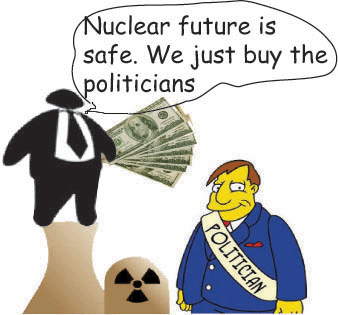 for Nuclear Payback*
* http://www.urbandictionary.com/define.php?term=Nuclear+payback
Those that support nuclear power because nuclear power somehow supports them; no matter what the health implications or other “costs” are for others.
The “other” reason is that the Nuclear Industry and their Utilities are desperate to create a radioactive waste dumping site for waste is that they are going to want to site Small Modular Reactors (SMRs) very soon, which companies like SD’s General Atomic are now working on. Since CA has a law that says no more nuclear reactors, until a waste site is developed, the lack of a disposal site is the biggest roadblock they face preventing them from deploying SMRs in CA.
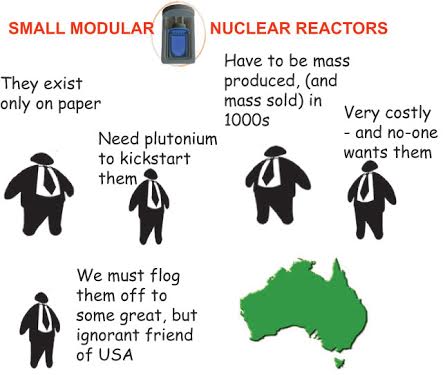
I believe that most Utilities will want to phase out Nat. Gas fired Peaker plants and install SMR’s “because they don’t emit CO2.” That is, unless they are going to be making big money using nat. gas like SDG&E will be, since they already have a contract to import Nat. Gas from Mexico (which Sempra owns a share of, so they will be kind of buying Nat. Gas from themselves) for use in their two new state of the art Billion Dollar Peaker Plants that the CPUC just approved for them (despite the fact that the cost of Wind and Solar generation continues to drop almost monthly)!
SCE just had the CPUC decide against approving a Nat. Gas Peaker plant for them, so you can bet that they are now getting “very excited” about installing one or more SMR’s at San Onofre, since the grid wiring connection is already in place and they are going to be guarding that “nuclear waste” site for decades to come.
http://www.kpbs.org/news/2016/jan/08/oceanside-takes-stand-relocating-san-onofres-nucle/
BTW: All waste facilities should be run by the Government, that way they will always be responsible for it, since Big Waste Corp.’s can go out of business any time they want as as everybody knows Radiation is FOREVER since 50 or more than 100 years is forever to everyone living today.
How do communities in other countries feel about hosting nuclear waste dumps?
The Nuclear Fuel Chain Royal Commission in full swing in South Australia , (though ignored in Australia at large), with its plan to import nuclear wastes.

It is timely to ask why foreign countries might want to send their radioactive trash here.
After all, the nuclear lobby keeps telling us that radioactive trash is a RESOURCE, not WASTES. So why wouldn’t other countries want to keep it, and get rich from new purportedly “waste eating” nuclear reactors?
An article from an American County is relevant to this discussion in Australia. As you read, you will get a whiff of the problem in USA.
Rocky road for nuclear waste bore hole study, http://bismarcktribune.com/news/state-and-regional/rocky-road-for-nuclear-waste-bore-hole-study/article_7698d465-0316-5031-83e9-bc727d3592b9.html By Lauren Donovan, A plan to explore deep ancient rock in Pierce County for its potential to store nuclear waste hit a bumpy road if not a rock wall in its first introduction to state officials Thursday.
The State Board of University and School Lands heard from the Energy and Environmental Research Center at Grand Forks that its team was awarded $35 million by the federal Department of Energy to drill 16,000 feet down into crystalline rock to learn whether the rock could suitably store spent nuclear fuels.
John Harju, project liaison, said the bore hole is for study purposes only, no waste would be stored there and that such storage isn’t even yet legal under federal rules.
Harju said the bore hole would be an opportunity to analyze rock core that’s rarely ever been looked at for minerals or geothermal properties. The chance to go that deep, into the oldest rock on the planet, “may never present itself again,” Harju said.
The issue was presented to the land board because EERC is proposing to drill on 20 acres of state-owned land about 15 miles south of Rugby.
Pierce County commissioners were at the meeting and said they were startled to read about the project before anyone from EERC even came to the county.
Commissioner Duane Johnston said, if the issue had come up at a local zoning meeting, “half the county would have been there to say no.” Commission chairman Dave Migler said it was tough to take calls from residents and not have much information to share. “It’d be nice to be in the loop,” he said.
While there was no formal application on the table, land board members didn’t hesitate to weigh in with worries that a federal project could become a federal mandate.
In the end, it was far from clear how the EERC would proceed with getting approval to use public land for the project in Pierce County, or perhaps anywhere in the state.
Afterward, Harju said he was a little surprised by his reception. “Plan B? We don’t have one. If the project is not able to proceed, the DOE will have to evaluate” alternatives, he said.
The five-year project was awarded to the Battelle Memorial Institute of Ohio, along with EERC and Schlumberger, a familiar drilling service company in the Bakken. The crystalline rock formation underlies much of the continent.
India subservient to foreign nuclear companies, represses public anti-nuclear protest
France Peddles Unsafe Nuclear Reactors to India, Drawing Protest , 29 January 2016 By Kumar Sundaram, Truthout | News Analysis On January 26, French President François Hollande was the chief guest for India’s Republic Day ceremony, where India showcases its military hardware in a colonial-era parade in its capital. Meanwhile, in Jaitapur on India’s western coast, farmers and fisherfolk were protesting against Hollande’s visit, arguing that the nuclear reactors that India is importing from France threaten their lives, livelihoods and the local ecology……..
The 2015 World Nuclear Industry Status Report concludes that, after the Fukushima accident, the international nuclear industry has faced its worst crisis globally. The industry is looking at India as a big market where they can compensate for their losses and revive their fortunes. India has become an attractive market for global nuclear corporations, where the government is mortgaging its financial and environmental health to welcome them. This includes channeling the accident liability to the public; undermining environmental, geological and safety laws; and ignoring the measured advice of independent experts.

Besides Jaitapur, massive and intense anti-nuclear protests have arisen in Koodankulam, Mithi Virdi and Kovvada, where Russian and US corporations are setting up nuclear power plants. Local  communities in other places like Chutka, Fatehabad and Mahi Banswara have also been agitating against the nuclear projects. The government has resorted to brutal crackdowns and repression against these consistently peaceful protests.
More than 8,000 people in Koodankulam are facing fabricated police cases under colonial-era sedition laws and charges of waging war against the Indian state. The police have killed, arrested and harassed villagers indiscriminately, including women and children. They surrounded the Idinthakarai village in 2012 and disrupted its vital supply lines that deliver goods, including food and milk for children and medicines, to force the village to surrender. One of the first steps that the new government under Modi took in 2015 was to come up with a “confidential” report by the Intelligence Bureau, naming Greenpeace, the Coalition for Nuclear Disarmament and Peace, and other anti-nuclear and environmentalist organizations “anti-national………”http://www.truth-out.org/news/item/34627-france-peddles-unsafe-nuclear-reactors-to-india-drawing-protest
Safety fears as Japan restarts nuclear reactor with MOX fuel (includes plutonium)
 Third reactor restart spurs fears over shaky Kansai evacuation plans BY ERIC JOHNSTON STAFF WRITER , JAPAN TIMES, TAKAHAMA, FUKUI PREF 29 JAN 16 . – Kansai Electric Power Co. on Friday restarted its Takahama No. 3 reactor, the nation’s third unit to go back online under new safety regulations but the first to run on mixed oxide (MOX) fuel, which contains plutonium extracted from spent nuclear fuel.
The restart has revived concerns, especially in neighboring Kansai, about the feasibility of plans to evacuate residents within 30 km of the plant in the event of an accident. It is also unclear where the spent fuel from the reactors will eventually be stored. Continue reading
Insurmountable Risks of the Jaitapur Nuclear Project
 France Peddles Unsafe Nuclear Reactors to India, Drawing Protest , 29 January 2016 By Kumar Sundaram, Truthout | News Analysis “………the concerns of the local community in Jaitapur go beyond the cost of the project. Jaitapur is located in the stunningly beautiful Konkan region, replete with verdant plateaus, magical mountains and undulating hills, lagoons, creeks, the open sea and infinite greenery. The NPCIL has labeled nearly 65 percent of the land as “barren,” despite the fact that Konkan is one of the world’s 10 “biodiversity hotspots,” sheltering over 5,000 species of flowering plants, 139 of mammals, 508 of birds and 179 of amphibians, including 325 globally threatened species.
Altogether, the nuclear park would jeopardize the livelihoods of 40,000 people. The annual turnover of Jaitapur’s fishing villages is about $2.2 million. In Nate Village alone, there are 200 big trawlers and 250 small boats. Nearly 6,000 people depend directly on fishing and over 10,000 are dependent on ancillary activities.
The community is apprehensive that the elaborate security arrangements around the project would block the fisherfolks’ use of the two creeks of Jaitapur and Vijaydurg. The fish population will also be affected since the nuclear plant would release a massive 52 billion liters of hot water into the Arabian Sea daily, raising the local sea temperature by 5 to 7 degrees Celsius.
Jaitapur has highly fertile land, which produces rice and other cereals, and arguably the world’s most famous mango, the Alphonso. Cashews, coconuts, kokum, betel nuts, pineapples and other fruits are found in abundance. The land is also quite productive in terms of its use for cattle-grazing and rain-fed agriculture.
The environmental impact assessment (EIA) for Jaitapur, conducted by the government-run National Environmental Engineering Research Institute (NEERI), did not even look into the crucial aspects of radiological releases, decommissioning and nuclear waste, besides summarily neglecting the vital issues of ecosystems and livelihoods, terrestrial ecosystems and farming, mangrove forests and the fragile marine ecology and fisheries in the region.
NEERI admits it does not have any expertise in radiation-related issues and it just mentioned in its report that all the stipulations of the government’s nuclear regulator would be followed. The then-minister for environment and forests, Jairam Ramesh, had himself termed these EIA assessments a joke. Even that environmental clearance, granted on 35 absurdly weak conditions, was given only for a period of five years, which lapsed as of November 2015. Citizens groups and independent experts have demanded a fresh EIA in place of an extension……… http://www.truth-out.org/news/item/34627-france-peddles-unsafe-nuclear-reactors-to-india-drawing-protest
How Japanese nuclear utilities buy politicians
 Utilities secretly buy tickets for pro-nuclear minister’s fund-raisers http://ajw.asahi.com/article/behind_news/politics/AJ201401270057 January 27, 2014 THE ASAHI SHIMBUN
Using money paid by consumers, nuclear plant operators have secretly bought tickets worth several million yen a year for fund-raising parties of Akira Amari, a pro-nuclear Cabinet minister, since 2006, The Asahi Shimbun learned. Continue reading
Cyber attack a special risk for nuclear stations in unstable regions
 Report: Nuclear plants in unstable regions vulnerable to cyberattacks, UPI By Allyson Chiu, Medill News Service WASHINGTON, D.C., January 28, 2016 — Nuclear power plants need to improve security systems to safeguard against non-traditional terrorist attacks, but that’s challenging for developing countries, experts said Thursday…….
a report released Thursday by the Stimson Center, a Washington think tank, said many nations do not have the resources to adequately protect their nuclear facilities from insider or cybersecurity attacks.
“In particular countries in close proximity to terrorist groups with vulnerable or unstable economies, the potential for incidents is much higher,” said Debra Decker, the report’s co-author and Stimson Center senior adviser.
West African nations like Nigeria are battling terrorist groups including Boko Haram. In the Middle East, territory in Syria has been taken by the Islamic State. Both countries are considering nuclear power programs, according to the World Nuclear Association.
Attacking a nuclear power plant can disrupt power grids or even cause a nuclear meltdown. Kathryn Rauhut, co-author of the Stimson report, said the Fukushima power plant in Japan — destroyed by a meltdown caused by a tsunami — could also have been vulnerable to cyberterrorism.
“Rather than the tsunami taking out backup power supply, you could just have that engineered through a cyberattack,” she said. “We hope that nobody would ever use planes or weapons of mass destruction again, but you don’t need to do that, you can wreak the same amount of havoc through cyber intrusions.”
Unlike American nuclear power plants, which are strictly monitored by the Nuclear Regulatory Commission, international plants do not have any binding safety standards, Decker said…….. http://www.upi.com/Top_News/US/2016/01/28/Report-Nuclear-plants-in-unstable-regions-vulnerable-to-cyberattacks/2321454019965/
1 This month
15 April – Zoom –Nuclear Power is Not the Solution
Apr 15, 2026 01:00 AM in Canberra, Melbourne, Sydney

Join the International Physicians for the Prevention of Nuclear War (IPPNW) on Tuesday, April 14th for a timely webinar exploring the risks associated with nuclear power and challenging the myth that it offers a simple, safe, carbon-free solution to the climate crisis

21 April Webinar: No Nuclear Weapons in Australia
Start: 2026-04-21 18:00:00 UTC Canberra, Melbourne, Sydney (GMT+10:00)
End: 2026-04-21 19:30:00 UTC Canberra, Melbourne, Sydney (GMT+10:00)
Event Type: Virtual
A virtual link will be communicated before the event.
Host Contact Info: australia@icanw.org

of the week – Australians for War Powers Reform (AWPR)
To see nuclear-related stories in greater depth and intensity
 Antinuclear