Energy self sufficiency- battery storage and solar getting cheaper
The latest report shows that almost two-thirds of Australians want to be self-sufficient in meeting their energy needs and while battery systems will not give complete independence for most consumers, it does offer a bit more control.
Costs of battery storage systems have been falling at a rapid rate and forecasts are for this trend to continue as more and more households adopt them. It is expected that prices will halve again within the next five years.
Solar panels have also gotten cheaper, with the Climate Council reporting a 75 per cent drop in price over the past five years.
Companies such as Reposit, an ACT-based start-up, are using the grid’s infrastructure to allow people to trade their energy directly on the wholesale market, effectively acting like a mini power station in everybody’s backyard.
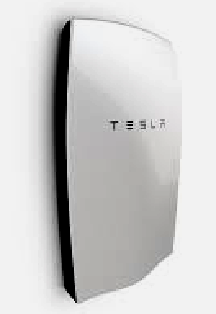 Explained: The Tesla Powerwall and what it means for Australia’s energy market, ABC News, 2 Feb 16, The Powerwall, a lithium-ion battery system designed to store electricity generated from rooftop solar panels, is widely considered to be a game-changer for the electricity industry. 7.30 has asked consumer group Choice to crunch the numbers. Here’s what they found.
What is the Tesla Powerwall?While the concept of a home battery storage system is not new to Australians, the Tesla Powerwall unit has been highly anticipated.
The Powerwall is a 7 kilowatt hour (kWh) lithium-ion-battery system that stores electricity generated from rooftop solar panels (or PV panels) during the day so that electricity can be used at night during the peak-usage times.
The system has attracted a cult-like following in recent months after the announcement that Australia would be one of the first countries to have access to it.
The first installations of the Tesla Powerwall are now underway and have a 10-year warranty period.
How does it work?The battery has a daily cycle, meaning it is designed to charge and discharge each day.
The efficiency of the battery is 92 per cent, so although it has a 7kWh capacity, the Powerwall’s working capacity is more like 6.4kWh.
Tesla also has a 10kWh weekly cycle version intended for back-up applications, but it is the 7kWh version you will see in most home installations.
People who already have solar panels will be able to use their own power rather than exporting it to “the grid” — the energy distribution network that carries electricity from power stations to homes and businesses……..
So what does this mean for the grid?
The latest report shows that almost two-thirds of Australians want to be self-sufficient in meeting their energy needs and while battery systems will not give complete independence for most consumers, it does offer a bit more control.
Costs of battery storage systems have been falling at a rapid rate and forecasts are for this trend to continue as more and more households adopt them. It is expected that prices will halve again within the next five years.
Solar panels have also gotten cheaper, with the Climate Council reporting a 75 per cent drop in price over the past five years.
With the global market for solar panels and battery storage expected to grow tenfold by 2020, the demand for battery systems like the Powerwall should have flow-on effects on prices as economies of scale kick in.
Even if consumers were able to make themselves independent of the electricity grid, they may benefit from selling their electricity back to it rather than storing it.
Companies such as Reposit, an ACT-based start-up, are using the grid’s infrastructure to allow people to trade their energy directly on the wholesale market, effectively acting like a mini power station in everybody’s backyard.
If there was a wholesale defection by consumers it could create what is known as a ‘death spiral’ in which a smaller and smaller amount of consumers are left on the grid, leaving only those on lower incomes or those unable to afford a Powerwall to carry the cost of running the grid……… http://www.abc.net.au/news/2016-02-02/tesla-powerwall-what-it-means-for-australia’s-energy/7130392
No comments yet.
1 This month

of the week – Australians for War Powers Reform (AWPR)
To see nuclear-related stories in greater depth and intensity
 Antinuclear
Leave a comment