The Lizard is biting back at Olympic Dam uranium mine
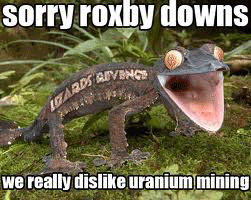 Lizard’ bites back with new message http://www.themonitor.com.au/news-articles/160210-lizard-bites-back-with-new-message– 10-Feb-2016 Patrick Glover Hundreds of protestors are set to descend on Olympic Dam for a three-day festival in July.
The Desert Liberation Front previously visited the area in 2012 with its Lizard’s Revenge event.
This year’s gathering, which will run from July 1-3, is being called The Lizard Bites Back.
“The first time, we were very focused on the expansion with the announcement having only been made a few months prior to our visit,” said event co-organiser Nectaria Calan.
“The mine is still there, and it’s four years later now, so we thought it was time to go back to the source.
“The mine is always an issue. It was not just when the expansion was going ahead – it is one of the largest uranium mines in the world, so for us it is already having an impact.
“Now there is the Royal Commission (into nuclear energy) on”
Ms Calan said the event was still in the early planning stages and no activities had been planned yet.
However, she said the group was hoping to hold educational workshops and other activities as part of the ‘protestival’.
The group is also aiming to reach out to more locals this time around. It is inviting anyone interested to visit the campsite during the event.
Ms Calan said she was hoping for a similar attendance to the previous festival’s crowd of hundreds.
Senior Sergeant Terry Boylan said South Australia Police (SAPOL) was well under way with planning for this year’s protest, as extra officers may need to be called in.
A BHP Billiton spokesperson told The Monitor the company wished to make no comment regarding the protestors’ visit at this point in time.
South Australia’s Greens leader warns on need for vigilance in preventing import of radioactive trash
 Greens leader Mark Parnell responds to the Ministerial Statement:
“It’s clear that the Government realises that regardless of the Royal Commission’s finding, they still have a lot of work to do to convince South Australians that we should expand the nuclear industry in SA”.
“We always knew that this campaign would be run over the long term. While it’s unlikely that we will see legislation this year, we still must remain vigilant.”
Environmental Defenders Office (SA) outlines critical issues in proposal for nuclear waste facility
 Possibility of a high level nuclear waste facility in SA Environmental Defenders Office (SA) Inc. The environment’s legal team since 1992 – protecting the public interest – evening the odds 10 Feb 16
As our nuclear industry, insofar as it exists is principally focused on mining and not on the generation of electricity there would have to be a large amount of new legislation that would have to be enacted in order to establish a high level nuclear waste facility in SA. There are issues regarding environmental impacts, workplace safety, the imposition on aboriginal land, the impact on future generations, the potential for technological changes and security concerns.
Some of the major issues.
Continue reading
Space for nuclear waste is determined by radioactivity level, not by the volum eof wastes

 nuClear News No 82 Feb 16 The Impact of a New Reactor Programme on the UK’s Radioactive Waste Inventory The proposed Hinkley Point C nuclear power station would produce radioactive wastes and spent fuel with a radioactivity inventory equal to roughly 80% of the radioactivity in all of the UK’s existing radioactive wastes put together.
South Australia – decision on nuclear expansion at end of 2016
 SA govt to hold off on nuclear call http://www.9news.com.au/national/2016/02/09/16/44/sa-govt-to-hold-off-on-nuclear-call South Australia’s government won’t decide whether to expand its nuclear industry until the end of the year, despite a royal commission preparing to release tentative findings.
Former governor Kevin Scarce will on Monday reveal his initial response to whether SA should play a bigger role in the mining, enrichment, energy and storage aspects of the nuclear fuel cycle before releasing his final report on May 6.
Premier Jay Weatherill told parliament on Tuesday that the government will consult with the community and the Commonwealth and provide its response before the end of the sitting year in December.
South Australian Premier Jay Weatherill’s Statement to Parliament on Nuclear Fuel Cycle Royal Commission
 Premier Jay Weatherill tabled a Statement (9/02/16) outlining the progress and next steps for the South Australian Nuclear Fuel Chain (sorry, they call it “Cycle”) Royal Commission.
Following the release on February 15, of its “tentative findings“, the Commission will hold a five week “comment period”, during which public meetings will be held in:
Adelaide, Port Pirie, Port Augusta, Whyalla, Port Lincoln, Mt Gambier, Ceduna, Renmark, and Aboriginal communities in the Far North and West Coast.
On 6 May, the Commission will present its final report.
Next – community discussion between May and August.
“Once we have the findings, I would anticipate some engagement with the Commonwealth Government about the final report”
Then “a period of decision making where Government will need to assess the evidence gathered by the Commission, and the feedback from the community before outlining its full response to the Royal Commission
I expect to provide a full response to the Royal Commission to the Parliament before the end of sitting this year.”
Renewables cheaper, faster, lower carbon footprint – busting the myth about “baseload” energy
 nuClear News No 82 Feb 16 Towards 100% Renewables As Shadow Secretary of State for Energy and Climate Change, Lisa Nandy, re-iterates the myth that nuclear power is an “important as part of the energy mix [if] we’re going to meet the commitments we made in Paris” we investigate how the UK could move to a 100% renewable energy system. Although Nandy says she is not happy with the Hinkley deal she says “we know we will need nuclear power as part of the mix”, but is she right? (1)
Have you heard the new joke about Anti Environment Minister Greg Hunt?
Greg Hunt named “best minister in the world”
Australia’s own Greg Hunt has been singled out as the “best minister in the world” by a high-powered international conference.

In bushfire season, Solar microgrids and batteries are safer than conventional grid
 Turner says his company has been in productive talks with Victorian energy minister Lily D’Ambrosio over the prospect of subsidising Zen Energy systems capable of running as a localised backup for periods when the grid needs to be switched off
|
Solar microgrids and batteries could prevent another Black Saturday bushfire, Guardian, Max Opray 9 Feb 16, The cause of the Kilmore East fires that contributed to Victoria’s 2009 Black Saturday bushfires was found to be an ageing SP AusNet power line
Smaller sustainable energy systems are a better option than trying to maintain ageing Australian energy infrastructure, say experts On 7 February, Australia solemnly marked the anniversary of an electrical fault.It was on this date in 2009 that Melbourne endured its hottest conditions on record – a sweltering 46.4C. To make matters worse, hot winds blasted through the region at speeds in excess of 100km/h. In Kilmore East, just north of Melbourne, a critical failure in a 43-year-old power line caused bursts of 5000C plasma to arc out and ignite the tinder-dry vegetation in the gully below. Fanned by such extreme winds, the fast-growing inferno would by the end of the day be responsible for the majority of the 173 lives lost in the dozens of fires that engulfed Victoria on Black Saturday, Australia’s worst bushfire disaster. Several of the other blazes that day were started by felled power poles and other electrical issues. This was also the case for many other fires before and since, including Australia’s previous-worst bushfire tragedy, the 1983 Ash Wednesday fires, which claimed 75 lives. Richard Turner, director of South Australian renewable energy powerhouse Zen Energy, has a plan to stop such a thing happening again. Continue reading |
South Australia Riverland farmers get new crop – harvesting the sun
 Solar venture in SA Riverland aims to make abandoned crop land productive again, ABC News, 10 Feb 16 By Isabel Dayman Solar energy might be a saviour for some South Australian Riverland fruit growers who abandoned their crops and land during severe drought late last decade.
Key points:
- Solar test site has 800 panels on the roof of an old storage depot
- Proponent Mark Yates says all profits would stay in the local community
- Many fruit blocks were abandoned at the end of last decade due to severe drought
A test site with 800 solar panels on the roof of an old storage depot at Renmark has been set up by Yates Electrical Services director Mark Yates to show what might be possible.
“We wanted to use this as a test case to see what the viability of the small-scale generation plants could be and whether they could be implemented in a community,” he said.
“We’d like to get 12 months of full data — that way we can draw a really clear picture and be really transparent to show people what the costs are and what the returns are.”
Mr Yates said the owners of vacant fruit blocks might be able to generate a profit from the abandoned land, which he said would be preferable to letting big investors set up large-scale solar operations and take any profits elsewhere.
“With our small-scale solar farms, 100 per cent of the profits that the system generates can be retained by the local community,” he said.
“Traditional methods of generating income are always going to [be there], but I suppose this is just a way we can introduce a completely new market to the area.”…….. The Renmark solar test site is expected to start generating power from the region’s abundant sunshine by the end of this month, and it is planned to be sold into the electricity grid. http://www.abc.net.au/news/2016-02-08/solar-plan-a-ray-of-hope-for-riverland’s-former-fruit-growers/7149150
Arrest of climate angels protesting Santos coal seam gas development
Five women aged between 50- and 75-years-old have been forcibly dragged from the road and arrested by police this morning at a Santos coal seam gas development near Narrabri, in north west New South Wales.
The protestors are part of the ‘Climate Guardians’, a group of theatrical activists who assume the guise of angles to create awareness of the need to keep fossil fuels in the ground. Continue reading
Queensland’s coal mines running at a loss
One third of Queensland coal mines running at a loss – report
The Queensland Resources Council wants mining companies to pay less royalties and laws to cap council rates following a new industry commissioned report, which shows a third of coal mines are losing money.
http://www.abc.net.au/news/2016-02-08/mining-queensland-resources-council-royalties-local-council-tax/7147570
Cool response to coal industry pleas for help
Politicians and environmentalists have hit back at the coal industry, after it appealed for government assistance to save jobs.
http://www.abc.net.au/pm/content/2015/s4402367.htm
Clean Energy Finance Corporation funds Energy-efficient housing
 Energy-efficient housing to get $250m boost from Clean Energy Finance Corporation, Guardian, Lenore Taylor, 8 Feb 16
The agency, which the government is still seeking to abolish, will fund up to 1,000 homes for low-income earners. The Turnbull government will announce $250m in loans for energy-efficient public housing on Tuesday, funded by an agency it is still seeking to abolish.
The $250m will be provided by the Clean Energy Finance Corporation (CEFC) to community housing providers to fund up to 1,000 new energy-efficient homes for low-income earners.
The government says it would still like to abolish the CEFC but cannot get the legislation through the Senate. Instead it is merging the body into a new division in the environment department called “climate change and renewables innovation”, apparently to reassure Coalition MPs sceptical about the CEFC’s operations that it is working in coordination with Coalition policy……..
Under Tony Abbott, the Coalition sought to ban the CEFC from investing in windfarms and the former treasurer Joe Hockey labelled it a “giant $10bn slush fund”.
After Malcolm Turnbull became prime minister that directive was softened to a request that it focus on “offshore wind technologies” as well as cities and the built environment. Hunt says abolishing the investment bank is still his “long-term” policy…… http://www.theguardian.com/australia-news/2016/feb/08/energy-efficient-public-housing-to-get-250m-boost-from-clean-energy-finance-corporation
$3.5m contract for Waterloo Wind Farm expansion in SA goes to Victorian firm Keppel Prince
A Victorian company has been awarded a $3.5 million contract to build turbine towers for a mid-north South Australian wind farm.
http://www.abc.net.au/news/2016-02-09/keppel-prince-wins-contract-for-waterloo-wind-farm-expansion/7152052
Rural Australia loses climate science guidance from CSIRO
Martin McDonald: Climate change has not been answered for farmers – we need more information, not less
Cuts to the CSIRO’s climate and land and water research will make finding solutions – and making milk Australian families can afford – ever more difficult
http://www.theguardian.com/commentisfree/2016/feb/09/climate-change-has-not-been-answered-for-farmers-we-need-more-information-not-less
 Canberra Times Editorial: CSIRO a chance for PM to lead on climate
Malcolm Turnbull should give the research organisation with a little more room to breathe.
http://www.canberratimes.com.au/comment/ct-editorial/csiro-has-given-the-prime-minister-an-opportunity-to-lead-on-climate-policy-lead-20160208-gmp38x.html
Mel Fitzpatrick: Job cuts threaten to sink science
CLIMATE research community fears Australia’s highly regarded programs are at risk
http://www.themercury.com.au/news/opinion/talking-point-job-cuts-threaten-to-sink-science/news-story/a6932b8499835afe3233593a3df7ac52
1 This month
Chernobyl: The Lost Tapes – A good documentary on Chernobyl on SBS available On Demand for the next 3 weeks– https://www.sbs.com.au/ondemand/tv-program/chernobyl-the-lost-tapes/2352741955560
15 April – Zoom –Nuclear Power is Not the Solution
Apr 15, 2026 01:00 AM in Canberra, Melbourne, Sydney

Join the International Physicians for the Prevention of Nuclear War (IPPNW) on Tuesday, April 14th for a timely webinar exploring the risks associated with nuclear power and challenging the myth that it offers a simple, safe, carbon-free solution to the climate crisis

21 April Webinar: No Nuclear Weapons in Australia
Start: 2026-04-21 18:00:00 UTC Canberra, Melbourne, Sydney (GMT+10:00)
End: 2026-04-21 19:30:00 UTC Canberra, Melbourne, Sydney (GMT+10:00)
Event Type: Virtual
A virtual link will be communicated before the event.
Host Contact Info: australia@icanw.org

of the week – Australians for War Powers Reform (AWPR)
To see nuclear-related stories in greater depth and intensity
 Antinuclear