Renewables cheaper, faster, lower carbon footprint – busting the myth about “baseload” energy

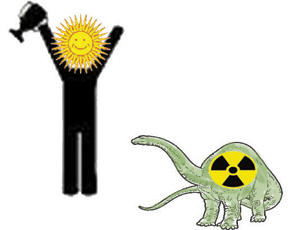
 nuClear News No 82 Feb 16 Towards 100% Renewables As Shadow Secretary of State for Energy and Climate Change, Lisa Nandy, re-iterates the myth that nuclear power is an “important as part of the energy mix [if] we’re going to meet the commitments we made in Paris” we investigate how the UK could move to a 100% renewable energy system. Although Nandy says she is not happy with the Hinkley deal she says “we know we will need nuclear power as part of the mix”, but is she right? (1)
The argument seems to be that renewables are fine up to a point, but they can’t provide baseload power and so we can never move to a system based on 100% renewables – this couldn’t reliably power a modern industrial society. Since we need to phase out the use of fossil fuels to combat climate change we need nuclear power to provide some baseload.
The reality is that baseload power as a concept is obsolete. And a system powered 100% by renewables supported by a backbone of electricity storage, smart grid technology and management, energy efficiency, and 21st century technology is feasible now. In fact, not only is it feasible, but strong market and social forces mean that such a system is increasingly the only kind of system that makes any sense. As Rainier Baake, Germany’s minister in charge of the Energiewende, points out, solar and wind have already won the technology race. (2)
100% is Possible Mark Jacobson of Stanford University and Mark Delucchi of the University of California have spelled out how 139 countries can each generate all their energy needs from renewables by 2050. The 139 national blueprints they have produced include the UK. (3)
Former Labour MP, Alan Simpson says anyone even glancing towards tomorrow knows that its energy systems will be smarter, quicker, lighter, more adaptive and more interactive than anything we have today. That means that energy systems will not be designed around big centralised power stations. They may not revolve around power stations at all. The energy we don’t use (and the energy we store) will become at least as important as the energy we consume. Energy security will be found, and financed, in a myriad of different ways. The Government’s plans for 19GW of new nuclear power stations will saddle Britain with an energy investment programme at a cost that will sink the country rather than save it. (4)
When renewables become the dominant source of power, baseload power stations get in the way because they have to operate as close to full-time as possible and cannot power up or down quickly. These old-fashioned plants are not merely a problem, they become an obstruction. Instead, it is necessary to have power sources whose power can be adjusted up and down quickly.
In NuClear News No.73, April 2015 (5) we discussed Intermittency, baseload, energy security and 100% renewables. We argued that what a renewable system needs is not baseload but flexible back-up which can be turned on and off quickly to provide electricity at peak times when renewables are not producing much. There are at least five ways this can be done:
1. By using the right mix of renewables intermittency can be reduced;
2. By increasing grid connections to other countries so that electricity can be imported at peak times when indigenous renewable production is low, and so that surpluses can be exported;
3. By storing surplus renewable electricity which can be called upon when wind and solar production is low;
4. Demand management – using various techniques to reduce demand at peak times;
5. By calling on combined heat and power stations working in conjunction with heat storage to generate electricity at peak times. ………
What happens when the sun doesn’t shine? Asked what happens when the sun doesn’t shine, Professor Keith Barnham, author of The Burning Answer, says “the short answer is that the wind is usually blowing”. PV power and wind tend to be complementary. But the fact that these two renewable sources of power are intermittent it doesn’t necessarily mean that a 100% renewable energy system would need lots of back-up batteries. A large-scale experiment, called Kombikraftwerk, started in Germany on 1st January 2006. This is a computer model which uses actual real time power output from a number of wind, PV and biogas electricity generators. The experiment worked – electrical power demand matched the electricity power supply throughout the year. The model showed that the actual output of wind and biogas generators was able to cope with the 7pm winter evening peaks. (9) The biogas electricity generators are crucial here – they are able to increase and decrease output in minutes to match increases in demand or a drop in the amount of electricity generated by wind. The contribution from PV is different with peaks every day within an hour or so of noon. This is around the time of peak daytime electricity demand in the UK and Germany anyway. ……
Storage Advances The Renewable Energy Association says 2016 is going to be the breakthrough year for energy storage and the growth of decentralised energy in the UK. Despite a total of 13 ‘sudden and severe’ changes to the Government’s green energy policies since the 2015 general election – which have created significant uncertainty in the UK renewables industry – a new independent report by KPMG for the REA says that ‘we could enter an era of continued green growth and domestic decentralised energy production’. The report Development of decentralised energy and storage systems in the UK – details that energy storage is a valuable and previously missing component in the movement towards a decentralised, consumer focused and low carbon energy system. (11) Substantial reductions in the cost of storage technologies have brought forward the anticipated timeframe for their deployment, the report points out. It finds that grid-scale projects, such as those recently announced by RES or completed by AES are already economic, but facing significant regulatory issues, including short contract lengths for balancing services and ‘discriminatory’ charges’ for grid connection. These could be relatively easily solved by more effective Government regulation, the report says. The research also found that energy storage can already be economic for domestic homes with solar PV panels installed and Feed-in Tarriff subsidies. (12)
Renewables too expensive? Another concern seems to be that renewables are too expensive. But solar PV electricity has already achieved grid parity in Italy and Germany. According to researchers at Oxford University, solar power costs are tumbling so fast the technology is likely to fast outstrip mainstream energy forecasts. (13)
February 10, 2016 -
Posted by Christina Macpherson |
Uncategorized
No comments yet.
 nuClear News No 82 Feb 16 Towards 100% Renewables As Shadow Secretary of State for Energy and Climate Change, Lisa Nandy, re-iterates the myth that nuclear power is an “important as part of the energy mix [if] we’re going to meet the commitments we made in Paris” we investigate how the UK could move to a 100% renewable energy system. Although Nandy says she is not happy with the Hinkley deal she says “we know we will need nuclear power as part of the mix”, but is she right? (1)


 Antinuclear
Leave a comment