News This Week: South Australia Nuclear Waste Plan, and Big Corporations go for Renewable Energy
 On Monday February 15, the South Australian Nuclear Fuel Chain (sorry “Cycle’) Royal Commission will announce its “tentative findings” . They’re most likely to concentrate on importing nuclear wastes. The pretense may be kept up, that this is only a South Australian matter. But it’s possible that the Australian media will notice it, and no doubt commend it, too?
In this week’s news I single out two significant themes – 1. the analysis of Senator Sean Edwards’ plan for importing nuclear wastes, and 2. the fact that big corporations are investing in renewable energy. Now, isn’t Australia’s Liberal Coalition government supposed to be on the side of business? Are they aware that Telstra and AGL Energy are not, in fact, tree-hugging hippies out to destroy Australia’s economy?
1.
- Australia Institute Analyses Senator Sean Edwards’ Nuclear Plan For South Australia.
- Sean Edwards proposal for nuclear pot of gold – a myth, says South Australia’s Conservation Council.
- Even Adelaide newspaper aware of unrealism of Sen Edwards nuclear fantasy.
- Here’s how the Australia Institute demolishes the argument for importing nuclear waste, and for new nuclear (PRISM) technology.
- Environmental Defenders Office (SA) outlines critical issues in proposal for nuclear waste facility.
- Traditional Owners vow to fight nuclear proposals ahead of the Royal Commission’s draft report
- Greens ready for #NuclearCommissionSAust report “all about waste dumping”
South Australia – decision on nuclear expansion at end of 2016.
Federal:
Hunt for site to dump LucasHeights radioactive trash. Friends of Omanama: A local community’s perspective on national nuclear waste storage. Senator Scott Ludlam backs 6 Australian communities opposing nuclear waste dump. Strong opposition to Hill End nuclear waste plan- petition
A big mistake to gut CSIRO climate change research.
They meant Environment Minister Greg Hunt won World’s Best Milliner (not Minister).
Renewable Energy & Energy Efficiency In bushfire season, Solar microgrids and batteries are safer than conventional grid.South Australia Riverland farmers get new crop – harvesting the sun. Clean Energy Finance Corporation funds Energy-efficient housing.
Inescapable conclusion – nuclear waste dump plan for South Australia is areal dud

 The impossible dream Free electricity sounds too good to be true. It is. A plan to produce free electricity for South Australia by embracing nuclear waste sounds like a wonderful idea. But it won’t work. The Australia Institute Briefing paper Dan Gilchrist February 2016
 Australia Institute Analyses Senator Sean Edwards’ Nuclear Plan For South Australia
The impossible dream Free electricity sounds too good to be true. It is. A plan to produce free electricity for South Australia by embracing nuclear waste sounds like a wonderful idea. But it won’t work. The Australia Institute Briefing paper Dan Gilchrist February 2016
Even if the countries of origin chose not to implement the miraculous technology proposed for South Australia, other countries could compete with Australia to provide this service. A plan predicated on monopoly profits of over 400 percent is, therefore, unrealistic.
Greens ready for #NuclearCommissionSAust report “all about waste dumping”
 “It’s all about the dump”: Greens gear up for nuclear war, IN Daily, 12 Feb 16 The South Australian Greens are preparing for a sustained public relations assault from next week, in the assumption that the Royal Commission into the state’s nuclear fuel cycle will recommend the viability of a nuclear waste dump. The commission, headed by former Governor Kevin Scarce, will detail its “tentative findings” on Monday morning, preceding another round on consultation.
Greens MLC Mark Parnell told InDaily the party had prepared a variety of options for leaflets and online material, with staff “putting out a call to Greens members for volunteers to hand out flyers”.
“What we’re doing is trying to anticipate what the Royal Commission might come up with, so there will be no surprises that the waste dump is front and foremost in our thinking,” Parnell said.
“That’s on the basis that nuclear power is incredibly expensive and slow [so] they might recommend it but I always thought that was less likely. The processing and value-adding stuff – my understanding is economically it doesn’t stack up [and] of all the different things they’re looking at, it keeps coming back to the dump.”
He said insiders he had spoken to insist “it’s all about the dump”.
“That’s the impression that we’ve had since about a week after the Royal Commission was announced, once the terms of reference were announced… but we’re preparing for a few different scenarios so we can respond on Monday,” he said.
“We have several different versions ready to go.”
He said his party’s position on nuclear waste storage “hasn’t really changed over the past many years”, and suggested Labor should maintain the position it took in 2004, when it went to the High Court to kill off a federal proposal to establish a repository at Woomera. Continue reading
Friends of Omanama: A local community’s perspective on national nuclear waste storage
https://www.facebook.com/Friends.of.Omanama/ Public Meeting: Friday 12th February 6:30pm McIntyre Sports Centre Chilcott Street, Inglewood
Presenters include:
Dr. Colin Owen – a local GP
Local speakers on the social, psychological, environmental impacts…
Video on nuclear medical waste & ANSTO’s safety record (Dr. Peter Karamoskos, MAPW)
Members of the Inglewood/Omanama community have voiced their overwhelming support for a chance to hear the ‘Other Side of the Story’ when ‘Friends of Omanama’ host an open function in the MacIntyre Sports Centre Inglewood tonight.
The function is designed to give a balanced presentation of facts about the Regional and National consequences if Omanama (21 kms east of Inglewood) is chosen as the site for Australia’s National Nuclear Waste Management Facility.
In November 2015 Omanama was announced as one of six sites short listed to accommodate the facility. Since then, the community has been bombarded with Government press releases, Radio and TV interviews and Government-convened public meetings, consultations and meetings with individual local organisations. As a result many locals have said they feel confused, intimidated and anxious about the future. They have said they need to know more about the other side of the story.
‘Friends of Omanama’ Co-0rdinator Dr Colin Owen said the function was designed to inform the community about the Nuclear waste Dilemma and for everyone to hear a Community perspective on concerns, as opposed to the Government agenda.
Regardless of their views on the subject every member of the community is welcome to attend the function. The evening will conclude with a free sausage sizzle.
Traditional Owners vow to fight nuclear proposals ahead of the Royal Commission’s draft report
Ahead of Monday’s release of the draft report of the Nuclear Fuel Cycle Royal Commission, SA Traditional Owners are once again voicing strong opposition to proposals for expanded uranium mining and proposals for nuclear waste dumps and other nuclear projects.
Sue Coleman-Haseldine, co-chair of the Aboriginal-led Australian Nuclear Free Alliance, is a Kokatha-Mula woman from Ceduna and winner of the 2007 Premier’s Award for excellence for indigenous leadership in natural resource management. Ms Coleman-Haseldine said: “I was born on Koonibba Aboriginal Mission in 1951. Atomic bomb tests began in the desert areas north of my birthplace in 1953 when I was two years old. First at Emu Fields and then Maralinga. I grew up under the Maralinga nuclear cloud. Do I want to see my state known worldwide as a nuclear waste dump? No. Do I have the right to subject our future generations to a life of nuclear fear? No. Accidents happen, be it at a uranium mine or on a nuclear freeway or at a nuclear reactor or a dump site.”
Kevin Buzzacott, Arabunna elder and President of the Australian Nuclear Free Alliance said: “We will fight this industry across the country, whether it be the expansion of uranium mining or a nuclear waste dump. It is our cultural obligation and responsibility to care for our land. It’s time the government and nuclear industry acknowledge and listen to us. There are and have been so many sick people as a result of this industry. Why has there not been a Royal Commission into the intergenerational health impacts of this industry? How will this Royal Commission measure the risks and impacts on culture and country? You cannot put a number on these things.”
Copied below is a statement from SA Traditional Owners.
 South Australian Traditional Owners say NO!
Statement from a community meeting held in Port Augusta on Saturday 16 May, 2015 to discuss the Royal Commission into the Nuclear Fuel Cycle.
We oppose plans for uranium mining, nuclear reactors and nuclear waste dumps on our land.
We call on the SA Royal Commission to recommend against any uranium mining and nuclear projects on our lands.
We call on the Australian population to support us in our campaign to prevent dirty and dangerous nuclear projects being imposed on our lands and our lives and future generations.
Endorsed by members from the following groups, Kokatha, Kokatha-Mirning, Arabunna, Adnyamathanha, Yankunytjatjara-Pitjanjatjara, Antikirinya-Yunkunytjatjara, Kuyani, Aranda, Western Aranda, Dieri, Larrakia, Wiradjuri
Senator Scott Ludlam backs 6 Australian communities opposing nuclear waste dump
 Greens senator wants towns off shortlist for waste dump site A Greens senator has backed six Australian communities campaigning to stop a nuclear waste dump being established in their areas. The Weekly, Mudgee, NSW, 10 Feb
- Acknowledge the opposition and lack of community support at all six sites, respect previous commitments on non-imposition and the importance of community consent, and remove all six sites from further consideration.
- Initiate a genuinely independent inquiry to investigate long-term stewardship options for spent fuel, reprocessing waste, and other categories of radioactive waste, including drawing on international examples and experience.
- Investigate options for active waste minimisation, including increased use of non-reactor based methods for radioisotope production.
- Clearly reaffirm policy and legislative prohibitions on the importation and disposal of international radioactive waste.
Strong opposition to Hill End nuclear waste plan- petition
 Petition calls to halt Hill End waste plans By ELLE WATSON , The Weekly, Mudgee, NSW, 10 Feb 16 Campaigners against a proposed nuclear waste dump at Hill End have taken to the streets of Mudgee to gather support for a petition to be presented to parliament later this month.
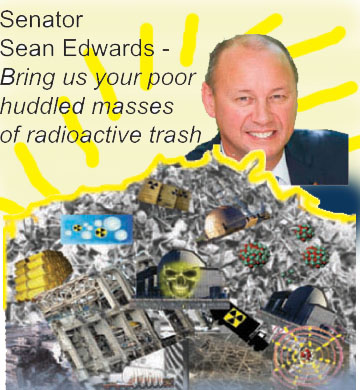
Senator Edwards’ fantasy of free nuclear electricity for South Australia
Free nuclear power is a fantasy: Report http://www.tai.org.au/content/free-nuclear-power-fantasy-report# A new report from The Australia Institute shows that a proposal to establish a global nuclear waste industry in South Australia would fail to secure 90% of the imported waste, leaving an expensive and risky legacy for the state.
The report was commissioned by the Conservation Council of South Australia to analyse the submission to the South Australian Nuclear Fuel Cycle Royal Commission by Liberal Senator Sean Edwards. The Royal Commission is due to release tentative results next week.
“The Edwards plan is deeply flawed. It is a plan funded by taking thousands of tonnes of nuclear waste, but would fail to process over 90% of that waste, leaving it to future generations to deal with,” said report author, The Australia Institute’s Dan Gilchrist.
Senator Edwards is proposing that South Australia imports 60,000 tonnes of spent nuclear fuel from other countries, and then leaves most of it, 56,000 tonnes, in dry cask storage which is designed for temporary use.
Report: The impossible dream: Free electricity sounds too good to be true. It is.
“The plan relies on technology that has never been deployed commercially – not with all the expertise in France or Germany or Japan or the United States.
“Indeed, logically, if a viable solution emerges, other countries will no longer pay Australia billions to hand over the waste.
“The plan fails to consider a basic economic principle: if Australia can generate free electricity – why wouldn’t other countries?
“Nothing in the plan explains what our great-great grandchildren are meant to do with this legacy. Indeed, the plan never mentions the leftover waste, as if it was not worth worrying about. Worse, all the money is spent in the first 50-60 years. Nothing is left to deal with the leftover waste.
“In many ways it is like a vastly complex loan. Australia will ‘borrow’ many billions of dollars, spend the lot, and leave it to future generations to pay it back. Indeed, a loan would be better, since it would not require South Australia to store tens of thousands of tonnes of radioactive material in the meantime.
“It is no wonder that Senator Edwards has been able to promise free electricity and reduced taxes. He is spending someone else’s money. Eventually, however, the piper must be paid.”
1 This month
Chernobyl: The Lost Tapes – A good documentary on Chernobyl on SBS available On Demand for the next 3 weeks– https://www.sbs.com.au/ondemand/tv-program/chernobyl-the-lost-tapes/2352741955560
15 April – Zoom –Nuclear Power is Not the Solution
Apr 15, 2026 01:00 AM in Canberra, Melbourne, Sydney

Join the International Physicians for the Prevention of Nuclear War (IPPNW) on Tuesday, April 14th for a timely webinar exploring the risks associated with nuclear power and challenging the myth that it offers a simple, safe, carbon-free solution to the climate crisis

21 April Webinar: No Nuclear Weapons in Australia
Start: 2026-04-21 18:00:00 UTC Canberra, Melbourne, Sydney (GMT+10:00)
End: 2026-04-21 19:30:00 UTC Canberra, Melbourne, Sydney (GMT+10:00)
Event Type: Virtual
A virtual link will be communicated before the event.
Host Contact Info: australia@icanw.org

of the week – Australians for War Powers Reform (AWPR)
To see nuclear-related stories in greater depth and intensity
 Antinuclear