Dr Dennis Matthews Critiques the Nuclear Royal Commission’s Findings
Nuclear Fuel Cycle Royal Commission Tentative Findings – A Critique Dr Dennis Matthews (BSc Hon, PhD) 18 Feb 16 In supporting uranium mining the Commissioner states that post-decommissioning impacts are addressed by a regulator holding a financial security or bond but then admits that the state’s largest uranium mining project, Olympic Dam, is exempt from this requirement.
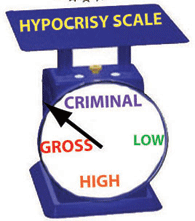 The commissioner states “Without nuclear power generation, a used fuel reprocessing facility would not be needed in South Australia, nor would it be commercially viable.” He then goes on to say that it is therefore unnecessary to address the environmental and health risks of reprocessing. However, when it comes to discussing nuclear power for SA he says “It would be wise to plan now to ensure that nuclear power would be available should it be required”. The basis for not considering the environmental and health risks of reprocessing is therefore invalid.
In discussing the major nuclear power accidents at Three Mile Island, Chernobyl, and Fukushima the  commissioner disregards deaths that occur years after exposure to ionising radiation. The probability of such deaths may be calculated using the same data that is used in calculating allowable exposures to ionising radiation, which he accepts as justified on the basis of the precautionary principle. Like the nuclear industry in general, the Commissioner considers only deaths from high doses of ionising radiation, for which cause and effect are inescapable. Even in this case he neglects to include the deaths of those who were involved in removing highly radioactive debris from the reactor building. Slavish adherence to pro-nuclear propaganda suggests that the commissioner was far from objective.
Given the economic, environmental and health consequences of Three Mile Island, Chernobyl, and Fukushima it is hard to understand the commissioner’s conclusion that “The risk of nuclear accident should not of itself preclude consideration of nuclear power as a future electricity generation option”. 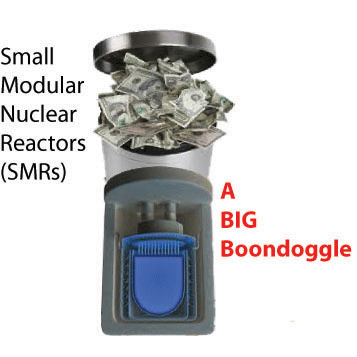 This callous disregard for the facts is frequently encountered in the arguments of pro-nuclear advocates.
The Commissioner favours consideration of small modular nuclear reactors for SA.
Despite recent decreases in peak demand and the shift of peak demand to later in the day, the Commissioner claims that solar PV has had little effect on peak demand requirements.
The Commissioner claims “there is value in having nuclear as an option that can be readily implemented”.
In relation to nuclear waste importing, storage and disposal the Commissioner states that it would be necessary to develop an associated scientific research group focused on processes for nuclear waste “management, storage and disposal and on possible future use”. The latter presumably refers to reprocessing of used (or spent) fuel into new fuel.
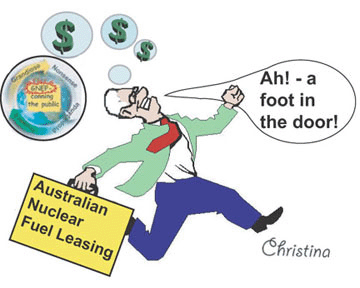 The reprocessing option is clearly spelt out in the section on fuel leasing.
“Fuel leasing based on an operating storage and disposal facility might resolve some of the significant economic barriers to new entrants seeking to provide global conversion, enrichment and fabrication services.”
“The decision to progress any uranium processing aspect of fuel leasing would predominantly be a commercial one.”
“A staged process to the development of any fuel leasing program would seem to have the
best prospects for success. Such a staged approach might involve: initially:
 a focus on storage and disposal of waste
second, the sale of uranium, with agreement to dispose of used fuel, to utilities  that have existing commercial arrangements for conversion, enrichment and fuel
  fabrication services
finally, the development of international partnerships to establish South Australian facilities undertaking 
 conversion, enrichment and fabrication, including
the participation of those using these services.”
Despite significant public and community opposition to uranium mining at Roxby Downs , Honeymoon and Beverley, for which neither public nor community consent was sought or obtained, the Commissioner claims “An  expansion of uranium mining would involve the continuation of a lawful activity” and that “No additional measures to further regulate community consent or community engagement with respect to new uranium mining projects appear required”.
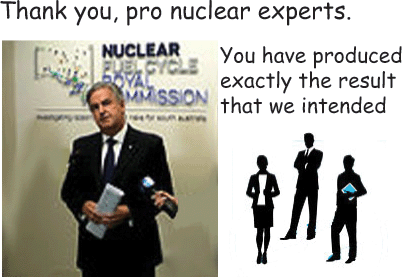
The Commissioner states “any progress towards an activity is based on a principle of negotiation in good faith on equal terms”. Given the heavily biased terms of reference of the Commission, the choice of pro-nuclear sympathiser as its chair, and the choice of committee stacked in favour of the nuclear industry then the commission failed the Commissioners own rules of community engagement.
The Commissioner states “There are existing regulatory mechanisms for the protection and preservation of heritage” but then goes on to point out, without any criticism or recommendations for remedial measures, that the largest uranium mining project in SA (the Olympic Dam Project) is excluded from these mechanisms.
The Commissioner correctly states, that in determining ionising radiation exposure, a precautionary approach is appropriate. His constant comparison of ionising radiation exposure due to uranium mining with that from background levels of ionising radiation is at odds with the precautionary principle. There is no evidence that exposure to background ionising radiation is safe. The implied suggestion that exposure to other sources of ionising is OK if it is comparable to that from background ionising radiation is misleading.
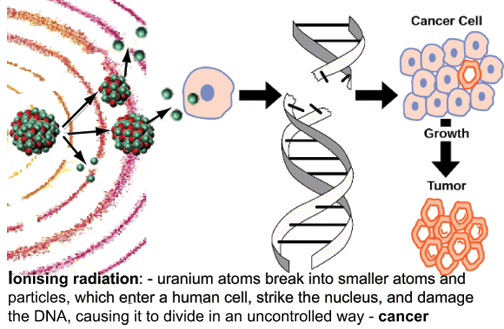
The Commissioner’s focus on acute radiation syndrome (ARS) due to relatively high levels of exposure to ionising radiation ignores the accepted scientific position that all levels of exposure are harmful, and it discards the precautionary principle which he claims to support. Just because, in cases of exposure that does not cause ARS, there is no known way of linking cause and effect does not mean that there is no effect. The scientific position is that the effect is proportional to the dose at all levels of exposure. The fact that the effects are not immediately obvious or (like asbestos and smoking) are manifest years after the exposure is no basis for ignoring them.
The fact that it is difficult to manufacture nuclear weapons from various sources of uranium and plutonium is no reason to discount the possibility as demonstrated by India’s use of Canadian low grade uranium to make a nuclear weapon.
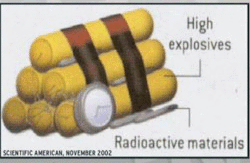 There is no mention of the use of nuclear waste to make a conventional, non-nuclear, but highly radioactive, “dirty bomb”. Given the Commissioner’s support for importing thousands of tonnes of high level nuclear waste and the global expansion of radical, fanatical terrorist activities, this is a serious oversight.
On the issue of insurance for nuclear activities the Commissioner makes the telling remark that insurance in Australia is not  sufficient to cover the risks involved in an expanded nuclear industry and that “the state and federal governments would become insurers of last resort”. This, in effect, would be a large tax-payer funded subsidy to the nuclear industry. The Commissioner made no recommendation about changing this situation.
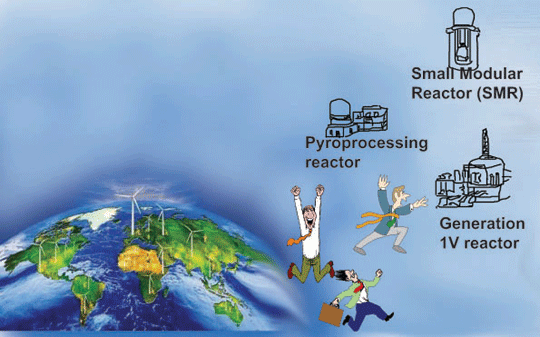 The Commissioner notes that “building up a sufficient level of local engineering expertise requires time, commitment and advanced planning”. Such a level of nuclear engineering expertise would open the door to a wide variety of nuclear projects including, as we saw with the aborted 1969 Jervis Bay project in NSW, nuclear weapons production.
Import of nuclear waste a burden on future generations
 Why would the world accept Australia’s offer to store nuclear waste? http://theconversation.com/why-would-the-world-accept-australias-offer-to-store-nuclear-waste-54742 Mark Diesendorf While acknowledging that nuclear electricity is not commercially viable in South Australia, the Royal Commission’s tentative findings give strong support to the extraordinary notion that the state should attempt to profit by storing high-level nuclear waste from countries that do have nuclear power.
The scheme envisages a combination of above-ground temporary storage in dry casks, together with storage in a permanent underground repository. In practice, almost all the imported waste would be stored initially in dry casks for several decades before being transferred to the proposed underground storage area, where they would have to be managed for hundreds of thousands of years.
I will examine each of the two storage systems separately.
Temporary above-ground storage
Hundreds of thousands of tonnes of high-level waste from nuclear power stations, both spent fuel rods and reprocessed waste, are in temporary storage around the world. They are “hot” in both temperature and radioactivity. Some are sitting in steel-lined concrete pools near reactors, while others are stored in so-called “dry casks”.
The idea that Australia could obtain a significant amount of this overseas waste for temporary storage in dry casks seems to be based on the dubious assumption that it would be cheaper for overseas countries to pay for shipping their dry casks to Australia for storage than to continue to store them where they are.
But it follows that if Australia could somehow offer an attractive price, then so could other countries with more experience in handling nuclear waste, as pointed out by the Australia Institute. The Royal Commission’s new findings do not reveal the cost of dry cask storage.
Permanent underground storage
The Royal Commission assumes that the “conservative baseline price” that could be received for permanent underground storage is A$1.75 million per tonne of heavy metal, including the operational cost. It is unclear whether this includes storage in dry casks for several decades. The report does not reveal the corresponding cost per tonne, although its bottom-line figures predict an extraordinary 77% undiscounted profit over the lifetime of the project.
These claimed huge profits are based on a long report by Jacobs & MCM, released just a week ago and which few people will have digested in full so far. Hardly any of the assumptions of this new report are mentioned by the Royal Commission’s tentative findings. In reality it is still unclear how much the proposed facility would cost to run, or what kind of return on investment it might create.
It is a heroic fantasy to imagine that Australia would finance and build a permanent underground nuclear waste repository when the United States, an established nuclear nation, has so far failed, and similar facilities in Sweden and Finland are still under construction. The United States spent US$13.5 billion on preparing its proposed site at Yucca Mountain, Nevada. Its estimated total cost rose to US$96 billion (in 1998 prices) before the project was scrapped by President Obama.
The Royal Commission discusses the alleged economic benefits of underground storage, while failing to acknowledge the economic risks of Australia paying huge capital and operating costs to manage high-level waste for hundreds of thousands of years by means of unproven technologies and short-lived social institutions.
Although storing waste temporarily in dry casks is technically relatively easy, building the permanent underground repository would be very expensive. Therefore, if this scheme were commenced by storing dry casks, it’s possible that the underground repository, which would not be needed for decades, would never be built.
Then South Australia (and Australian taxpayers) could be stuck with managing a huge number of dry casks far beyond their lifetimes. As the casks began to decay and release their contents, the financial burden on future generations, and the environmental and health risks, would be substantial.
Aboriginal Elders accuse authorities of paying lip service only to traditional owners objection to nuclear waste dumping
Aboriginal elders on Tuesday accused authorities of paying lip service to traditional owners’ fears that waste could be dumped in the outback.
 Australian Nuclear Free Alliance co-chair and Kokatha-Mula woman Sue Coleman-Haseldine says the proposal threatens her people’s spiritual health.
“We can’t survive in this world without our culture and the land is the main part of that. We’ve got sacred sites, we’ve got Dreamtime stories out there,” she told AAP on Tuesday.
“We don’t seem to be able to get this through the government’s heads, the people’s heads. All they see is the dollar signs.” 9 News Feb 16
South Australian Royal Commission a “Trojan Horse” for radioactive waste dump push
The move surprised many at the time both because SA is a national leader in renewable energy production and also because uranium prices and production had plummeted following the Australian uranium-fuelled Fukushima crisis.
But while the commission might have been a surprise, its interim findings – released this week in Adelaide – were not.
The commission, headed by former state governor Kevin Scarce, was tasked with examining development options over four broad areas: uranium mining, expanded uranium processing, domestic nuclear power and the storage and management of high-level radioactive waste.
From the start critics of the commission’s pro-industry terms of reference argued that the process was a Trojan horse for a renewed push for international radioactive waste disposal in Australia. This view has been vindicated this week. Continue reading
Civil liberties under threat in Western Australia. UN urges WA govt to withdraw anti protest Bill

 UN urges WA Government not to bring in anti-protest laws, ABC News, By Briana Shepherd, 16 Feb 16 The United Nations has called on the West Australian Government to withdraw controversial new legislation that imposes harsh penalties on protesters.
The proposed laws were first introduced into Parliament in March 2015, and the Government insists it will only target radical protesters using devices like chains or thumb locks to block or stop lawful activities.
But the UN said it would “result in criminalising lawful protests and silencing environmentalists and human rights defenders”.
“If the bill passes, it would go against Australia’s international obligations under international human rights law, including the rights to freedom of opinion and expression as well as peaceful assembly and association,” the UN Human Rights Office said in a statement.
“The bill would criminalise a wide range of legitimate conduct by creating criminal offences for the acts of physically preventing a lawful activity and possessing an object for the purpose of preventing a lawful activity.
If the offence was committed in circumstances of aggravation, the penalty could be as high as imprisonment for two years and a fine of $24,000. Continue reading
Bill Shorten showing his true pro nuclear colours?
 Bill Shorten flags shift on nuclear waste storage, THE AUSTRALIAN, Michael Owen, Jared Owens, 16 Feb 16 “……..In a big shift from his position a year ago, when he refused to back South Australia’s nuclear royal commission, the Opposition Leader yesterday signalled the possibility of bipartisan support for the inquiry’s proposal that South Australia store some of the world’s high-level nuclear waste.
The radical plan could not proceed without bipartisan support to change commonwealth laws, with federal Labor viewed as the major roadblock.
Visiting a school in Adelaide yesterday, Mr Shorten said federal Labor supported safe storage of low-level domestic nuclear waste and could be persuaded under the right conditions to consider “getting into the international business of storing other people’s nuclear waste”…….
His remarks dismayed some in the ALP, with the party platform “strongly opposed” to storing of imported nuclear waste.
Melissa Parke, the federal MP for Fremantle, said Labor members were “very passionate” about the platform. “Therefore federal Labor’s response to any proposal to store international high-level nuclear waste must be a resounding ‘no’,” she said.
A year ago, Mr Shorten refused to back South Australian Premier Jay Weatherill’s establishment of a royal commission to examine whether the state should increase nuclear fuel cycle activities.
In 2013, he quashed a call by Labor MPs for the party to reopen debate about support for a nuclear industry. Another move last year to change the policy was put on hold until the commission delivered its final report to the Weatherill government. This is due on May 6. http://www.theaustralian.com.au/national-affairs/bill-shorten-flags-shift-on-nuclear-waste-storage/news-story/ef1280d83926b7c7d10692d5910e15a6
Omigawd! A Senior Labor politician who is Not A Fan of Nuclear!
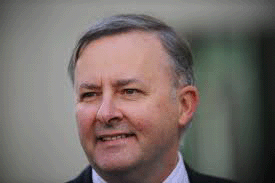 Albanese ‘cautious’ on SA nuclear proposal 9 News 17 Feb 16 Senior Labor figure Anthony Albanese says he is “very cautious” about a proposed high-level nuclear waste dump in South Australia’s outback.
This comes after opposition leader Bill Shorten indicated he was open to a royal commission recommendation that SA earn billions of dollars and create thousands of jobs by storing and disposing nuclear waste.
But Labor’s infrastructure spokesman Mr Albanese appears more wary of the proposal, telling 5AA radio “I would be very cautious about it”.
Mr Albanese also said he was “not a fan” of the nuclear fuel cycle and said renewable energies were more economically viable……… http://www.9news.com.au/national/2016/02/17/10/25/albanese-cautious-on-sa-nuclear-proposal#JtxocOdo0XoCmzd1.99
The Nuclear Commission findings do not bode well for Australia’s renewable energy development
The repeal of the carbon price and the stalling of renewable energy development has put Australia on a path to increase emissions to record levels and will likely not reach a peak before 2030.
The nuclear industry is essentially counting on failure on these tasks, and then having some sort of Marshall plan to allow for the extra expense of nuclear generation.
 Nuclear commission findings spell more trouble for wind and solar in Australia REneweconomy, By Giles Parkinson on 15 February 2016 The South Australian Royal Commission into the nuclear fuel cycle has conceded that nuclear power is not a viable alternative for Australia, but has urged authorities to consider it anyway – in what could have serious implications for the roll out of renewable energy across the country.
The commission delivered the results of its “tentative” findings on Monday, indicating that it supports the establishment of a nuclear waste facility in the state, the storing of spent nuclear fuel and the expansion of uranium mining.
On the subject of nuclear generation, the commission admitted that it wasn’t viable in South Australia in the foreseeable future (2030) – even with a significant carbon price and a sharp reduction in the cost of capital.
It conceded that Australia should only adopt “proven” new nuclear technologies such as “small modular reactors” and next generation “fast reactors” , but that these were some way off, and likely to be very costly.
 But commission chairman Kevin Scarce wants the nuclear generation dream to continue. He admitted that while there were real risks in nuclear generation – and there are “no guarantees on its safety” – he doesn’t “think the positive side of nuclear power is being presented.” Continue reading
ANSTO directs its nuclear propaganda to Hale in Central Australia
 Nuclear waste dump: ANSTO testing mood for repository at Hale in Central Australia, ABC News, 16 Feb 16 By Rick Hind Nuclear technicians are holding briefings in and around Alice Springs to gauge the level of public support for a nuclear waste dump at Hale, located 75 kilometres south of the town.
Representatives from the Australian Nuclear Science and Technology Organisation (ANSTO) and the Federal Department of Industry, Innovation and Science will hold private briefings and public forums over two days in Alice Springs, and at Titjikala, the closest Indigenous community to the 120-hectare Aridgold date farm, which has been nominated to become home to a dump.
Ahead of the sessions Federal Energy and Resources Minister Josh Frydenberg said phone polling was being used in communities near all six shortlisted sites around the country, including three in South Australia and one each in NSW, QLD and the NT.
“In all six sites there will be that sort of phone polling,” he told 783 ABC Alice Springs…….
The largest public meeting will be held in Alice Springs at 6:00pm on Tuesday.
Consultations are expected to wind up on March 11. http://www.abc.net.au/news/2016-02-15/ansto-testing-mood-for-nuclear-waste-dump-in-central-australia/7169180
Time Australian governments stopped pretending that Adani and coal are viable
You have to hand it to Adani Australia chief executive Jeyakumar Janakaraj. Despite years-long delays on Adani’s Queensland Carmichael coal mine – a project mired in court challenges and no realistic prospect of obtaining the financing it needs to proceed – Mr Janakaraj retains a cheerful disposition. Last week he said Adani was “absolutely committed” to proceeding with the mine. The show of optimism is designed to obscure the fact that his company’s coal mine project looks increasingly likely to fail.
The Carmichael mine and associated coal port at Abbot Point have been the target of sustained opposition from a wide range of community organisations, both in Australia and overseas, because of the catastrophic impact they would have on the Great Barrier Reef. UNESCO has kept the Reef on its world heritage watch list due to the threat that projects like Adani’s pose to its health. In August 2015, a Federal Court challenge forced Environment Minister Greg Hunt to overturn the approval for the mine. Two more legal challenges against the Carmichael project remain, and the project is yet to obtain mining leases from the government. The project itself is effectively stalled, with the Adani contractors who were sent home in 2015 still not back on the job.
Yet even if all of these obstacles were removed, the mine’s financials simply don’t stack up. Continue reading
Kind of incestuous: pro Nuclear Commission quotes its own pro nuclear Commissioner
Despite what nuclear boosters tell us about wind and solar, numerous reports, including by the Australian Energy Market Operator, the French government, and various think tanks, say 100% renewable energy based largely around wind and solar is perfectly feasible, and will likely even reduce costs.
 Nuclear commission findings spell more trouble for wind and solar in Australia REneweconomy, By Giles Parkinson on 15 February 2016 “………The Royal Commission has chosen to run with some of those myths, which is disappointing, but not surprising given that one of the biggest proponents is a web-site operated by one of the commissioners, Professor Barry Brook. A paper co-authored by Brook is repeatedly cited in the commission’s report and by pro-nuclear submissions to the commission.
Among these myths, promoted by Scarce on Monday, is the need for more peaking gas and imports in South Australia because of the growth in wind and solar. Actually, as has been pointed out repeatedly,South Australia now uses less peaking gas and less imports from Victoria than before it produced a lot of wind and solar.
The document also says that solar PV has had a negligible impact on peak demand in South Australia. Actually, it has had a significant impact on peak demand, pushing the peak from late afternoon and into the evening and made it smaller, to the benefit of the network in heat waves.
The royal commission document also says battery storage applications are not yet commercial. Actually, they are, and Ergon Energy has already rolled out dozens of 100kWh, utility-scale battery storage arrays, saying it reduces grid upgrade costs by one-third – with no subsidy. Continue reading
New South Wales Riverina could become a solar energy hub
 Solar company sees potential for NSW Riverina to become renewable energy hub ABC Riverina, 16 Feb 16, A solar energy company believes the western New South Wales city of Griffith has the potential to market itself as a renewable energy hub. http://www.abc.net.au/news/2016-02-16/solar-company-envisages-nsw-riverina-energy-hub/7170684
Riverina Solar wants to build a $62 million, 30 megawatt solar farm at Yoogali near Griffith. The project has been shortlisted for funding from the Australian Renewable Energy Agency.
Director Steve McCall is hopeful a second solar farm project, also shortlisted for funding, will receive backing. He said it could be the start of a new industry for the region.
“We’ve been talking with Griffith council as well. We believe there’s a great opportunity for Griffith to become a renewable energy hub, or a region where you’ve got large scale solar here,” he said.
“That would hopefully potentially attract universities coming in and doing studies. “We’re also looking at other options, potentially in the future of how solar or how other renewable energies could be attracted to the area.”
Information sessions about the Riverina Solar proposal will be held at the Griffith Regional Theatre on Tuesday and Thursday.
Mr McCall said he would like to have the project’s environmental impact statement completed by the end of the month, and is hopeful the solar farm may be approved by mid-year.
“Griffith has an excellent substation based at Yoogali and it has just recently been upgraded over the last few years, so it has sufficient capacity to be able to connect into that site without a great deal of further upgrade,” he said. Mr McCall said the project would not be affected by the grants process. “We’ve got a number of different, interested offtakers and so once we establish that and finalise that aspect of it, that completes the commercial aspect of the project,” he said.
“While the funding would be terrific, and it’s only a small portion of the project, it doesn’t look like it would jeopardise our project going forward in any sense.”
1 This month

of the week – Australians for War Powers Reform (AWPR)
To see nuclear-related stories in greater depth and intensity
 Antinuclear