Dr Dennis Matthews Critiques the Nuclear Royal Commission’s Findings
Nuclear Fuel Cycle Royal Commission Tentative Findings – A Critique Dr Dennis Matthews (BSc Hon, PhD) 18 Feb 16 In supporting uranium mining the Commissioner states that post-decommissioning impacts are addressed by a regulator holding a financial security or bond but then admits that the state’s largest uranium mining project, Olympic Dam, is exempt from this requirement.
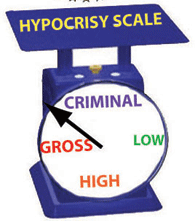 The commissioner states “Without nuclear power generation, a used fuel reprocessing facility would not be needed in South Australia, nor would it be commercially viable.” He then goes on to say that it is therefore unnecessary to address the environmental and health risks of reprocessing. However, when it comes to discussing nuclear power for SA he says “It would be wise to plan now to ensure that nuclear power would be available should it be required”. The basis for not considering the environmental and health risks of reprocessing is therefore invalid.
In discussing the major nuclear power accidents at Three Mile Island, Chernobyl, and Fukushima the  commissioner disregards deaths that occur years after exposure to ionising radiation. The probability of such deaths may be calculated using the same data that is used in calculating allowable exposures to ionising radiation, which he accepts as justified on the basis of the precautionary principle. Like the nuclear industry in general, the Commissioner considers only deaths from high doses of ionising radiation, for which cause and effect are inescapable. Even in this case he neglects to include the deaths of those who were involved in removing highly radioactive debris from the reactor building. Slavish adherence to pro-nuclear propaganda suggests that the commissioner was far from objective.
Given the economic, environmental and health consequences of Three Mile Island, Chernobyl, and Fukushima it is hard to understand the commissioner’s conclusion that “The risk of nuclear accident should not of itself preclude consideration of nuclear power as a future electricity generation option”. 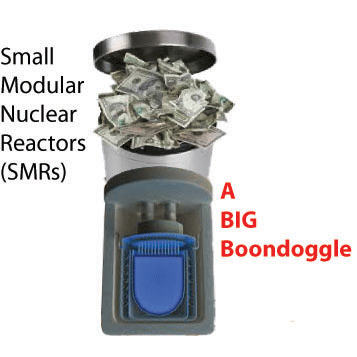 This callous disregard for the facts is frequently encountered in the arguments of pro-nuclear advocates.
The Commissioner favours consideration of small modular nuclear reactors for SA.
Despite recent decreases in peak demand and the shift of peak demand to later in the day, the Commissioner claims that solar PV has had little effect on peak demand requirements.
The Commissioner claims “there is value in having nuclear as an option that can be readily implemented”.
In relation to nuclear waste importing, storage and disposal the Commissioner states that it would be necessary to develop an associated scientific research group focused on processes for nuclear waste “management, storage and disposal and on possible future use”. The latter presumably refers to reprocessing of used (or spent) fuel into new fuel.
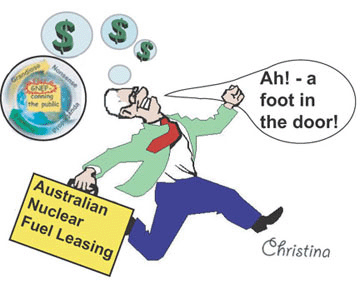 The reprocessing option is clearly spelt out in the section on fuel leasing.
“Fuel leasing based on an operating storage and disposal facility might resolve some of the significant economic barriers to new entrants seeking to provide global conversion, enrichment and fabrication services.”
“The decision to progress any uranium processing aspect of fuel leasing would predominantly be a commercial one.”
“A staged process to the development of any fuel leasing program would seem to have the
best prospects for success. Such a staged approach might involve: initially:
 a focus on storage and disposal of waste
second, the sale of uranium, with agreement to dispose of used fuel, to utilities  that have existing commercial arrangements for conversion, enrichment and fuel
  fabrication services
finally, the development of international partnerships to establish South Australian facilities undertaking 
 conversion, enrichment and fabrication, including
the participation of those using these services.”
Despite significant public and community opposition to uranium mining at Roxby Downs , Honeymoon and Beverley, for which neither public nor community consent was sought or obtained, the Commissioner claims “An  expansion of uranium mining would involve the continuation of a lawful activity” and that “No additional measures to further regulate community consent or community engagement with respect to new uranium mining projects appear required”.
The Commissioner states “any progress towards an activity is based on a principle of negotiation in good faith on equal terms”. Given the heavily biased terms of reference of the Commission, the choice of pro-nuclear sympathiser as its chair, and the choice of committee stacked in favour of the nuclear industry then the commission failed the Commissioners own rules of community engagement.
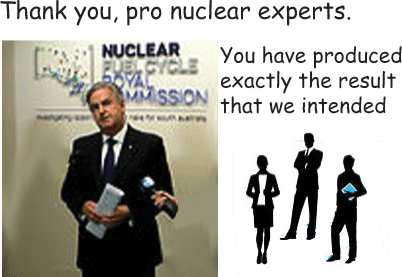
The Commissioner states “There are existing regulatory mechanisms for the protection and preservation of heritage” but then goes on to point out, without any criticism or recommendations for remedial measures, that the largest uranium mining project in SA (the Olympic Dam Project) is excluded from these mechanisms.
The Commissioner correctly states, that in determining ionising radiation exposure, a precautionary approach is appropriate. His constant comparison of ionising radiation exposure due to uranium mining with that from background levels of ionising radiation is at odds with the precautionary principle. There is no evidence that exposure to background ionising radiation is safe. The implied suggestion that exposure to other sources of ionising is OK if it is comparable to that from background ionising radiation is misleading.
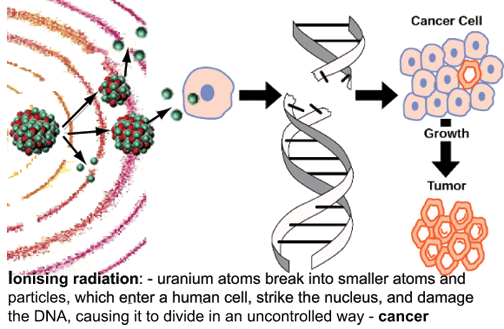
The Commissioner’s focus on acute radiation syndrome (ARS) due to relatively high levels of exposure to ionising radiation ignores the accepted scientific position that all levels of exposure are harmful, and it discards the precautionary principle which he claims to support. Just because, in cases of exposure that does not cause ARS, there is no known way of linking cause and effect does not mean that there is no effect. The scientific position is that the effect is proportional to the dose at all levels of exposure. The fact that the effects are not immediately obvious or (like asbestos and smoking) are manifest years after the exposure is no basis for ignoring them.
The fact that it is difficult to manufacture nuclear weapons from various sources of uranium and plutonium is no reason to discount the possibility as demonstrated by India’s use of Canadian low grade uranium to make a nuclear weapon.
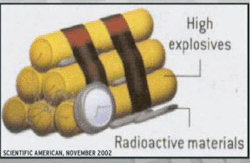 There is no mention of the use of nuclear waste to make a conventional, non-nuclear, but highly radioactive, “dirty bomb”. Given the Commissioner’s support for importing thousands of tonnes of high level nuclear waste and the global expansion of radical, fanatical terrorist activities, this is a serious oversight.
On the issue of insurance for nuclear activities the Commissioner makes the telling remark that insurance in Australia is not  sufficient to cover the risks involved in an expanded nuclear industry and that “the state and federal governments would become insurers of last resort”. This, in effect, would be a large tax-payer funded subsidy to the nuclear industry. The Commissioner made no recommendation about changing this situation.
 The Commissioner notes that “building up a sufficient level of local engineering expertise requires time, commitment and advanced planning”. Such a level of nuclear engineering expertise would open the door to a wide variety of nuclear projects including, as we saw with the aborted 1969 Jervis Bay project in NSW, nuclear weapons production.
No comments yet.
1 This month
15 April – Zoom –Nuclear Power is Not the Solution
Apr 15, 2026 01:00 AM in Canberra, Melbourne, Sydney

Join the International Physicians for the Prevention of Nuclear War (IPPNW) on Tuesday, April 14th for a timely webinar exploring the risks associated with nuclear power and challenging the myth that it offers a simple, safe, carbon-free solution to the climate crisis

21 April Webinar: No Nuclear Weapons in Australia
Start: 2026-04-21 18:00:00 UTC Canberra, Melbourne, Sydney (GMT+10:00)
End: 2026-04-21 19:30:00 UTC Canberra, Melbourne, Sydney (GMT+10:00)
Event Type: Virtual
A virtual link will be communicated before the event.
Host Contact Info: australia@icanw.org

of the week – Australians for War Powers Reform (AWPR)
To see nuclear-related stories in greater depth and intensity
 Antinuclear
Leave a comment